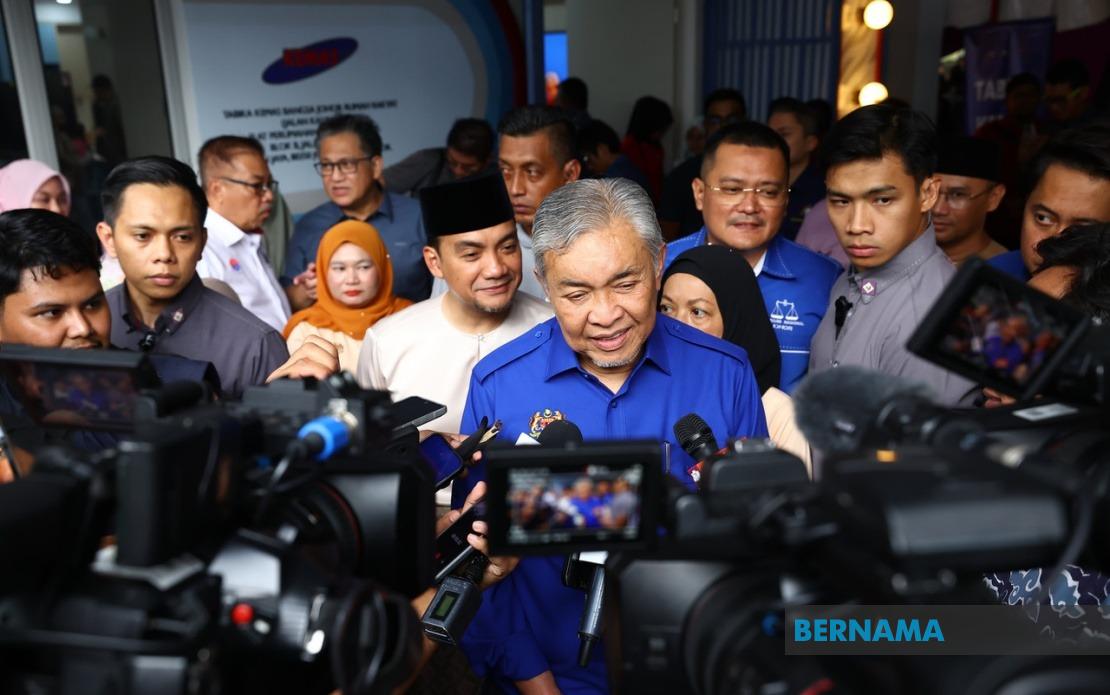
In a display of political courtesy ahead of the Johor state election scheduled for July 11, Barisan Nasional Chairman Datuk Seri Dr Ahmad Zahid Hamidi has publicly stated his party's respect for Pakatan Harapan's policy proposals unveiled during the campaign period. The Deputy Prime Minister made the remarks during an engagement session with parents at a Tabika Kemas facility in Larkin, signalling that despite electoral competition, Malaysia's ruling and opposition coalitions maintain acknowledgement of each other's democratic participation. This measured approach reflects how Malaysian politics has evolved in recent years, where inter-party courtesy has become more visible even as substantive policy disagreements remain sharp.
Ahmad Zahid's statement carries significance beyond mere pleasantries, as it underscores how BN positions itself as the custodian of Malaysia's democratic traditions. By welcoming proposals from competing parties and explicitly stating respect for an opposition coalition's platform, the government signals confidence in its own electoral appeal and governance record. This rhetorical positioning matters in a context where Malaysian voters have demonstrated willingness to shift their support based on performance and alternative offerings, as evidenced by the 2018 general election result. The Deputy Prime Minister's framing suggests BN believes its track record speaks louder than any criticism it might level at rivals.
Packatan Harapan's Johor manifesto centres on ten concrete commitments designed to address quality-of-life concerns among Johor residents. The proposals include establishing a Johor Health Scheme to improve healthcare accessibility, providing financial assistance for first-time property buyers navigating an increasingly expensive housing market, and allocating RM500 million specifically for youth empowerment programmes that address employment and skills development. Additionally, the opposition coalition has pledged initiatives to strengthen educational infrastructure and quality, recognising education as a persistent priority for Malaysian families. These offerings target specific demographic segments and socioeconomic concerns that polling data typically identifies as voter priorities across peninsular states.
In response, BN has anchored its own Johor campaign on the state government's documented performance in fulfilling previous electoral promises. Ahmad Zahid cited that the previous BN-led administration achieved more than 90 per cent implementation of its manifesto commitments, a statistic designed to establish credibility regarding the coalition's ability to deliver pledges. This emphasis on track record represents BN's primary strategic counter to an opposition that has built recent campaigns around promises of change and fresh approaches. The incumbent advantage is particularly significant in Johor, where BN has exercised uninterrupted state-level governance, allowing the party to claim responsibility for visible infrastructure and developmental projects across the state.
BN's manifesto is characterized as comprehensively addressing multiple life stages and social categories, from expectant mothers through to senior citizens, encompassing school and university students, and specifically acknowledging single-parent households. This broad-based approach aims to demonstrate inclusive governance that does not discriminate along demographic lines, a messaging strategy particularly important in a state as diverse as Johor. Ahmad Zahid's emphasis that "anyone residing in Johor" would be considered part of "Bangsa Johor" and receive equivalent benefits reflects attempts to frame BN as a non-sectarian governing force, a positioning especially relevant given contemporary Malaysian political sensitivities around religious and ethnic representation.
The framing of benefits extending across all population segments without sidelining any racial or social group represents BN's direct counterargument to critiques that have periodically emerged regarding preferential treatment in government programmes. By explicitly articulating that BN's welfare commitments transcend categorical boundaries, the coalition attempts to neutralise opposition narratives around inclusivity and equal opportunity. This messaging carries particular resonance in Johor, where urban-rural divides and varied socioeconomic conditions create diverse voter expectations regarding state-level resource allocation and development priorities.
Ahmad Zahid's dual role as Deputy Prime Minister and Rural and Regional Development Minister positions him as a conduit for federal-state coordination in Johor's development trajectory. His assurance that he will personally continue supporting the state's advancement as long as he leads the ministry creates implicit linkage between federal investment capacity and BN's electoral performance in the state. This intersecting of national and state-level politics reflects how Malaysian electoral contests operate, where federal resources and ministerial attention can materially influence voter calculations, particularly in constituencies seeking developmental projects or infrastructure improvements. The statement thus carries both symbolic and practical implications for how Johor voters perceive BN's commitment to their state.
The 2024 Johor state election represents a critical electoral test in Malaysia's political calendar, encompassing 172 candidates competing across 56 state seats. Early voting was scheduled for July 7, with the main polling day on July 11, providing a fortnight campaign window for both BN and PH to present their cases to voters. The scale of the contest—with 56 state positions determining Johor's legislative composition—means that the outcome will significantly influence the state's policy direction for the subsequent five-year term. Given Johor's population size, economic importance, and historical significance as a BN stronghold, the electoral result carries implications extending beyond the state itself, potentially affecting national political calculations regarding coalition strength and momentum.
For Malaysian and regional observers, the Johor election serves as a bellwether regarding voter sentiment on governance performance, cost-of-living pressures, and the comparative appeal of incumbent versus alternative leadership. The contest unfolds against a backdrop of broader Southeast Asian political developments, where incumbent parties across the region have faced electoral challenges amid economic uncertainty and rising public expectations. How Johor voters evaluate BN's development record against PH's reformist pledges will provide data points regarding Malaysian voter priorities and the resilience of established political structures when confronted with organized opposition campaigns. The manifesto-driven contest between the coalitions demonstrates that Malaysian electoral politics increasingly focuses on programmatic offerings and demonstrated competence rather than purely identity-based appeals.
The public mutual respect articulated by Ahmad Zahid regarding PH's manifesto also reflects Malaysia's evolving democratic culture, where acknowledgement of opposition legitimacy has become more routine at senior political levels. This normalisation of inter-coalition discourse contrasts with earlier periods when government-opposition relations were more acrimonious. The measured tone employed by the BN Chairman suggests confidence in the ruling coalition's electoral standing while simultaneously positioning BN as a responsible custodian of democratic institutions. Such rhetorical positioning matters for Malaysia's international image and domestic political stability, as it reinforces perceptions that electoral competition occurs within established democratic frameworks where outcomes are accepted regardless of results.
For Southeast Asian political observers, the Johor election illustrates how Malaysia's two-coalition system has matured following the significant electoral upheavals of 2018 and subsequent political realignments. The campaign demonstrates that both BN and PH have developed sophisticated policy platforms extending beyond simple anti-incumbency or nostalgia messaging, instead offering distinct visions of governance and social welfare provision. This programmatic differentiation, combined with more professional campaign messaging and documented commitments backed by timelines and resource allocations, reflects how Malaysian electoral politics has become increasingly sophisticated. The contrast between BN's emphasis on track record and PH's focus on fresh initiatives represents genuine substantive choice for voters navigating their state's future direction.

