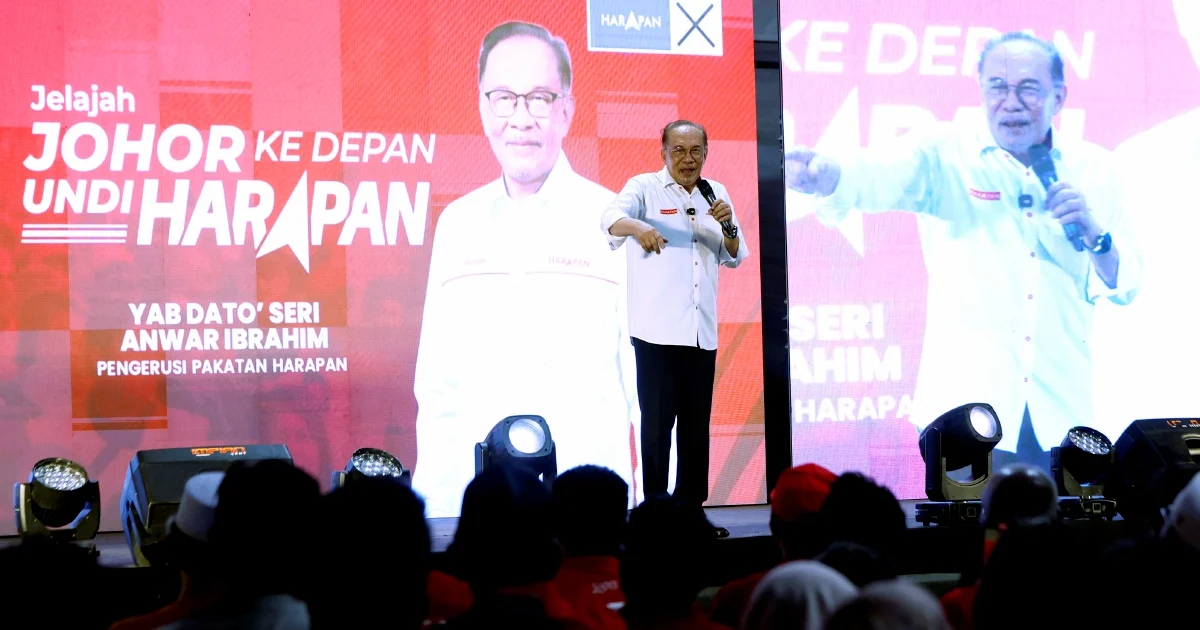
Pakatan Harapan (PH) chairman Datuk Seri Anwar Ibrahim has alleged that Barisan Nasional (BN) orchestrated the dissolution of the Johor state assembly as a calculated maneuver to restore the coalition's erstwhile political supremacy in one of Malaysia's most significant states. Speaking at a campaign event in Tangkak, Anwar suggested that the decision to call for fresh state elections reflected BN's determination to claw back power after a period of diminished influence in Johor's political landscape.
The Johor state election represents a pivotal moment in Malaysian politics, particularly as it concerns the balance of power between the two major political coalitions competing for control of the state government. Anwar's characterization of the election call as a power-recovery maneuver underscores the high stakes involved, as Johor has traditionally served as a crucial electoral battleground and stronghold of varying political factions throughout Malaysia's modern political history. The state's economic importance and its sizeable representation in parliament have long made it a focal point for both BN and opposition parties seeking to strengthen their national position.
BN's historical dominance in Johor extended across several decades, during which the coalition maintained near-monopolistic control over state governance and resources. This entrenched position was gradually eroded following broader shifts in Malaysian electoral dynamics, particularly in the 2018 general election that brought Pakatan Harapan to federal power and altered the political landscape across multiple states. Johor's trajectory reflects these national trends, though the state maintained its own distinctive political character shaped by local issues, community demographics, and regional leadership dynamics.
The timing of the assembly dissolution carries particular significance within the context of Malaysia's broader political volatility. The decision to call for elections when BN perceived favorable conditions demonstrates the coalition's strategic calculation that the current political environment offered an optimal window for attempting to reverse electoral losses. Such moves require careful assessment of voter sentiment, demographic shifts, and the popularity of competing party leadership and policy platforms across diverse constituencies within the state.
Anwar's criticism addresses not merely the fact of the election being called, but the underlying motivation he attributes to BN's decision-making process. By framing the election call as primarily motivated by desires to reclaim lost dominance rather than addressing pressing governance issues or responding to popular demand for electoral renewal, the Pakatan Harapan leader seeks to shape public perception of BN's intentions and character. This rhetorical approach attempts to redefine the election narrative around questions of power consolidation rather than policy substance or competent governance.
The political dynamics within Johor reflect broader national tensions between established and emerging power structures within Malaysian politics. Voters in Johor constituencies face genuine choices between competing visions for the state's future, with different coalitions offering distinct approaches to economic development, social services, and the governance model they would implement. These substantive policy differences intersect with deeper questions about political accountability, leadership legitimacy, and the proper role of various communities within Johor's social fabric.
Packlanding Harapan's positioning in Johor contests has evolved significantly over recent years, with the coalition attempting to consolidate its presence while maintaining internal cohesion among its constituent parties. The opposition coalition's strategy involves presenting itself as the agent of continued reform and progressive governance, contrasting its vision with what it characterizes as BN's return to older patterns of politics. This framing becomes particularly important in a state where electoral margins may prove decisive in determining which coalition controls state government.
The economic dimensions of Johor politics cannot be overlooked when assessing the significance of state elections in the region. Johor's substantial manufacturing sector, port facilities, and role in regional trade networks mean that state policy decisions carry implications extending beyond state borders. Both BN and Pakatan Harapan have articulated positions on attracting investment, developing infrastructure, and managing Johor's economic relationship with neighboring jurisdictions and the broader Southeast Asian region.
Voters across Johor's constituencies will ultimately render judgment on which coalition's vision and leadership they prefer to trust with state power. The election offers an opportunity for residents to assess the performance records of competing parties, evaluate their proposed solutions to local challenges, and consider the character and capability of candidates seeking their support. Electoral outcomes will reflect not merely the calculations of political elites but the genuine preferences and priorities of Johor's diverse communities across urban and rural areas, among different demographic groups, and across the state's various socioeconomic strata.

