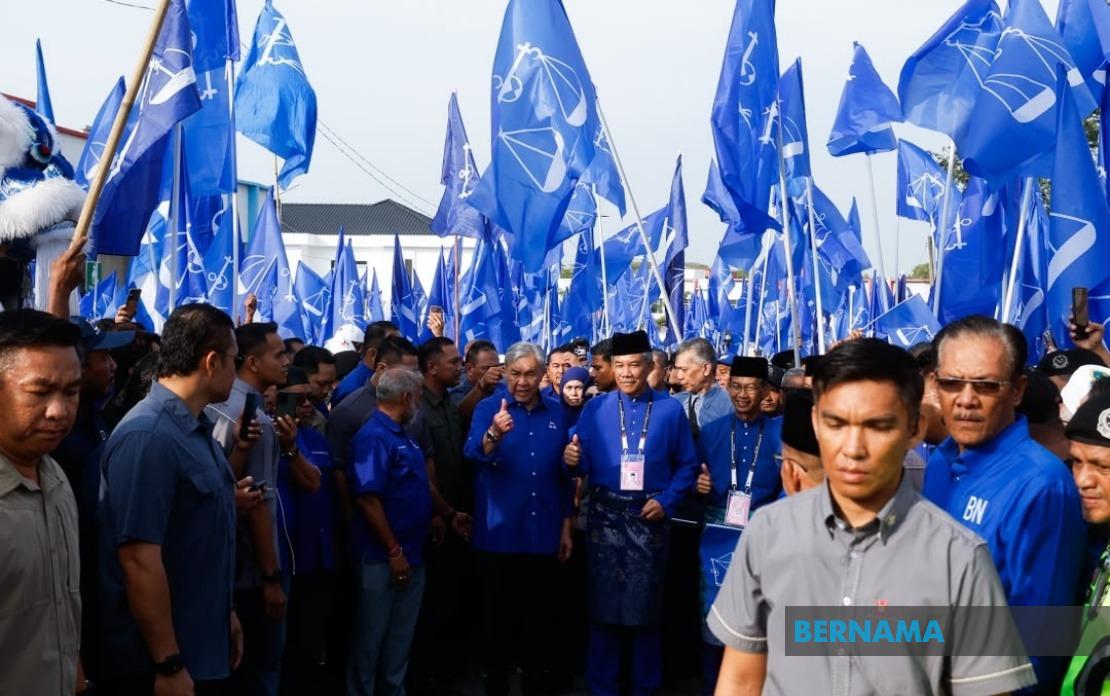
The leadership structure of Barisan Nasional took centre stage in Negeri Sembilan on July 18 as senior party officials fanned out across nomination centres to publicly endorse their candidates contesting the state election. The coordinated show of support reflected the coalition's bid to project a unified front during a critical phase of the campaign, with the party's top echelon making deliberate appearances alongside their nominees to emphasise commitment to victory at the ballot box.
The most prominent moment came at the Dewan Seri Rembau nomination centre in Rembau, where BN chairman Datuk Seri Dr Ahmad Zahid Hamidi, who simultaneously serves as UMNO president, arrived early with his deputy Datuk Seri Mohamad Hasan at 8.40 am. The timing underscored the importance BN attached to the Rantau state seat, where Mohamad has entrenched himself as the constituency's representative since 2004, submitting his nomination papers to defend the position. This particular endorsement carried symbolic weight, as Mohamad Hasan represents continuity and party establishment within Negeri Sembilan's political landscape, and Ahmad Zahid's presence signalled UMNO's determination to retain ground in a state where the coalition remains dominant.
Across the sprawling state, nomination activity commenced simultaneously at eight designated centres at 9 am sharp, creating a carefully orchestrated nationwide submission process that lasted precisely one hour. The Election Commission's tight scheduling ensured all candidates navigated the bureaucratic requirements within a compressed timeframe, establishing procedural fairness while requiring campaign machinery to operate at peak efficiency. For party strategists, the narrow window presented logistical challenges but also opportunities to concentrate media attention and demonstrate organisational prowess through seamless coordination.
In Port Dickson, BN secretary-general Datuk Seri Dr Zambry Abd Kadir personally escorted Datuk Mohd Faizal Ramli to the nomination centre for the Linggi state seat, leveraging the second-highest administrative position within the coalition to amplify a candidate's profile. Simultaneously, UMNO vice-president Datuk Seri Johari Ghani accompanied Suhaimizan Bizar, who contested the Gemencheh seat located within Tampin parliamentary constituency. The deployment of multiple senior figures across different constituencies revealed a strategic calculus about where BN perceived its vulnerabilities or opportunities, directing seniority and organisational resources to constituencies deemed strategically significant.
The Jempol parliamentary constituency, encompassing three state seats, attracted particular attention from UMNO hierarchy. Secretary-general Datuk Dr Asyraf Wajdi Dusuki personally shepherded three nominees—Datuk Mustapha Nagoor for Palong, Datuk Mohd Zaidy Abdul Kadir for Jeram Padang, and Chong Fui Ming for Bahau—to the nomination process. This concentration of high-level accompaniment suggested that Jempol represented terrain where the coalition anticipated competitive contests or sought to consolidate advantages through displays of institutional backing. The decision to deploy a senior UMNO administrator across multiple candidates within a single parliamentary division indicated resource allocation reflecting either past electoral volatility or anticipated challenger strength.
Beyond UMNO's internal machinery, the broader Barisan Nasional coalition structure manifested through PAS participation. Tan Sri Abdul Hadi Awang, the PAS president, accompanied Mohd Fairuz Mohd Isa for the Serting state seat nomination, demonstrating the coalition's multiparty character and signalling that despite occasional frictions, the PAS-BN partnership held sufficiently firm to warrant public gestures of mutual support. This was particularly noteworthy given broader polarisation within Malaysian politics, where PAS maintains complex relationships across the political spectrum. The appearance alongside a PAS candidate underscored BN's effort to present a united electoral front encompassing multiple communal and ideological constituencies.
Partially distinct from mainstream BN machinery, Parti Orang Asli Malaysia (ASLI) president Rashid Ka accompanied Dayana Dal, ASLI's nominee for the Jeram Padang state seat, also within Jempol. As a smaller alliance partner focused specifically on indigenous representation, ASLI's participation reflected BN's attempt to maintain coalition breadth and secure constituencies with significant Orang Asli populations. The nomination of Dayana Dal represented an effort to mobilise indigenous voter blocs through dedicated community advocacy, though ASLI's electoral impact typically remained limited compared to UMNO and PAS's organisational reach.
The Negeri Sembilan state election had been formally triggered through the dissolution of the State Legislative Assembly on June 5, following approval from the Yang Dipertuan Besar of Negeri Sembilan, Tuanku Muhriz Tuanku Munawir. This constitutional process set in motion an election cycle that would culminate in polling on August 1, with early voting facilities scheduled for July 28. For Malaysian voters, particularly those in Negeri Sembilan, this represented an opportunity to reshape state representation, though in reality, incumbent BN strength and structural advantages typically favoured coalition retention of power in the state.
The nomination day proceedings reflected standard Malaysian electoral choreography whereby party hierarchies deploy senior figures to candidacy submissions as an investment in media visibility and grassroots morale-building. However, the extent and coordination of BN leadership presence across multiple constituencies suggested deliberate strategic messaging about party discipline and resource commitment during a critical campaign phase. For Southeast Asian observers, the event illustrated how established coalition structures in Malaysia maintain electoral competitiveness through institutional coordination and hierarchical discipline, contrasting with more fragmented opposition configurations.
Looking toward August 1 polling, the enthusiasm demonstrated through leadership endorsements on nomination day would require translation into electoral performance. Voter sentiment in Negeri Sembilan, particularly regarding state governance quality, economic management, and social provision, would ultimately determine outcomes more decisively than symbolic shows of leadership unity. Nevertheless, BN's coordinated nomination day strategy indicated confidence in retaining control while acknowledging competitive pressures requiring maximum mobilisation across party machinery.
The election schedule established a campaign period spanning nearly two weeks following nomination day, allowing candidates and parties to intensify grassroots engagement, launch manifestos, and attempt persuasion of undecided voters. For Malaysian politics more broadly, the Negeri Sembilan election functioned as a significant barometer of national sentiment regarding BN governance and coalition stability, with results potentially influencing perceptions of government strength ahead of potential federal-level contests. The careful orchestration of nomination day thus represented not merely procedural compliance but strategic positioning within Malaysia's competitive political economy.

