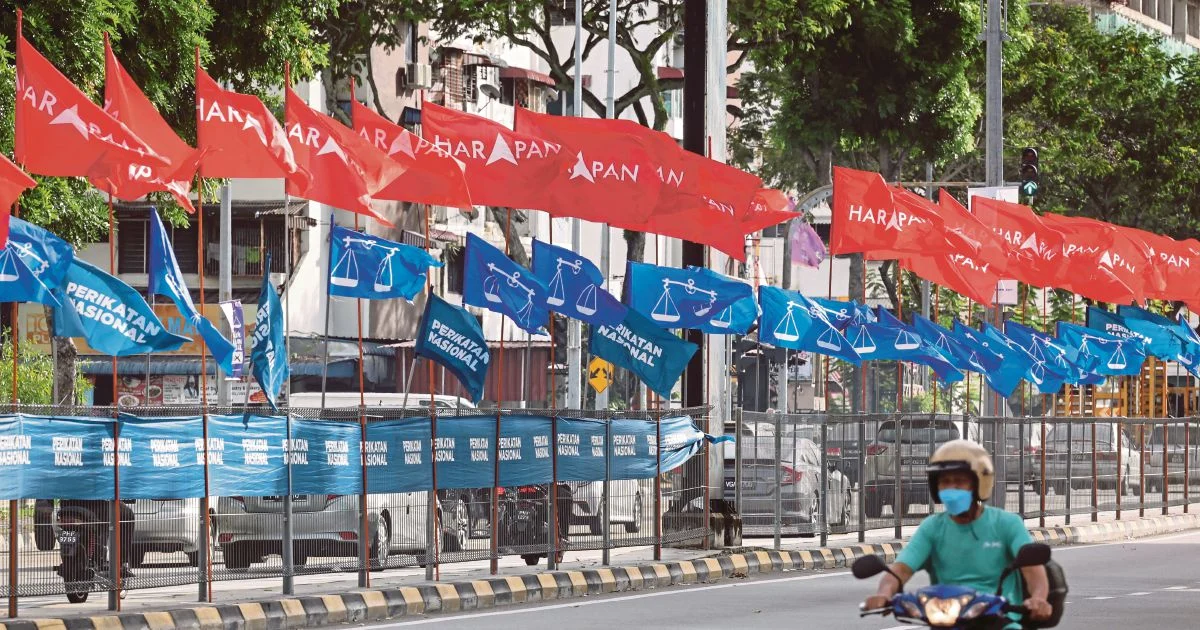
The Johor state election next month will feature an unusually fragmented political landscape, with Barisan Nasional, Pakatan Harapan and Perikatan Nasional all putting forward candidates in 33 of the 56 available seats. This level of three-way competition marks a significant development in Malaysian electoral politics, fundamentally altering the dynamics of what voters will face when they cast their ballots across the southern state.
The concentration of three-cornered contests in nearly 60 percent of Johor's constituencies signals a departure from the more traditional two-coalition struggle that has characterised recent Malaysian elections. This fragmentation stems from the fractured nature of Malaysia's political landscape following the collapse of the Pakatan Harapan government in 2020 and the subsequent rise of Perikatan Nasional as a serious electoral contender. Rather than clear-cut battles between a government coalition and opposition, Johor voters in these seats will be weighing the merits and messages of three distinct political blocs.
For Barisan Nasional, which has governed Johor since independence and maintains deep institutional roots throughout the state, these three-cornered contests present both challenges and opportunities. The coalition's traditional advantage lies in its organisational machinery and established voter networks, yet the splitting of the anti-BN vote between PH and PN could work against it. However, BN cannot rely on opposition fragmentation alone; the coalition must actively court voters by articulating its vision for Johor's development and addressing the state-specific concerns that resonate most strongly with residents.
Pakatan Harapan's presence across 33 seats reflects the coalition's determination to regain relevance in Johor after setbacks in recent elections. The coalition experienced significant electoral losses in the 2022 general election and has been working to rebuild its grassroots support, particularly among younger voters and urban constituencies. For PH, these Johor contests offer a crucial opportunity to demonstrate renewed strength and rebuild momentum ahead of future national elections. The coalition's campaign messaging will likely focus on governance, economic opportunities and institutional reform.
Perikatan Nasional's entry into such a large proportion of contests underscores the political network's growing confidence as a third force in Malaysian politics. Emerging from the defunct Pakatan Nasional framework and led by figures including Muhyiddin Yassin, PN has cultivated support through its emphasis on Malay-Muslim interests and regional autonomy. For PN, Johor represents a critical battleground where strong performance could significantly enhance its standing nationally and prove its capacity to compete effectively across diverse constituencies.
The presence of three major coalitions across 33 seats will test the effectiveness of campaign messaging and ground operations in ways that straightforward two-way contests do not. Voters will face more fragmented political offers, and winning majorities may require lower vote shares than in previous elections. This scenario often favours candidates and parties with the most dedicated voter bases or those able to build the broadest cross-community support.
For the remaining 23 seats where three-way contests are absent, the electoral dynamics will differ substantially. These constituencies may feature straight fights between two coalitions or instances where one or two major players do not field candidates. Understanding these regional variations is essential for interpreting the overall results, as performance in two-way contests may not directly translate from or to three-way scenarios.
Geographically, the distribution of these three-cornered contests across Johor will influence overall state outcomes significantly. Urban centres like Johor Baru may feature different political patterns than rural or semi-rural constituencies, and the Malay-Muslim demographic composition of each area will likely correlate with varying degrees of PN support. BN's performance in its traditional strongholds will be particularly important; if the coalition cannot secure comfortable victories in regions where it has enjoyed longstanding support, the results would signal fundamental shifts in voter preferences.
The timing of this fragmented contest coincides with broader uncertainty in Malaysian politics following various federal developments. Voters across Johor will be influenced not only by state-level concerns but also by their perceptions of how state elections might affect national political dynamics. A strong showing for any coalition in Johor could provide momentum for federal-level ambitions, making state-level contests increasingly linked to national political calculations.
Election observers will be particularly interested in measuring whether three-way competition suppresses overall voter turnout, as some voters may feel less motivated when facing complex multi-option ballots. Additionally, the volume and sophistication of campaign activity across such a large number of contested seats may stretch the resources of all three coalitions, with implications for campaign quality and messaging coherence.
The Johor election thus represents more than a simple state-level exercise; it serves as a barometer for the current strength of Malaysia's three major political blocs and provides insight into voter preferences as the country navigates its evolving political terrain. The results will likely reshape calculations about coalition viability and regional political power ahead of future electoral contests.

