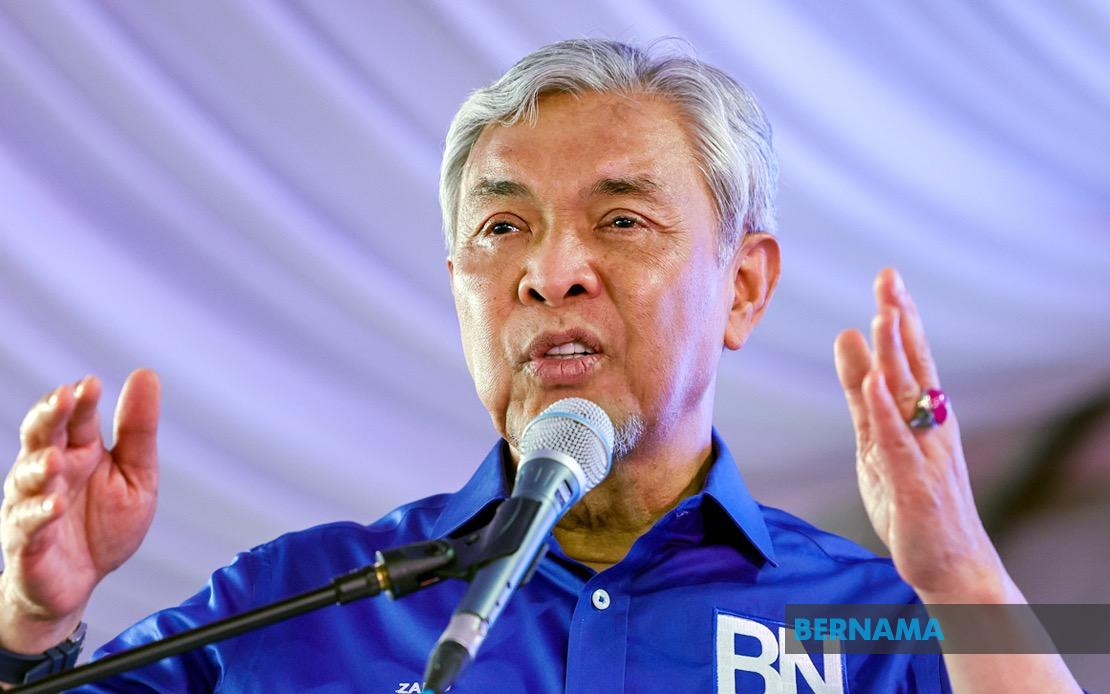
Barisan Nasional has made an explicit commitment to translate its election promises into concrete action if voters back the coalition in Johor's state election this Saturday. The pledge came from party chairman Datuk Seri Dr Ahmad Zahid Hamidi, who stressed that every commitment detailed in the BN manifesto would be pursued with vigour during the next term of government. Speaking after an engagement session with village development committees in Kluang, Ahmad Zahid—who serves as Deputy Prime Minister—indicated that manifesto implementation would form a cornerstone of the coalition's priorities, serving to maintain the trajectory of state development while enhancing living standards for Johor residents.
The BN leadership has sought to differentiate itself from campaign rhetoric by emphasising accountability in the delivery phase. Ahmad Zahid made clear that BN's manifesto commitments represent genuine undertakings rather than empty electoral posturing. He indicated that party leaders would assume an active supervisory role to monitor progress on all pledged initiatives, ensuring that campaign promises do not languish unexecuted once votes are cast. This framing suggests BN is attempting to counter any voter scepticism about whether winning coalitions follow through on their campaign pledges—a concern that resonates across Malaysian electoral politics given historical cases where manifesto items have received inconsistent implementation.
The deputy prime minister drew a philosophical distinction between electoral victory and the responsibilities it entails. He cautioned against interpreting a government mandate as licence for complacency or self-congratulation. Instead, Ahmad Zahid characterised the mandate as a solemn duty to deepen unity among Johor's populace and to build broad social consensus around the incoming administration's direction. The emphasis on maintaining "Bangsa Johor" cohesion suggests BN recognises that even with a winning vote share, effective governance depends on securing cooperation from opposition areas and ensuring that development benefits are distributed equitably across different communities and regions within the state.
Ahmad Zahid's comments arrive as Johor prepares for polling on Saturday, marking the sixteenth iteration of the state election cycle. The contest has mobilised substantial political energy, with 172 candidates competing across 56 state assembly seats. The electorate comprises approximately 2.7 million registered voters, making the Johor election a significant democratic exercise and a meaningful barometer of contemporary electoral sentiment in one of Malaysia's most populous states. Johor's political significance extends beyond state-level governance, as outcomes here can influence calculations at the federal level and shape perceptions about broader coalition viability.
The BN's manifesto commitments, while not enumerated in detail in Ahmad Zahid's remarks, presumably address standard policy domains that resonate with voters: economic development initiatives, infrastructure investment, social welfare enhancements, and governance improvements. For Malaysian readers, the specifics of BN's Johor platform likely touch on concerns common to the state such as employment generation, agricultural support, urban planning, and service delivery efficiency. Ahmad Zahid's repeated emphasis on full implementation signals that BN anticipates voter focus on delivery capacity and practical results rather than mere ideological positioning.
The manifesto pledge carries particular weight in Malaysian politics given periodic criticisms that governing coalitions have failed to execute campaign commitments with adequate urgency or comprehensiveness. By anchoring his remarks to the explicit promise of full implementation, Ahmad Zahid attempts to establish a performance standard against which BN's eventual Johor government can be measured. This transparency creates both opportunity and risk—opportunity to demonstrate competence and trustworthiness, but risk that shortfalls in delivery could be attributed to broken promises rather than external constraints or implementation complexities.
For Johor voters, the pledge invites evaluation of BN's track record in the state and nationally. The coalition has alternated periods of governance with opposition rule, and voters will assess whether past BN administrations successfully executed their manifesto commitments. Ahmad Zahid's emphasis on the party leadership's proactive monitoring role suggests recognition that accountability mechanisms matter to contemporary voters, who increasingly demand transparency about government performance against stated objectives. The commitment to monitor progress "at the national level" alongside other party leaders also implies coordination between Johor's state government and the federal administration, suggesting manifesto implementation would benefit from alignment between these governance tiers.
The timing of Ahmad Zahid's remarks—delivered immediately before the election campaign enters its final intensive phase—represents a calculated effort to reinforce BN's credibility narrative. By framing the mandate not as a prize but as a responsibility, the BN chairman attempts to position the coalition as serious custodians of public trust rather than opportunistic political operators. This messaging may particularly resonate with swing voters or those persuadable on grounds of governance competence rather than partisan loyalty or ideological alignment.
For the broader Malaysian political context, the Johor election serves as a litmus test for coalition dynamics and voter priorities in the post-2018 electoral landscape. The results will indicate whether BN has successfully rehabilitated its image following the 2018 federal election defeat, or whether voter sentiment continues to favour alternatives. Ahmad Zahid's manifesto delivery pledge forms part of this rehabilitation narrative, seeking to demonstrate that BN has absorbed lessons about voter expectations and is committed to performance-based legitimacy rather than assumption of permanent entitlement to power.

