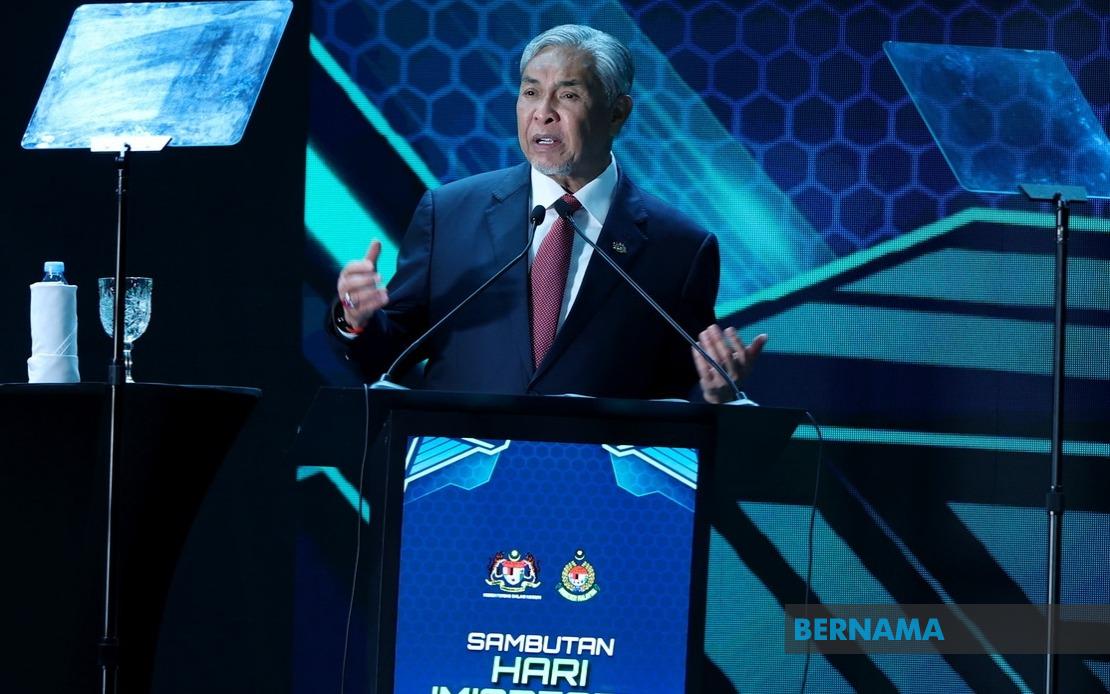
Barisan Nasional has formally committed to remaining within the Unity Government framework, with party chairman Datuk Seri Dr Ahmad Zahid Hamidi making the announcement during the 2026 Immigration Day celebration in Cyberjaya. The statement represents a significant reassurance to coalition partners at a time when political tensions have surfaced around campaign conduct and ministerial accountability. The declaration aligns with the resolution approved at UMNO's most recent General Assembly, reinforcing what Ahmad Zahid described as the party's definitive stance on the matter.
Ahmad Zahid, who simultaneously holds the positions of UMNO president and Deputy Prime Minister, sought to underscore the finality of the assembly's decision by emphasizing that no institutional body within the party structure ranks higher than the General Assembly itself. His remarks carried an implicit message to party members and the broader political establishment that this commitment reflects a binding consensus reached through the party's highest deliberative mechanism. By invoking the assembly's authority, he framed the decision not merely as leadership preference but as a collective mandate from UMNO's grassroots and hierarchical structures.
The timing of this reaffirmation reflects underlying pressures within Malaysia's political landscape. The Unity Government, formed following the 2022 general election, has consistently faced questions about its durability and the extent to which all component parties remain genuinely committed. For BN, which historically dominated Malaysian politics before losing federal power in 2018, remaining within the coalition represents both a pragmatic calculation and a strategic choice. The party's continued participation lends legitimacy to the government while positioning BN to influence policy and secure ministerial portfolios.
Ahmad Zahid's statement also carried an implicit appeal for party unity and discipline, addressing concerns that may have arisen among UMNO members regarding the coalition's direction. By repeatedly emphasizing respect for the assembly's decision, he attempted to establish a standard of party loyalty that would discourage dissent or defection. This approach reflects awareness that any wavering in BN's commitment could trigger cascading political instability, potentially emboldening other coalition partners to reassess their own positions.
In a parallel development that sheds light on contemporary governance tensions, Ahmad Zahid addressed the division of authority between the Prime Minister and cabinet members. He emphasized that Datuk Seri Anwar Ibrahim possesses unambiguous constitutional power to appoint and dismiss government officials, a principle that extends to taking corrective action based on alleged misconduct or disloyalty. This clarification appeared responsive to recent guidance from the Prime Minister regarding ministerial conduct during state-level electoral campaigns.
Prime Minister Anwar had issued warnings against government office-holders using their positions to attack Unity Government partners during campaign activities. The directive reflected concern that factional competition among coalition members, while normal in multi-party arrangements, was potentially escalating into conduct that undermined the government's coherence and public standing. Those found to have violated this directive would reportedly face consequences including forced resignation.
Ahmad Zahid's characterization of the Prime Minister's authority as absolute carries significant implications for understanding executive power in Malaysia's Westminster-derived system. While technically accurate that appointment and dismissal powers rest with the Prime Minister, his framing effectively reinforced hierarchical accountability within the cabinet structure. For ministers contemplating actions that might provoke Prime Ministerial disapproval, the message was unambiguous: such actions carried potential career consequences.
The broader context involves managing tensions inherent to any coalition government in Malaysia's multi-ethnic, multi-party political environment. BN comprises multiple ethnically-based parties with distinct constituencies and interests. UMNO, as the dominant component, must balance its identity and voter expectations with the compromises necessary to maintain coalition cohesion. Simultaneously, other coalition partners including PAS, MIC, and various Sabah and Sarawak-based parties pursue their own agendas. The Unity Government adds further complexity by including PKR, DAP, and other parties that historically opposed UMNO.
For Malaysian observers and regional analysts, BN's explicit reaffirmation of commitment to the Unity Government provides temporary stability assurance at a moment when political calculations are intensifying ahead of future electoral cycles. However, the repeated need to make such statements suggests underlying fragility. Coalition governments globally frequently issue reassurances about permanence precisely when such permanence faces genuine question. The fact that Ahmad Zahid felt compelled to reiterate support, rather than allowing it to remain implicit, may itself signal that pressure points exist.
Looking ahead, BN's participation remains consequential for Malaysian governance. The coalition commands significant parliamentary representation and includes constituencies with deep institutional roots. Its continued involvement lends the Unity Government access to administrative capacity, state-level governance networks, and an electoral machinery that opposing forces would struggle to replicate. This structural importance likely explains why party leadership, despite occasional tensions, has maintained commitment to the coalition.
The implications extend beyond Malaysia's borders to the broader Southeast Asian region, where coalition governments and power-sharing arrangements increasingly characterize political systems. Malaysia's experience with managing multi-party coalitions, while imperfect, offers both cautionary lessons and pragmatic insights for neighboring democracies navigating similar complexity. How Malaysia's parties balance ideological distinctiveness with coalition discipline, and how executives manage heterogeneous cabinets, attracts attention from political analysts across the region.
Moving forward, observers should monitor whether BN's commitment remains merely declarative or translates into consistent political behavior. Real tests will emerge during budget cycles, legislative votes on contentious measures, and particularly as the next general election approaches. At that moment, electoral logic may create pressures that compete with coalition solidarity. For now, however, Ahmad Zahid's announcement establishes the official position and creates expectations against which political behavior will be measured.

