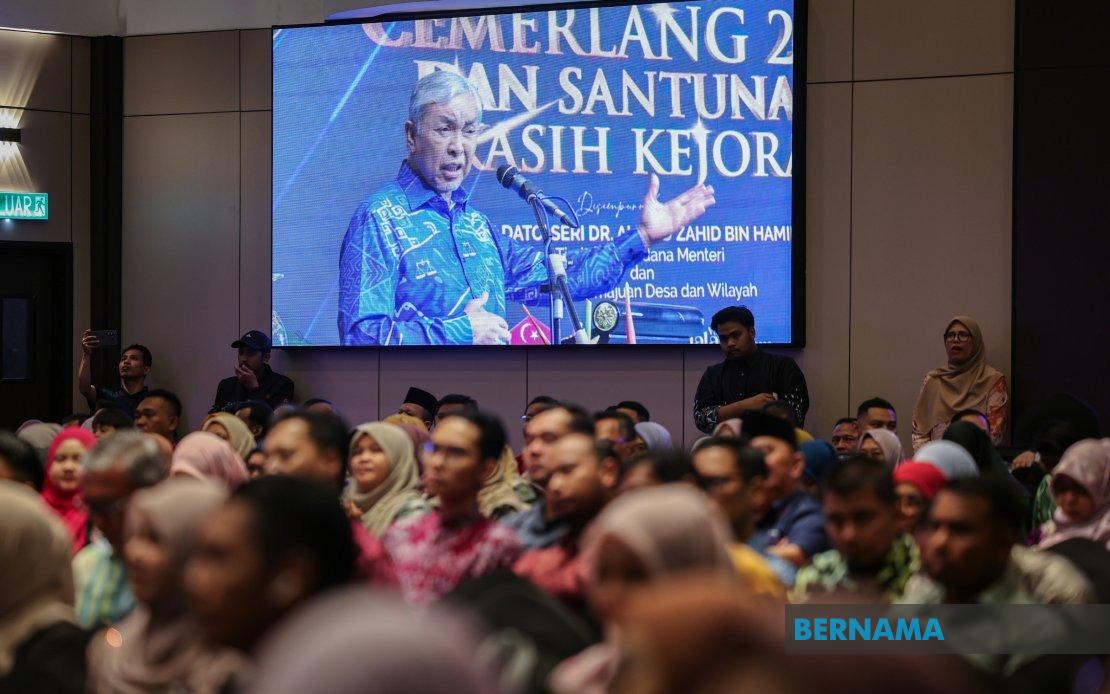
Barisan Nasional's campaign for the Johor state election is operating at full momentum despite external suggestions otherwise, according to BN chairman Datuk Seri Dr Ahmad Zahid Hamidi, who characterised criticism of the coalition's electioneering efforts as merely a matter of political perspective rather than observable reality. Speaking after inaugurating the Southeast Johor Development Authority's Excellent Service Awards 2025 in Kota Tinggi, Zahid emphasised that BN's election machinery remained actively engaged across constituencies, and that perceptions held by rival political coalitions reflected their own vested interests rather than ground conditions.
The assertion comes as multiple parties contest the 56-seat Johor legislature, with both BN and Pakatan Harapan fielding complete slates, alongside significant challenges from Perikatan Nasional, which is fielding 33 candidates. Zahid's comments suggest that rather than addressing structural weaknesses in campaign organisation, BN leadership views criticism as a predictable feature of competitive politics. He noted that individual coalitions retained the right to their own assessments and electoral strategies, signalling that BN would not be distracted by such commentary as it focused on securing victory for its candidates on July 11.
A central argument underpinning BN's confidence rests on the administrative performance of the current Johor state government under Menteri Besar Datuk Onn Hafiz Ghazi. Zahid highlighted that Johor achieved state revenue of RM2.26 billion in the preceding year, the highest figure recorded by any state government in Peninsular Malaysia. This financial performance, he suggested, demonstrated effective governance and provided a tangible achievement on which BN could campaign, presenting voters with evidence of the coalition's capacity to translate mandates into developmental outcomes. The revenue statistic serves as a cornerstone of BN's electoral narrative, positioning the coalition as a competent custodian of public resources.
Zahid addressed a potential vulnerability in BN's electoral positioning by directly tackling concerns that federal-level cooperation between BN and Pakatan Harapan under the Unity Government might alienate traditional BN voters in Johor who remain ideologically distinct from PH. He reframed the question by emphasising Johor's unique institutional context: the state government had been established before the Unity Government took office at the federal level, meaning no structural contradiction existed between supporting the state administration and the wider coalition arrangement. This framing attempts to neutralise what could otherwise become a potent source of voter confusion or defection, particularly among constituencies where BN's traditional support base remains stronger than PH's.
The Deputy Prime Minister stressed that cooperation between state and federal governments proceeded on professional grounds, with all participating parties working cohesively despite ideological differences. For Malaysian readers accustomed to viewing BN and PH as fundamentally opposed forces, Zahid's insistence on professional functionality rather than political merger signals that institutional arrangements can transcend party identity. This messaging becomes particularly important in a state where BN retains governmental control, as it must reassure traditional supporters that local autonomy remains intact even as the federal apparatus encompasses rival parties.
In addressing the more confrontational posture adopted by PAS president Tan Sri Abdul Hadi Awang, who has called on voters to categorically reject PH even in direct contests with BN, Zahid positioned BN as taking a higher ground. Rather than reciprocating PAS's uncompromising rhetoric, BN stated its preference for conducting the campaign through professional means, focusing messaging on its own candidates rather than attacking competitors. Zahid suggested that additional support from any quarter would be welcomed, but that BN's primary obligation remained to its own slate of contenders. This stance reflects a calculation that aggressive politicking might undermine BN's appeal to centrist voters potentially fatigued by polarisation.
The coalition's strategy involves contesting all 56 state seats, seeking what Zahid explicitly described as a resounding victory that would strengthen BN's electoral mandate and political authority within Johor. A decisive result would provide the incoming government with clearer legitimacy to pursue its five-year developmental agenda as outlined in its election manifesto. For BN, the stakes extend beyond mere seat retention; the party seeks to rebuild momentum after national electoral setbacks in preceding years, making the Johor result symbolically significant for broader coalition morale and positioning ahead of future national contests.
The composition of the electoral field reveals a fragmented opposition, with no single rival coalition commanding overwhelming resources or unified messaging. Perikatan Nasional's presence with 33 candidates, along with smaller parties including Bersama, MUDA, Parti Orang Asli Malaysia, and Parti Sosialis Malaysia, suggests that votes will disperse across multiple contenders. This fragmentation could theoretically benefit BN if it maintains consolidated support, though it equally complicates voter preference prediction. The presence of six independent candidates further underscores the atomised nature of Johor's political landscape.
Early voting has been scheduled for July 7, providing voters unable to cast ballots on polling day with an alternative mechanism. The two-week campaign period preceding the election allows parties to conduct intensive ground operations, though Zahid's comments suggest BN believes it has already established sufficient momentum to translate campaigning into electoral victory. The emphasis on existing achievements rather than future promises reflects a confidence-through-retrospection strategy, positioning voters as judges of incumbent performance rather than evaluators of untested proposals.
For Malaysian observers tracking broader political dynamics, the Johor election serves as a barometer of BN's capacity to maintain state-level dominance while functioning within the federal Unity Government framework. Success would validate the claim that institutional cooperation does not erode electoral support, while a diminished result might suggest that voter attachment to traditional coalitions weakens when those coalitions embrace unexpected partnerships. Zahid's defensive tone regarding campaign intensity, despite his protestations to the contrary, suggests that BN leadership recognises the election carries wider significance beyond state boundaries and cannot afford outcomes that might be interpreted as weakness or voter rejection.

