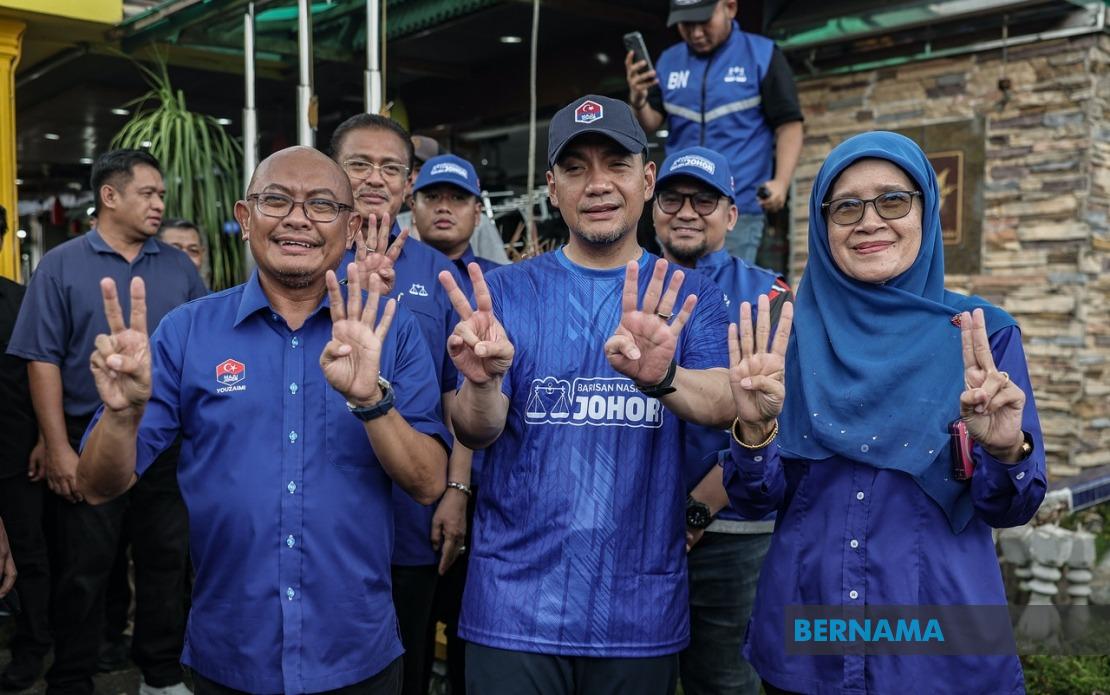
The principle of power-sharing that underpins Barisan Nasional's political strategy hinges fundamentally on mutual sacrifice and unwavering commitment from each member party, according to Johor Menteri Besar Datuk Onn Hafiz Ghazi. Speaking during a machinery meeting in Mersing, he framed the coalition's approach as essential to maintaining both internal cohesion and broader political stability across the state, setting the tone for BN's campaign ahead of the July 11 state election.
Onn Hafiz highlighted Tenggaroh as a case study in coalition discipline, drawing attention to UMNO's steadfast loyalty despite four decades of unsuccessful bids to contest the seat. Rather than abandoning the coalition framework, UMNO machinery has consistently rallied behind MIC's candidacy in the constituency, demonstrating what Onn Hafiz characterised as the maturity required to sustain multi-party political partnerships. This narrative of restraint and party unity carries particular weight in Malaysian politics, where intra-coalition tensions frequently threaten the stability of governing arrangements.
The Tenggaroh contest itself encapsulates the broader challenge facing BN in maintaining its traditional social contract. Although Indian voters constitute a modest segment—approximately 500 out of more than 39,000 registered voters—the seat has remained symbolically important to MIC's positioning within the coalition. Onn Hafiz's explicit acknowledgment that demographic composition has never deterred BN's commitment to multi-racial governance suggests an attempt to reinforce the coalition's inclusive credentials, particularly relevant as it competes against both Perikatan Nasional and Pakatan Harapan in an increasingly fragmented electoral landscape.
The three-way battle for Tenggaroh reflects the complexity of contemporary Johor politics. BN candidate Mohd Youzaimi Yusof faces competition from Perikatan Nasional's Muhamad Amerul Muhamad and Pakatan Harapan's Md Yusof Dawam, representing the multiple political forces now contesting what were once safely held seats. This fragmentation underscores why Onn Hafiz's emphasis on coalition discipline resonates—without internal cohesion and voter confidence in power-sharing arrangements, BN risks being outflanked by rivals who can present themselves as alternatives to the established coalition structure.
Onn Hafiz's specific target of tripling the previous majority from 1,356 votes to 3,000 votes reflects BN's ambitions to consolidate rather than merely maintain its position. The goal signals confidence in mobilising both traditional BN supporters and swing voters who may have drifted toward opposition parties in recent elections. For Tenggaroh specifically, achieving such an expansion would require broad-based appeal across Malay and non-Malay communities, testing the real-world viability of the power-sharing model Onn Hafiz articulated.
The Johor state election carries implications extending beyond the state's borders. As the first major electoral test since the 2023 general election realignment, the result will be scrutinised as an indicator of BN's capacity to rebuild electoral dominance and stabilise its internal coalition mechanics. The manner in which UMNO's Tenggaroh machinery translates its loyalty into votes will offer concrete data on whether power-sharing arrangements remain politically sustainable or whether component parties face mounting pressure to break ranks.
For MIC, which has experienced steady electoral decline over decades, seats like Tenggaroh represent critical anchors within the coalition framework. The party's dependency on UMNO's magnanimity in seat allocation reinforces its junior status within BN, yet resisting such arrangements risks isolation. Onn Hafiz's public recognition of Tenggaroh UMNO's loyalty can therefore be read as affirming the bargain: component parties accept confined electoral territory in exchange for guaranteed representation and a voice in coalition decision-making.
The early voting arrangement scheduled for July 7, preceding the main poll on July 11, reflects standard electoral procedures but also highlights the campaign intensity BN machinery must maintain. The condensed timeline between the machinery meeting and actual voting leaves limited opportunity for voter persuasion, making the existing party structures and their effectiveness paramount. Onn Hafiz's appeal to the BN machinery to demonstrate the power-sharing formula's efficacy thus amounts to a direct call for organisational effectiveness.
Regionally, Johor's election dynamics carry significance for understanding broader coalition politics across Southeast Asia. Malaysia's experience with managing multi-party coalitions while maintaining electoral competitiveness offers both lessons and warnings about the sustainability of power-sharing arrangements under electoral pressure. The visible tensions between principle and pragmatism evident in Onn Hafiz's remarks—celebrating loyalty while demanding increased vote margins—reflect the constant recalibration required to sustain such political structures.
The Tenggaroh narrative ultimately illustrates a fundamental paradox in Malaysian coalition politics: parties are expected to demonstrate loyalty by accepting unfavourable electoral conditions, yet coalitions require sufficient electoral victories to justify their component parties' continued participation. Onn Hafiz's framing attempts to resolve this tension by positioning sacrifice as noble and politically rational, though whether voters and party machinery will internalise this messaging remains to be determined on July 11.

