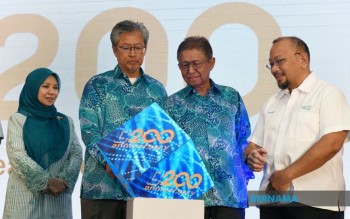
Boustead Holdings Bhd announced an ambitious growth trajectory on Tuesday, targeting a 150 per cent increase in group revenue from its current RM12 billion to RM30 billion over the next five years. The transformation reflects a fundamental repositioning of the conglomerate away from its traditional roots, with leadership committing to a strategic pivot that capitalises on Malaysia's emerging defence industrial ecosystem and government mandates for national capability development.
The revenue expansion forms part of a comprehensive business restructuring announced by group managing director Datuk Dr Ahmad Sabirin Arshad during the soft launch of Boustead's 200-year commemorative celebrations in George Town. His remarks underscore a deliberate strategic recalibration shaped by directives from major shareholders and the Defence Ministry, particularly following the unveiling of Malaysia's National Defence Industry Policy in January this year. This policy framework provides the institutional scaffolding for Boustead's pivot from its historical focus on agriculture, coconut trading and warehouse operations toward contemporary defence manufacturing and strategic infrastructure development.
Central to Boustead's expansion blueprint is the commitment to achieve at least 30 per cent local content in defence industry technology products by 2030, a target aligned with national self-sufficiency objectives. The company intends to cultivate an ecosystem of approximately 400 vendors across the defence sector, effectively seeding a new industrial base that management believes will generate substantial economic wealth and employment opportunities for Malaysia. This vendor development strategy extends beyond Boustead itself, positioning the group as an orchestrator of broader industrial transformation rather than a standalone manufacturer.
The conglomerate has been assigned leadership responsibility for four flagship defence initiatives that represent Malaysia's strategic priorities. These encompass satellite development, rolling chassis manufacture for armoured vehicles, light weapons production capability, and the creation of an advanced Combat Management System. These four pillars collectively address gaps in Malaysia's defence autonomy and reflect a conscious shift toward reducing dependency on foreign suppliers for critical military capabilities. Each project carries significant implications for regional security dynamics and Malaysia's positioning within Southeast Asia's evolving defence landscape.
Beyond defence industrialisation, Boustead is advancing the Batu Cantonment strategic development project in partnership with the Armed Forces Fund Board, a major infrastructure initiative centred in the nation's capital. This undertaking involves the comprehensive relocation of nine existing military installations, a logistically complex endeavour that will enable transformation of the site into a modern commercial and mixed-use hub. The project demonstrates the intersection of defence modernisation with urban development objectives, addressing both national security requirements and the pressure to optimise high-value land utilisation in Kuala Lumpur's central precincts.
Chairman General (Retd) Tan Sri Abdul Aziz Zainal contextualised the transformation within Boustead's dual mandate to deliver shareholder returns while serving the Malaysian Armed Forces' institutional interests. He emphasised that the responsibilities entrusted to the company necessitate unwavering commitment to governance standards and accountability mechanisms that preserve the organisation's institutional integrity across its bicentennial milestone in 2028. This framing positions Boustead's commercial transformation as inseparable from its stewardship obligations to the defence establishment and Armed Forces Fund Board contributors.
The acquisition of technology transfer capabilities emerges as a critical enabler within Boustead's defence ambitions. Leadership has committed to forging strategic alliances with credible international partners to access advanced defence technologies while ensuring effective domestic capability transfer. This approach acknowledges Malaysia's current technological gaps in sophisticated defence manufacturing while establishing a pathway toward gradual self-sufficiency. The selection of partner nations and firms will carry geopolitical significance, particularly given regional tensions and Malaysia's non-aligned foreign policy traditions.
Boustead's existing operations in tourism and insurance sectors will persist as supporting pillars for overall group growth, rather than becoming peripheral activities. These subsidiaries provide revenue diversification and cash generation that can be channelled toward more capital-intensive defence and infrastructure projects. The deliberate retention of these business streams reflects sophisticated portfolio management rather than mere legacy operation, maintaining financial flexibility during the transformation period.
The timing of this strategic repositioning carries particular resonance for Malaysia's regional standing. As Southeast Asian nations confront evolving security challenges and supply chain vulnerabilities exposed by global disruptions, national champions capable of anchoring domestic defence industrial capacity become strategically invaluable. Boustead's transformation positions Malaysia within a broader regional movement toward defence self-sufficiency, following similar trajectories in countries like Indonesia and Thailand that have progressively invested in indigenous capability development.
For Malaysian investors and stakeholders, particularly Armed Forces Fund Board members and contributors, the revenue expansion target carries implications for medium-term returns and institutional financial sustainability. The scaling of defence manufacturing operations typically involves extended gestation periods before profitability materialises, requiring patient capital and sustained government procurement commitments. Boustead's performance over the next two to three years will provide crucial indicators regarding the feasibility of the RM30 billion revenue projection and the pace at which the company can translate policy mandates into operational reality.
The broader economic context merits attention, as Boustead's defence-centric transformation reflects Malaysian policymaking calculations about emerging growth sectors. Traditional manufacturing faces structural headwinds from labour cost competition and automation, whereas defence industrialisation offers higher-value-added opportunities combined with implicit government demand assurances. Whether this sectoral reorientation generates the anticipated wealth creation and employment outcomes will depend substantially on execution quality and the effectiveness of vendor ecosystem development across Malaysia's industrial base.
International partnerships represent another potential flashpoint, given the sensitive nature of defence technology transfer and Malaysia's requirement to maintain balanced diplomatic postures toward major powers. The selection of technology partners will send subtle but consequential signals about Malaysia's strategic alignments, particularly relevant in an Indo-Pacific context marked by intensifying great power competition. Boustead's vendor development programme and technology integration framework will require careful calibration to advance defensive capabilities while preserving Malaysia's strategic autonomy and non-aligned credentials.

