An ordinary moment in a hospital office in northwest England became a profound reminder of home for one Malaysian healthcare worker. While managing a hectic clinic schedule without time for lunch, a team secretary offered a simple mandarin orange—a gesture that sparked a cascade of memories about how food has served as the primary dialect through which care has been expressed throughout their life. This seemingly small act of consideration unlocked a deeper understanding about the universal nature of human connection, revealing that what many assume to be uniquely Malaysian customs may actually reflect something far more fundamental to the human experience.
Food in Malaysian culture occupies a role that extends far beyond mere sustenance. For those who grew up in the country, the preparation and sharing of meals represent deliberate acts of affection and familial responsibility. Within this writer's own family, the tradition took particularly tender forms. Their paternal grandmother meticulously cut, peeled, and salted green apples to accompany meals, a ritual so consistent that when she passed this duty to the writer's mother, barely a beat was missed. Their late father would crack open crabs with patient precision, extracting the sweet meat piece by piece—a skill so thoroughly performed on their behalf that they never learned to do it themselves. These were not casual acts of food preparation; they were declarations of belonging and protection.
Childhood behaviours often reveal how families encode their values through food. The writer's stubbornness about reading during mealtimes prompted their grandmother to hand-feed them for years, well into adolescence, a sacrifice of efficiency that prioritised both their safety and their happiness. Later memories crystallise around specific brands and flavours—blue packet Hup Seng Teddy biscuits that their mother continues to purchase every single time they return home from abroad, despite eight years having passed since their mother's retirement. Even the minor irritation of a mother perpetually forgetting that their favourite crisp flavour was tomato, not other varieties of Mr Potato, emerged as a cherished memory rather than a complaint. These small imperfections in the expression of care somehow made those gestures more authentic.
Malaysian festivities have long woven food into their deepest spiritual and social fabric, creating edible markers of the calendar year. During Deepavali celebrations, the writer's aunt deliberately prepared extra potatoes in the customary chicken curry, knowing that her niece or nephew would consume the potatoes while politely declining the meat. That dish remains their favourite decades later, now inseparable from their understanding of the festival. The appearance of a colleague's legendary chocolate moist cake every Deepavali season became so anticipated that its arrival felt as essential to the celebration as any other ritual—and when that colleague eventually retired, the tradition did not fade because the emotional investment had become mutual. These food traditions transcended the purely nutritional; they became the tangible vocabulary through which families and communities reinforced their bonds.
Intercommunal relationships in Malaysia have historically been expressed through the language of shared food. The writer's mother's Malay colleague from her school would appear at their doorstep each Deepavali bearing chocolate cake, an action driven purely by choice rather than obligation. Similarly, the writer's aunt still distributes cookies throughout the neighbourhood on Deepavali day, including packages for garbage collectors and Chinese neighbours. Come Chinese New Year, the favour returns through boxes of cookies, though nowadays these are more often store-bought than homemade—a pragmatic evolution that does not diminish the gesture's significance. A retired colleague continues to arrive at their house every Chinese New Year with mandarin oranges, maintaining a rhythm of reciprocal care that has outlasted even their professional relationship by many years. These exchanges represent something deeper than seasonal etiquette; they embody the Malaysian ideal of neighbourly harmony expressed through the sharing of food.
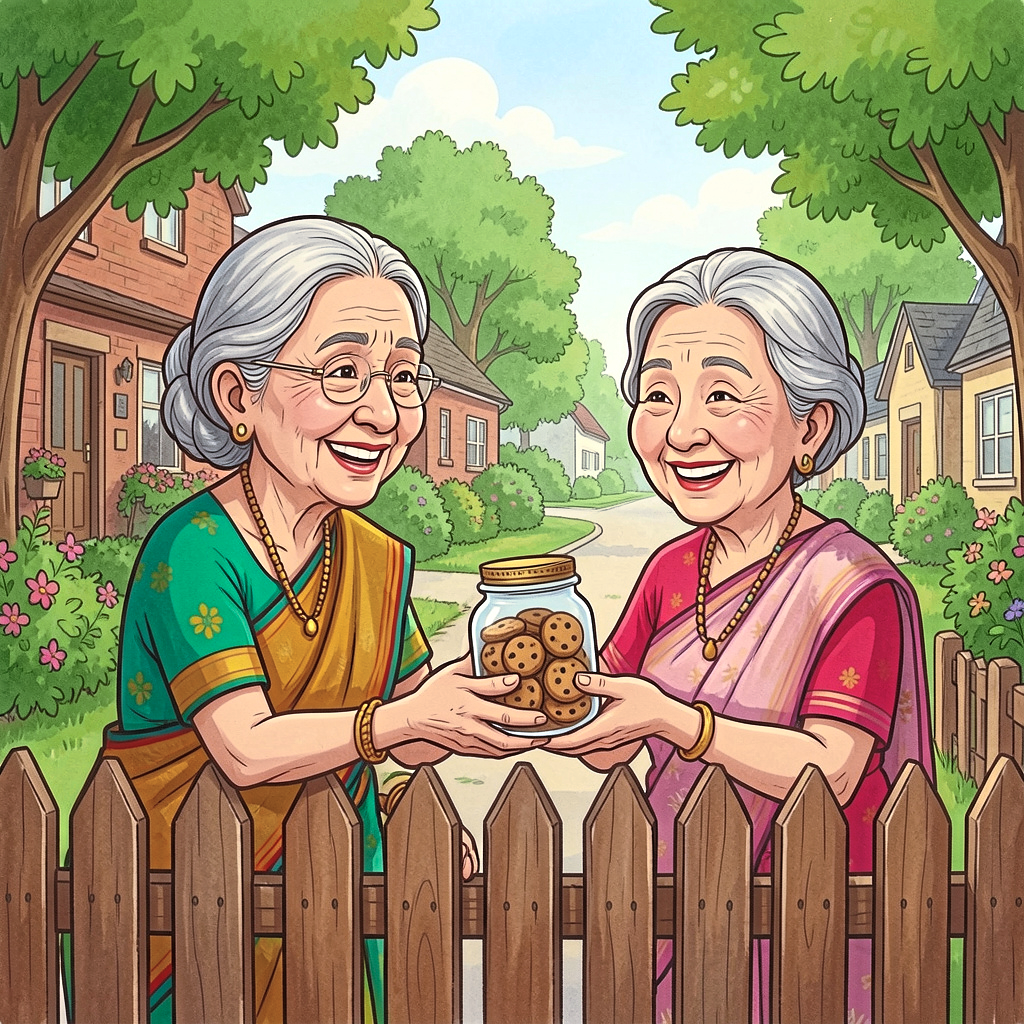
The writer's relationship with their neighbour of over fifty years perhaps crystallised this understanding most vividly. Throughout childhood, this neighbour would appear over the dividing stone fence carrying containers of various dishes—sweet upma for breakfast remained their most cherished offering, a flavour memory so powerful that it still dominates their recollection of this person decades later. Afternoon or evening visits might bring onion cucur instead. The reciprocal nature of these exchanges became equally important; whenever containers were returned, the writer's mother and aunt ensured they never went back empty. This fifty-year-long conversation conducted primarily through food created a bond that survived even when the neighbour eventually suffered a stroke and moved away, no longer able to cook. What remained was not the practical sustenance but the emotional nourishment those dishes had always represented.
Living abroad has thrown this Malaysian inheritance into sharper relief for the writer. The experience of being far from home amplified the emotional weight of these food traditions, transforming them from everyday occurrences into anchors for identity and belonging. Returning to Malaysia meant returning to the ritual of blue packet biscuits and carefully cut green apples, to the predictable appearance of specific dishes tied to specific seasons. The contrast between this food-rich emotional landscape and their daily life in northwest England made the nurse's simple offer—to peel a mandarin orange—resonate with unexpected power. In that moment, something that had seemed distinctly and intimately Malaysian revealed itself to be something far more universal.
The gesture of a colleague offering to remove the labour from consuming a piece of fruit illuminated a broader truth: that care expressed through food appears across cultures in remarkably consistent patterns. While the specific dishes, seasons, and occasions may vary dramatically between Malaysia and England, the fundamental impulse remains identical. Whether it is a grandmother hand-feeding a book-obsessed child in Kuala Lumpur or a nurse offering to peel fruit for an exhausted colleague in Manchester, the message underneath the gesture reads the same. These acts represent a decision to notice someone's struggle and to temporarily absorb that struggle into one's own effort. They communicate, wordlessly but unmistakably: your wellbeing matters to me.
This realisation carries significant implications for how we understand global human connection and cultural exchange. The assumptions we make about the uniqueness of our traditions may sometimes obscure the deeper universality beneath them. While Malaysian ways of expressing care through food carry their own particular flavours, histories, and contexts, the fundamental language being spoken is one that humans everywhere recognise. Different cultures may indeed speak this language with different accents and vocabulary, but the underlying grammar of compassion remains consistent. A Japanese mother packing a carefully arranged bento, an Italian grandmother stirring sauce for hours, a Kenyan family sharing ugali, a Swedish baker leaving cinnamon buns for neighbours—all are fluent speakers of this ancient human dialect.
For Malaysians navigating an increasingly globalised world, this recognition offers both comfort and perspective. The food traditions that seemed so specifically tied to home, to family, to a particular culture and geography, are simultaneously expressions of something universal. This does not diminish their particularity or reduce their significance; rather, it suggests that the warmth and intentionality embedded in Malaysian food customs reflect something fundamental about human nature itself. Whether someone is offering a simple piece of fruit in a hospital office or spending hours cooking a elaborate curry, the act itself participates in an ongoing human conversation that has outlasted empires and border changes.
The writer's journey from a quiet corner of Malaysia to northwest England has taught them that home is not just a place but a language—specifically, the language of care expressed through food. That language began in childhood through the patient hands of grandparents and parents, was reinforced through decades of neighbourhood exchanges and festive seasons, and continues to be spoken by their own mother in the form of biscuits purchased for every homecoming. But it is also a language that transcends geography, one that any human being can learn to speak fluently by simply noticing another's hunger—literal or figurative—and choosing to help ease it. In the end, food remains humanity's oldest, most honest, and perhaps most beautiful language: a simple, nourishing way of saying to another person, across all the barriers that might separate us, that we see you, and we care.

