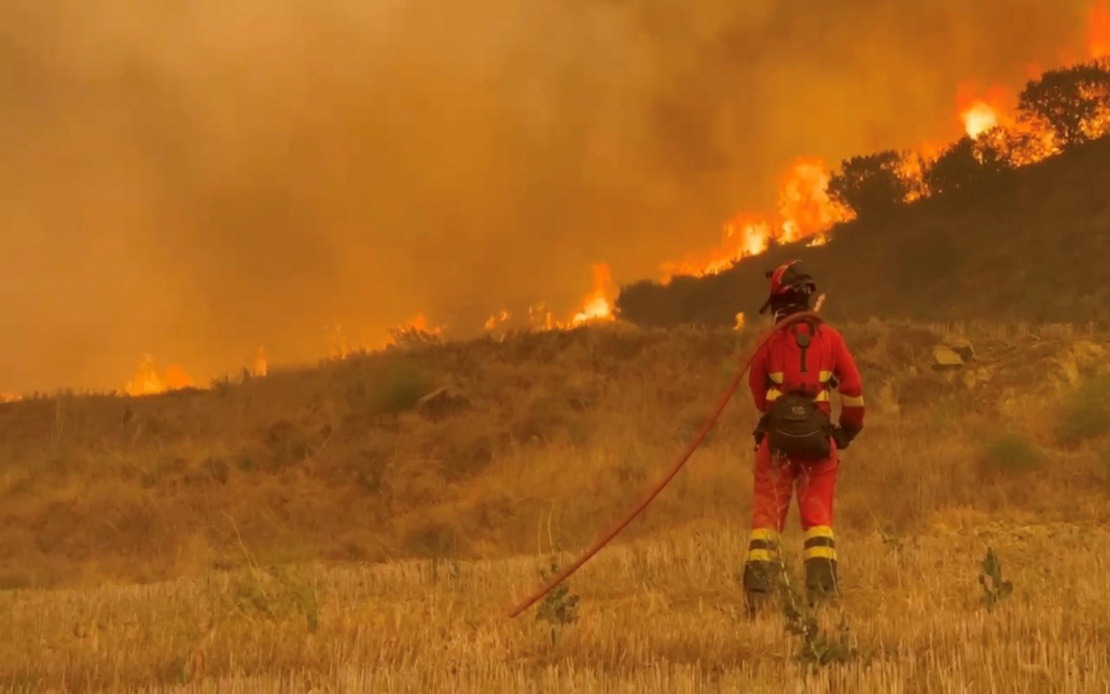
Britain's government is convening an urgent crisis session on Wednesday to coordinate its response to a mounting weather emergency that threatens public safety, agricultural output and health services across the country. The Cobra meeting, the government's highest-level emergency response mechanism, reflects deepening alarm over extreme heat, widespread wildfires and severe drought that have gripped large parts of the United Kingdom in recent weeks.
Andy Burnham will lead the meeting, bringing together officials and stakeholders from across the public sector to address the cascading challenges now confronting the nation. According to government representatives, the session will focus on the mounting pressures facing three critical groups: firefighters battling unprecedented blazes, farmers struggling with parched conditions, and National Health Service personnel dealing with heat-related illnesses and mortality. The convening of such a high-level emergency forum underscores how quickly the climate crisis has escalated from a distant concern to an immediate governance challenge requiring coordinated state intervention.
The timing of the meeting reflects the accelerating pace of weather extremes battering the UK. This week alone, additional areas of England have slipped into official drought status, joining Wales, which declared a drought on July 30 after weeks of scorching temperatures and minimal rainfall. Simultaneously, firefighting crews continue battling a major wildfire consuming the New Forest in Hampshire, one of several significant incidents across the country. The Met Office, Britain's national weather authority, has issued a rare amber heat warning for Thursday, signalling conditions of exceptional severity that warrant immediate public health and safety interventions.
The meteorological data itself paints a stark picture. Officials from the Met Office announced Tuesday that current trends suggest this will become the UK's warmest summer on record when measured by average temperature across the season. Such a designation carries profound implications for infrastructure, agriculture, public health and social cohesion. Temperature records, when broken year after year in rapid succession, signal fundamental shifts in climatic patterns rather than mere statistical fluctuations, a distinction with serious long-term planning consequences for a nation accustomed to temperate conditions.
The human toll has already become apparent in mortality figures. During May and June, when the first major heat waves struck, Britain's health security agency documented 2,877 excess deaths attributable to extreme heat—nearly double the 1,504 excess deaths recorded during the summer of 2025. These figures represent not abstract statistics but families experiencing loss, hospitals overwhelmed, and vulnerable populations—the elderly, the chronically ill, the isolated—bearing disproportionate burdens. The disparity between this year and the previous summer demonstrates how rapidly heat-related mortality can escalate when temperatures breach thresholds that healthcare and social systems are unprepared to manage.
The political response has been swift, with opposition figures already articulating competing visions for action. Zack Polanski, leader of the Green Party, has used the emergency meeting to call for transformative policy shifts. In a statement circulated on social media, he emphasized that climate science permits no negotiation—the laws of physics demand response proportional to the threat. His specific proposals target both immediate relief and long-term prevention: establishing tax measures on major fossil fuel corporations to fund emergency firefighting capabilities, ensuring access to cooling facilities in every community to protect vulnerable populations from heat exposure, introducing maximum working temperature regulations to protect workers, and halting all new petroleum extraction projects in the North Sea.
These demands reflect a growing consensus among climate advocates that incremental adjustment is insufficient given the scale and speed of climate disruption now unfolding. The framing—that one cannot negotiate with scientific reality—challenges policymakers to ground their decisions in empirical evidence rather than political convenience. For Southeast Asian observers, the UK's crisis offers both warning and instruction. Nations across the region already grappling with heat and humidity are witnessing how even wealthy, developed economies with sophisticated infrastructure and resources struggle when climatic extremes exceed historical norms and contingency planning assumptions.
The confluence of heat, drought and fire creates cascading vulnerabilities. Water scarcity threatens agricultural productivity at a moment when crop stress from heat already reduces yields. Simultaneous emergency demands—fighting fires, managing water distribution, treating heat casualties—strain emergency services across multiple sectors. Supply chains face disruption. Energy systems strain as cooling demand peaks. The interdependencies reveal how climate change, though often discussed as an environmental matter, fundamentally reshapes economic and governance systems.
For Malaysia and the broader Southeast Asian region, the UK scenario carries particular relevance. While tropical nations experience high baseline temperatures, they have adapted to these conditions over millennia. However, further warming beyond historical ranges produces similarly disruptive effects. Urban heat island effects already affect Malaysian cities; agricultural regions face uncertain monsoon patterns; water resources face competing demands from growing populations. The UK's mobilization of high-level governance structures, its acknowledgment that multiple sectors face simultaneous stress, and its consideration of both emergency response and structural policy reform all suggest frameworks worth studying as Southeast Asian governments prepare for intensifying climate impacts in coming decades.
The emergency meeting represents a critical moment in how democracies respond to climate crises. The decision to convene at the highest levels signals that this is no longer a peripheral concern delegated to environmental ministries. It elevates climate response into core governance, demanding coordination across health, defense, agriculture and infrastructure authorities. Whether the meeting produces meaningful policy shifts or merely coordinates existing responses will indicate whether governments can overcome institutional inertia and short-term political cycles to address threats operating on decadal timescales.

