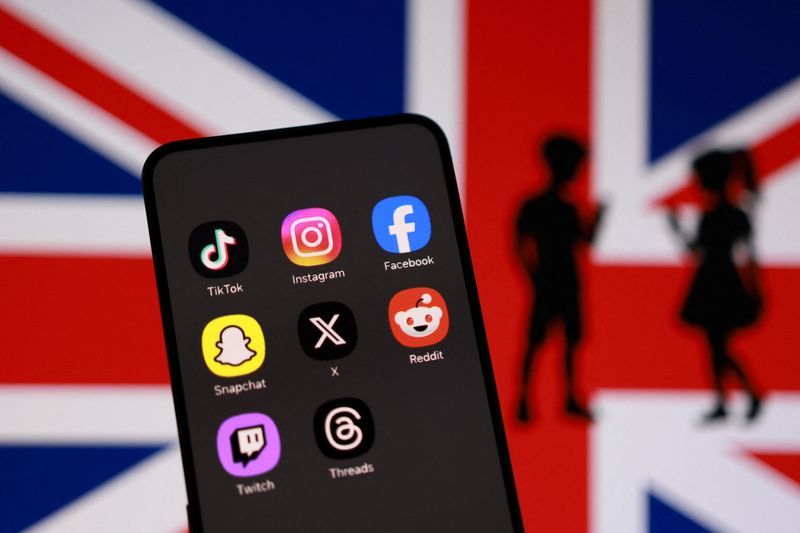
The British government has announced plans to impose automatic overnight restrictions on social media use for teenagers aged 16 and 17, marking an escalation in its approach to youth online safety. Under the proposed rules, users in this age group would find themselves locked out of social media platforms between midnight and 6 a.m. unless they deliberately modify their account settings to regain access. This default curfew follows an earlier announcement last month in which the government outlined intentions to introduce a comprehensive ban on social media access for anyone under 16, positioning Britain among the world's strictest regulators of youth online activity.
The proposals extend beyond simple time restrictions. Technology minister Liz Kendall explained that the measures will also deactivate engagement features designed to encourage prolonged usage by default, further discouraging late-night scrolling. The government framed these interventions as essential protections, arguing they will help young people obtain adequate sleep, maintain focus on their education, and allocate more meaningful time to family connections. This reasoning reflects growing international anxiety about the documented effects of social media on adolescent mental health and physical wellbeing, concerns that have mobilised parents and policymakers across multiple democracies.
Implementation of the curfew regime will become a legal obligation imposed directly on technology companies. Online safety minister Kanishka Narayan stated unequivocally that the government would compel platforms to implement the restrictions, removing any discretion from corporate decision-making. Speaking to LBC Radio, Narayan indicated that technology firms failing to comply with robust age verification requirements and other safeguarding obligations would face substantial regulatory penalties. This hardline stance reflects frustration among British policymakers with what they perceive as insufficient efforts by major platforms to protect younger users.
Despite the government's resolve, significant implementation challenges lie ahead. Experience from Australia, which became the first nation to enact a social media ban for children, revealed that major platforms stumble at the foundational stage of age verification. That scheme's effectiveness was undermined when Google, TikTok, and other companies proved incapable of reliably confirming user age, rendering the regulatory intent difficult to enforce. Similar technical and compliance obstacles could hamper Britain's efforts, particularly given that determined teenagers may discover workarounds or that platforms might implement solutions that satisfy regulatory requirements while providing limited practical protection.
The timeline for implementation provides ample runway for both government refinement and industry lobbying. Parliament will receive the first set of draft regulations before year's end, but the measures are not expected to take effect until spring 2027—nearly two years away. This extended schedule allows stakeholders time to shape the rules but also creates uncertainty about their final form. The gap between announcement and enforcement has historically been exploited by technology companies seeking to soften restrictions or secure carve-outs, and British industry players have already signalled resistance.
Opposition from the Conservative Party education spokesperson Laura Trott underscores the political fault lines emerging around youth social media policy. Trott characterised the curfew approach as incoherent, arguing that a restriction users can easily disable sends a muddled message about whether 16- and 17-year-olds should be permitted on these platforms at all. Her criticism suggests that the government's bifurcated approach—banning under-16s while imposing weak restrictions on older teens—may struggle to gain cross-party consensus. This internal political debate mirrors broader disagreement internationally about whether age-based restrictions or engagement restrictions are more appropriate tools for youth protection.
Major platforms have thus far declined to comment publicly on the proposals. Meta, which operates Instagram and Facebook; ByteDance, owner of TikTok; and Google, parent of YouTube, have remained silent following the government announcement. This muted response may reflect a wait-and-see posture as the regulations develop, or it could indicate behind-the-scenes negotiations with government. Notably, both Google and TikTok have faced recent legal accountability in the United States, having separately settled lawsuits from a minor alleging that exposure to their platforms caused mental health damage—a factor that may influence their compliance calculus with stricter overseas requirements.
For Malaysian and Southeast Asian observers, Britain's regulatory trajectory carries significant implications. As a major technology-exporting region with substantial youth populations engaged on global platforms, Southeast Asia watches closely how wealthy democracies legislate digital safeguarding. If Britain's model succeeds in implementation, it could encourage regional governments to adopt similar approaches, potentially fragmenting the internet experience for young users across different jurisdictions. Conversely, if the British scheme falters due to technical limitations or legal challenge, it may discourage Southeast Asian policymakers from investing resources in comparable restrictions, instead favouring lighter-touch approaches focused on digital literacy and parental guidance.
The deeper challenge underlying Britain's initiative concerns the fundamental design of social media platforms. These applications were engineered to maximise engagement and time spent on-platform, features that work against natural sleep cycles and educational focus. Imposing overnight curfews is essentially asking technology companies to voluntarily curtail revenue opportunities, as evening hours constitute peak engagement periods. Unless regulations include penalties sufficiently severe to outweigh lost advertising revenue, platforms may comply nominally while optimising their systems to make curfew bypassing effortless, rendering the policy performative rather than protective.
Britain's emerging regulatory stance also reflects a broader philosophical shift toward treating technology companies as utilities subject to public obligation rather than as purely commercial entities. By mandating default protections and imposing liability for age verification failures, the government is establishing a precedent that platform operators bear responsibility for user welfare. This stance contrasts sharply with the self-regulatory models predominant in the United States and represents a model other democracies may eventually emulate. However, implementation success will determine whether this approach becomes a template for global regulation or a cautionary example of ambitious policy outpacing technical feasibility.

