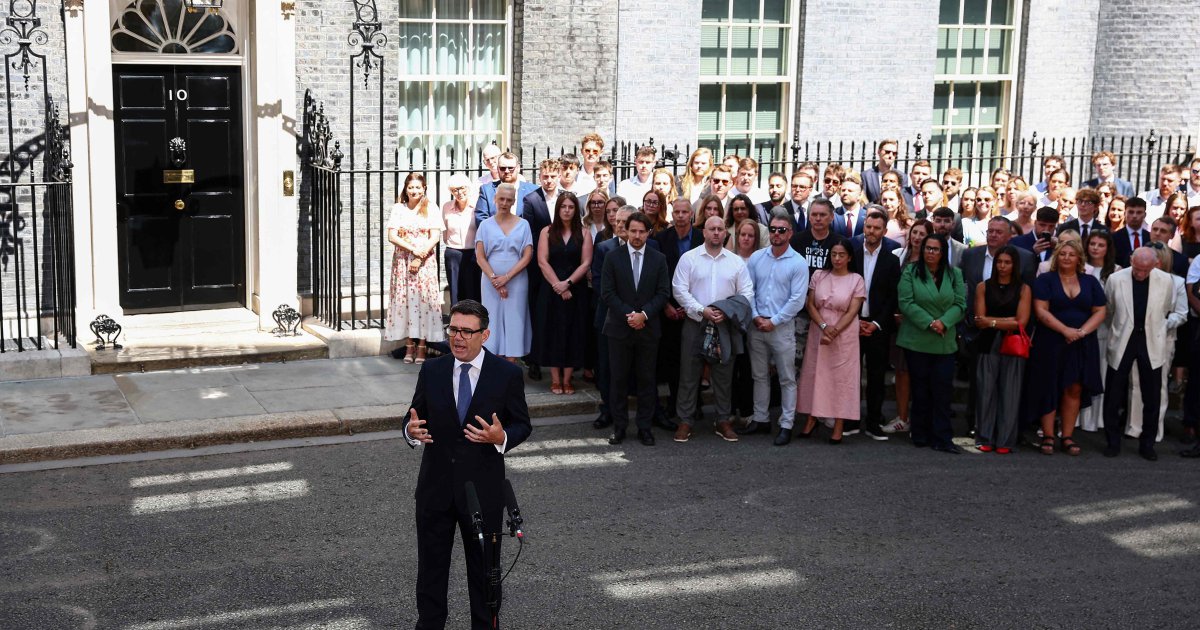
Andy Burnham's ascension to 10 Downing Street marks a sobering milestone for British democracy: the seventh change of prime minister in fewer than ten years. The appointment, confirmed on Monday, has crystallised widespread public dismay at a political system that appears locked in perpetual crisis. Across the country, voters like Claire Walker are expressing barely concealed exasperation at the relentless carousel of leadership changes that has defined British politics since the Brexit referendum of 2016.
The sheer rapidity of ministerial turnover reflects deeper fractures within the British body politic that extend far beyond individual personalities or scandals. Since David Cameron's tenure ended in mid-2016, the office has passed through the hands of Theresa May, Boris Johnson, Liz Truss, Rishi Sunak, Keir Starmer, and now Burnham. Each transition carried its own political drama—some occasioned by electoral defeats, others by internal party rebellion, and at least one by constitutional convention so strained that the incumbent's fitness to continue was questioned. For ordinary British citizens witnessing this repeated upheaval, the cumulative effect has been demoralising rather than reassuring.
The phenomenon reflects a broader erosion of political stability that has analogues across the democratic world, though few Western democracies have experienced such concentration of executive turnover in such a compressed timeframe. Malaysia, by comparison, has witnessed five changes of prime minister since 2009, a pace that has itself generated concerns about institutional disruption. The British experience suggests that when leadership changes accelerate beyond a certain threshold, voters begin to perceive the political class not as responding to their preferences but as consumed by internal struggle for power. This perception corrodes public confidence in governance itself.
Walker's resigned sigh encapsulates a broader sentiment detected across demographic and geographic divides in Britain. Polling data consistently indicates that voters, regardless of party affiliation, view the frequency of prime ministerial changes as a symptom of governmental dysfunction rather than a feature of democratic responsiveness. The expectation that a prime minister should serve a full electoral term, typically five years, has been shattered so comprehensively that British voters have begun to treat extended leadership tenure as remarkable rather than normal. The fatigue extends beyond political activists to casual observers who resent the distraction from substantive policy discussion that each transition inevitably produces.
For business and institutional stakeholders, the constant leadership turnover presents tangible challenges. Foreign investors monitoring British political stability have grown increasingly cautious. Economic policy requires consistency and long-term strategic vision; neither emerges easily when administrators are preoccupied with succession contests and internal consolidation of power. The civil service, meanwhile, faces the practical challenge of implementing directives from a succession of executives, each potentially arriving with differing priorities and governing philosophies. In sectors from financial services to infrastructure development, the disruption translates into delayed decision-making and reduced strategic investment.
Burnham's appointment itself carries particular significance as it potentially marks a stabilisation point, or alternatively signals that existing institutional mechanisms have become inadequate to restrain internal party dynamics. His background as mayor of Greater Manchester and former shadow secretary of state for health suggests a figure with substantive executive experience, yet his emergence from relative parliamentary obscurity also underscores how the repeated crises have promoted politicians who might otherwise have required longer apprenticeships. The question confronting the British polity is whether this latest transition represents an opportunity for genuine governance renewal or merely another chapter in an extended narrative of institutional instability.
The international dimensions of Britain's political churn merit consideration, particularly for Southeast Asian observers. A period of reduced British political coherence affects London's capacity to project consistent foreign policy across the region. Trade negotiations, security partnerships, and diplomatic initiatives all require sustained attention from a government with sufficient political capital and stability to follow through on commitments. When leadership changes interrupt these processes, partners must recalibrate expectations and often wait for clarification of new priorities. This reduces British effectiveness on the international stage and potentially creates space for other powers to expand their influence.
The underlying causes of Britain's leadership instability operate at multiple levels. Brexit triggered the initial rupture in the Conservative Party consensus that had anchored British politics for decades. Subsequent economic challenges, including inflation, energy crises, and public sector pressures, created circumstances where dissatisfied backbenchers possessed sufficient leverage to remove leaders they deemed inadequate. None of these individual crises would necessarily have produced such rapid turnover; collectively, they created conditions where party members and parliamentarians lost patience with sitting prime ministers far more quickly than historical norms would suggest.
For voters now accustomed to this pattern of constant change, the psychological impact should not be underestimated. Political engagement requires some degree of stable reference points against which to evaluate progress and performance. When leadership changes so frequently that voters struggle to attribute outcomes to identifiable decision-makers, they withdraw from active political participation. This creates a vicious cycle wherein declining engagement produces less accountability, which in turn facilitates further instability. Reversing this dynamic will require not merely a change of personnel but a fundamental restoration of institutional norms that constrain leadership contests within sustainable boundaries. Whether Burnham's administration can achieve this stabilisation remains among the most significant questions confronting British democracy as this turbulent decade enters its next phase.

