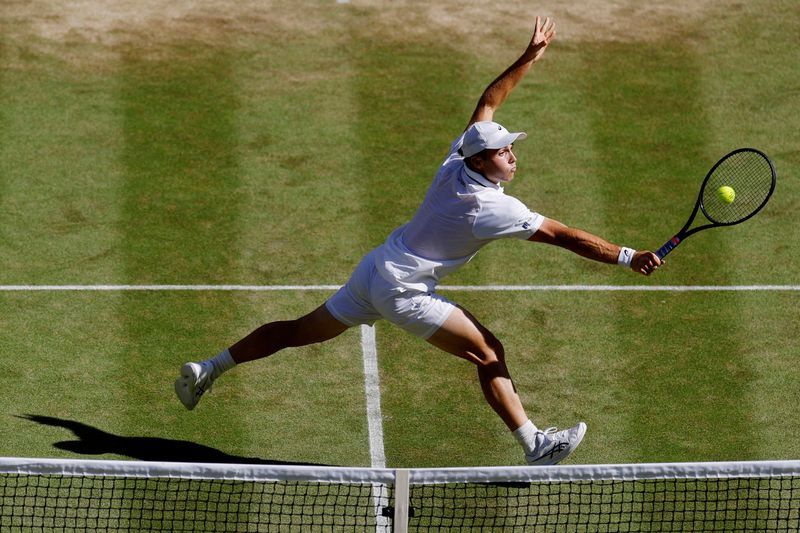
Arthur Fery's improbable journey through Wimbledon has captured the imagination of British tennis fans, with the 24-year-old wildcard pulling off an extraordinary feat by advancing to the quarter-finals through consecutive five-set marathons. The France-born, London-raised player, who celebrates his birthday on the same day as the men's singles final on Sunday, has provided a rare bright spot for home supporters during a Championships marked by the early elimination of nearly all British competitors.
Fery's remarkable run became even more dramatic with his latest victory over Grigor Dimitrov, a former world number three now 35 years old. In a display of mental fortitude against the Bulgarian campaigner, Fery engineered a stunning comeback from the brink of defeat. With Dimitrov holding a commanding position at 4-3 with a break of serve in the fourth set, the match appeared destined to slip away. Yet Fery summoned the resilience to turn the tide, eventually triumphing 7-5 3-6 4-6 6-4 7-6(7) in a Centre Court encounter that coincided with England's World Cup last-16 victory over Mexico. The roar that erupted when he sealed match point was reportedly the loudest Centre Court has witnessed in years, creating an atmosphere more akin to a football stadium than a tennis venue.
This second consecutive five-set victory capped a week of extraordinary exertion for the Stanford-educated player. Just two days earlier, Fery had overcome Zizou Bergs in the third round, demonstrating exceptional courage by fighting back from two sets to one down and a double break deficit in the fourth set. That marathon encounter remained the longest match of the entire tournament, yet Fery managed this feat while battling recurring nosebleeds, a physical impediment that would have deterred many competitors. The contrast between Fery's performances and those of his compatriots underscores his exceptional qualities; whilst 15 of the 19 British singles participants crashed out at the first hurdle, Fery has become the nation's standard-bearer at the Championships.
The significance of Fery's presence on Centre Court cannot be understated within the context of British tennis's struggles at Wimbledon. His appearance represents a rare occasion when a homegrown player has advanced deep into the draw, carrying the hopes of a nation that struggles to produce consistent Grand Slam contenders. His fourth-round showdown awaits against world number 10 Flavio Cobolli of Italy, against whom Fery already holds a head-to-head advantage from their Australian Open encounter earlier this year. The quarterfinal spot would place Fery within striking distance of the final itself, an achievement that would be transformative for his career trajectory and morale for British tennis.
In the immediate aftermath of his victory over Dimitrov, Fery reflected on the emotional weight of his achievement, recognising both the historic nature of the moment and the uncertainty of whether such a stage would ever come again. He spoke candidly about the convergence of British sporting triumphs occurring simultaneously, noting the positive ripples created when domestic athletes perform well on the global stage. The timing of his match, following England's World Cup heroics in Mexico City during the early hours of British morning, created a unique sporting narrative that united different fan bases in collective celebration.
Fery's ascent has been carefully observed by fellow professionals on the circuit, and his performances have begun attracting genuine respect from established players. Taylor Fritz, the sixth seed and American talent, has offered candid testimony about Fery's capabilities based on their practice sessions ahead of the 2024 World Tour Finals. Fritz noted that Fery had outplayed him consistently during their training week, despite Fritz himself playing at high level and having just reached the Turin tournament final. The American was particularly impressed by Fery's forehand technique relative to his physical stature and his exceptional serving ability, suggesting that these technical strengths position him well against top-ranked opponents.
Ranking points have begun reflecting Fery's meteoric rise through the draw. Having entered Wimbledon ranked 114th in the world, his performances have already pushed him inside the top 70, with further advancement guaranteed to accelerate his ascent through the rankings. This trajectory, should he continue advancing, would place him amongst the legitimate contenders for major tournaments in future years. The financial and ranking implications of a potential final appearance would fundamentally reshape his career opportunities and trajectory on the professional circuit.
The contrast between Fery's exceptional week and the broader struggles of the British contingent raises important questions about the structure and development of tennis talent in the United Kingdom. Whilst the nation possesses a tennis infrastructure and tradition at Wimbledon, the ability to produce multiple competitive players at the elite level has proven elusive. Fery's success, particularly as a wildcard rather than a seeded player, demonstrates that talent can emerge from unexpected quarters, though the reliance on a single player to represent Britain's hopes reflects underlying challenges in domestic player development.
As Fery prepares for his quarter-final encounter against Cobolli, the dimensions of his achievement become increasingly apparent. Whether celebrating his 24th birthday on Centre Court or exiting in the quarter-finals, his Wimbledon campaign has already secured his place in British tennis history as an unlikely champion-in-waiting. The narrative of a France-born, London-raised player carrying an entire nation's hopes at the sport's most prestigious tournament encapsulates both the democratic nature of sport and the power of individual determination against systemic odds.

