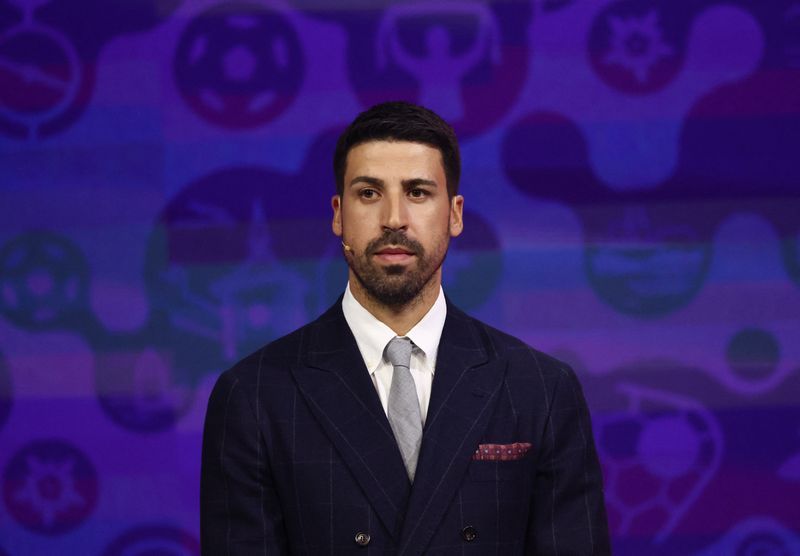
Sami Khedira, part of Germany's 2014 World Cup triumph, has emerged as an unlikely voice of perspective on one of contemporary football's most intriguing demographic phenomena: siblings representing rival nations on the sport's grandest stage. Speaking at the Home of Football museum in New York, the former German midfielder rejected the notion that brothers wearing different international shirts constitutes any form of identity problem, instead framing it as a natural expression of how the modern world operates across borders and cultures.
Khedira's position carries particular weight because he inhabits precisely this intersection himself. His brother Rani represented Tunisia at recent World Cup tournaments, their father's country of origin, while Sami committed to Germany, where he was raised by his German mother. Rather than viewing this as an internal family conflict or a dilution of sporting allegiance, Khedira articulates a philosophy that both nations and identities can coexist authentically within a single family. His perspective suggests that questioning the legitimacy of such arrangements reflects outdated assumptions about how nationality and belonging function in increasingly interconnected societies.
The phenomenon has become sufficiently common that the 2026 World Cup will feature multiple examples of fraternal international division. The Williams brothers, Inaki and Nico, both playing for Athletic Bilbao at club level, have chosen divergent national paths with Inaki representing Ghana and Nico opting for Spain. Similarly, Guela and Desire Doue split their loyalties between Ivory Coast and France, while the Souttar brothers divided between Australia and Scotland. The Luckassen-Brobbey situation presents an additional layer of complexity, with Derrick and Brian technically brothers through their mother yet competing under their fathers' respective surnames, representing Ghana and the Netherlands. Beyond these pairs, the forthcoming tournament will showcase the Hernandez brothers playing together for France, the Timber siblings for the Netherlands, and Duarte and Bacuna combinations representing Cape Verde and Curacao respectively.
What renders Khedira's commentary particularly significant is his explicit rejection of the competitive framework through which many observers evaluate such arrangements. He does not perceive these situations as families torn between loyalties or as players forced to choose one identity over another. Instead, he conceptualises them as manifestations of modern migration patterns, where families maintain genuine connections to multiple homelands simultaneously. The German-born midfielder acknowledges that people sometimes questioned his own Germanness based on his surname and physical appearance, while simultaneously viewing him as fundamentally foreign when in Tunisia. His response to this paradox was philosophical rather than defensive: both identities are simultaneously true, neither invalidating the other.
A particularly evocative moment crystallised Khedira's thinking when he witnessed the Doue brothers singing both the French and Ivorian national anthems before their countries' friendly match earlier this month. Rather than viewing this as a conflict of interest or emotional confusion, Khedira interpreted it as football operating at its most powerful—transcending mere sporting competition to communicate something meaningful about human experience. The image encapsulates what he terms a wonderfully human dimension of the modern game, where multicultural realities generate their own compelling narratives.
The structural expansion of the World Cup format to 48 teams has contributed meaningfully to creating space for nations like Cape Verde, Curacao, and Haiti to demonstrate competitive viability on football's largest platform. This development carries particular significance for African and Asian federations, which Khedira observes have progressively narrowed the performance gap separating them from traditional European and South American dominance. He attributes this convergence to systematic improvements in educational programmes, coaching infrastructure, and grassroots development, though he simultaneously argues that European footballing nations bear responsibility for strengthening development at source rather than merely benefiting from the talent acquisition mechanisms that dual-nationality systems enable.
Yet Khedira tempers his celebration of multicultural possibility with realistic acknowledgment of the pressures imposed on young athletes navigating these decisions. Adolescents courted by multiple national federations frequently lack the maturity and life experience necessary to comprehend the profound implications of their choice. The decision cannot authentically be dictated by political considerations, inherited heritage, or federation pressure alone. Khedira emphasises that such profoundly personal determinations must ultimately derive from an internal conviction—a gut feeling that pulls a young person toward one community rather than another.
Recalling his own experience at eighteen years old, Khedira recognises the immense difficulty inherent in committing to a national identity when still developing as a person. While he acknowledges that federations legitimately attempt to influence such choices, he ultimately respects the individual agency of young players who must navigate these competing claims. The burden falls disproportionately on teenagers already managing the considerable pressures of professional football development. His observation suggests that while international football federations should conduct themselves respectfully in these contexts, they must simultaneously recognise that the final decision belongs authentically to the athlete themselves, driven by personal conviction rather than external coercion.
Khedira's broader vision positions multicultural representation within international football not as an anomaly requiring resolution but as a strength reflecting contemporary reality. His argument carries particular resonance for Southeast Asian readers in a region where migration, diaspora communities, and mixed-heritage populations constitute increasingly visible demographic features. The normalisation of athletes representing nations beyond their countries of birth or ethnic heritage challenges essentialist understandings of national identity that have historically dominated sporting discourse. By celebrating rather than pathologising these arrangements, Khedira implicitly advocates for football to model more inclusive approaches to belonging that acknowledge how millions of individuals across the globe maintain authentic connections to multiple communities simultaneously.