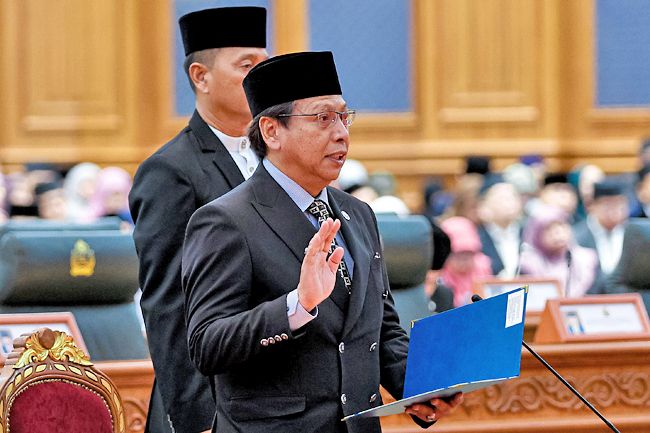
Brunei's government proceeded with constitutional ceremony on Monday as four senior Cabinet ministers took their oaths of office as members of the Legislative Council in Bandar Seri Begawan. The swearing-in marked the opening day of the Second Meeting of the 22nd Legislative Council Session and followed longstanding procedures outlined in the 1959 Brunei Constitution governing the appointment of ex-officio members to parliament.
The new ministerial appointees brought fresh leadership perspectives to several strategically important portfolios. Datuk Seri Setia Awang Sufian Sabtu assumed his role at The Prime Minister's Office with responsibility for Security and Law matters, positioning him at the heart of national security governance. His counterpart in the same ministerial office, Datuk Seri Setia Awang Mohamad Azmi Mohd Hanifah, took charge of the Energy, Upstream and Downstream portfolio, a sector of critical economic importance to the sultanate given its substantial hydrocarbon reserves and revenue streams.
Two additional ministers completed the quartet of appointees. Pengiran Datuk Seri Setia Mohammad Tashim Pengiran Hassan accepted the portfolio of Religious Affairs, a particularly significant responsibility in the context of Brunei's Islamic governance framework and its role as custodian of religious matters within the sultanate. Datuk Seri Setia Awang Mohammed Riza Datuk Paduka Mohammed Yunos moved into the Transport and InfoCommunications ministry, overseeing infrastructure development and digital connectivity initiatives across the nation.
The constitutional arrangement whereby Cabinet ministers serve simultaneously as ex-officio members of the Legislative Council represents a hallmark feature of Brunei's parliamentary system. This institutional design creates a direct pipeline between executive policymaking and legislative deliberation, ensuring government ministers maintain active presence and voice within parliamentary proceedings. The practice derives from the sultanate's 1959 Constitution and reflects Westminster-influenced governance structures adapted for Brunei's unique political context under the Sultan's authority.
Legislative Council Speaker Pehin Orang Kaya Seri Lela Datuk Seri Setia Awang Abdul Rahman Datuk Setia Mohamed Taib presided over the formal proceedings, underscoring the ceremonial and constitutional gravity of the occasion. The speaker's attendance highlighted the institutional importance of welcoming new parliamentary members and reinforced the interconnected nature of Brunei's executive and legislative branches. Such ceremonies, while often routine from a procedural standpoint, carry symbolic weight in demonstrating governmental continuity and constitutional observance.
For Southeast Asian observers, Brunei's deliberate adherence to constitutional formalities reflects the sultanate's commitment to structured governance despite its absolute monarchy framework. While Brunei does not operate as a conventional democracy, its institutional arrangements demonstrate how traditional authority can coexist with formal legislative processes. The involvement of multiple Cabinet portfolios in concurrent parliamentary membership suggests an intentional design to facilitate government coordination and ensure ministerial accountability within parliamentary settings.
The energy portfolio assumption carries particular regional significance given current discussions within ASEAN regarding energy security and the transition toward sustainable fuel sources. Brunei's hydrocarbon sector remains foundational to its economy, and ministerial direction in this domain influences both domestic development priorities and bilateral energy cooperation with regional partners including Malaysia and Indonesia. Appointments to such positions therefore carry implications extending beyond Brunei's borders into broader Southeast Asian economic calculations.
Similarly, enhanced ministerial focus on transport and information communications reflects broader regional trends toward infrastructure modernization and digital economy development. As ASEAN nations pursue connectivity initiatives and digital transformation, ministerial portfolios governing these sectors wield increasing influence over national competitiveness and regional integration efforts. Brunei's appointment of leadership in these domains signals continued emphasis on positioning the sultanate within evolving Southeast Asian networks.
The religious affairs portfolio carries distinctive weight within Brunei's governance structure, particularly given the nation's constitutional position as an Islamic state with the Sultan as supreme arbiter of Islamic matters. The ministry oversees faith-based policies, Islamic jurisprudence application, and religious institution management within a framework where Islamic law intersects with civil administration. This ministerial role shapes how Brunei calibrates religious governance in contemporary contexts while maintaining institutional stability and public confidence in faith-based governance.
The security and law portfolio acquisition by Datuk Seri Setia Awang Sufian Sabtu positions him within the sultanate's internal security architecture at a time when regional security challenges encompass transnational threats, maritime security concerns, and cybersecurity vulnerabilities affecting ASEAN states collectively. Brunei's location within critical maritime chokepoints and its role within regional security frameworks render this ministerial appointment consequential for broader Southeast Asian security considerations.
These appointments collectively demonstrate how parliamentary sessions generate opportunities for formal constitutional observances that reinforce governmental legitimacy and institutional continuity. The ceremonial nature of such proceedings, while potentially appearing routine to external observers, serves essential functions in maintaining constitutional order and public understanding of governmental processes within Brunei's distinctive political system. The coordination between executive appointments and legislative membership reflects institutional design emphasizing interconnection between policy formulation and parliamentary oversight mechanisms available within the sultanate's framework.

