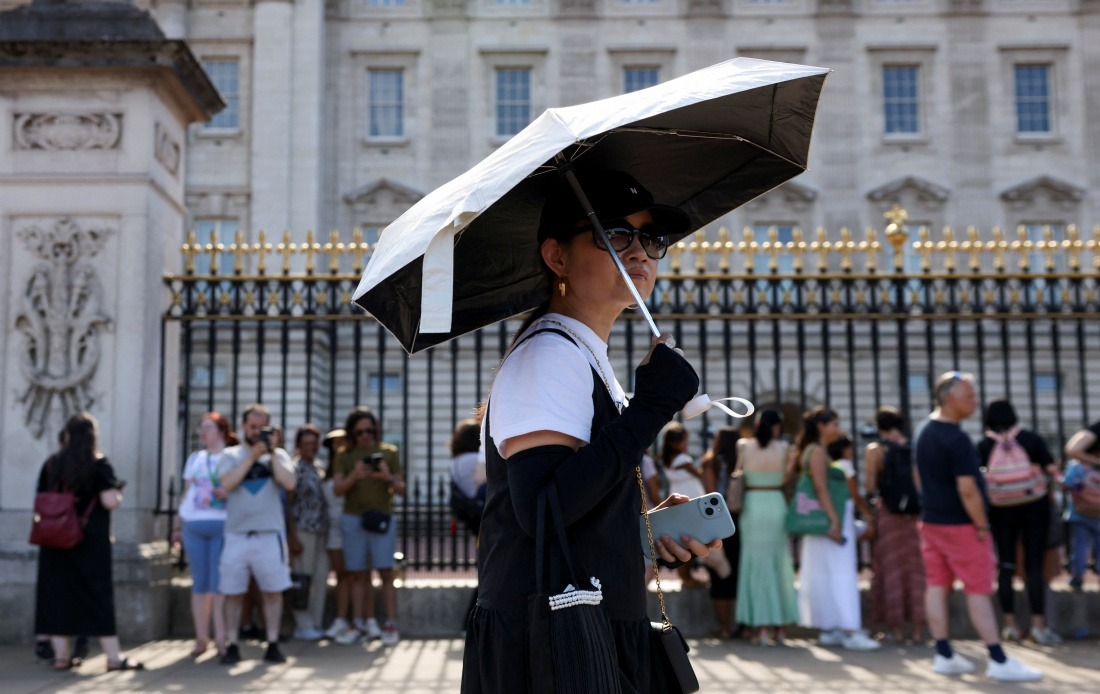
The United Kingdom's Household Division announced the suspension of all ceremonial guard changing ceremonies across London and Windsor on Tuesday, Wednesday, and Thursday this week, citing an extreme heatwave that is forecast to shatter the nation's June temperature record. The decision represents an unusual move for one of Britain's most iconic ceremonial traditions, demonstrating the severity of weather conditions expected to grip the country during mid-week.
The UK's Met Office issued a rare red weather warning for large portions of southern England and Wales, signalling the most serious level of heat alert. This cautionary stance reflects meteorological predictions that temperatures will climb to 39 degrees Celsius on both Wednesday and Thursday, with certain regions potentially recording even more extreme readings. Such temperatures would constitute a significant departure from typical June conditions and potentially establish new benchmarks for heat records during this month.
In an official statement, the Household Division emphasised that the welfare of its personnel, military working horses, and civilian spectators who gather in substantial numbers to witness these ceremonies represented the paramount consideration in making this determination. The organisation acknowledged that large crowds congregating outdoors during peak heat periods would pose genuine health risks to attendees, while the animals involved in the ceremonies would face particular stress under such extreme conditions. This reasoning underscores how climate-related challenges are compelling even Britain's most traditional institutions to adapt their operations.
While completely cancelling the ceremonies for three consecutive days, military authorities did permit a modified version of the Royal Horse Guards' changing ceremony scheduled for Wednesday. This alternative arrangement would commence earlier in the morning hours when temperatures remained lower, and would dispense with the elaborate ceremonial pageantry that normally characterises the event. Additionally, soldiers participating in any ceremonies would be positioned in shaded locations and rotated at more frequent intervals to minimise their exposure to direct sunlight and extreme heat.
The meteorological emergency has triggered disruptions far beyond ceremonial London. Educational institutions across southern England have shuttered en masse, with Somerset county council confirming that approximately 100 schools would remain closed throughout the heatwave period. Buckinghamshire reported a similar closure rate, whilst Gloucestershire suspended classes at more than 80 educational facilities. These three counties fall within the area designated by the red weather warning, alongside London, where nearly 10 major schools cancelled in-person instruction for the week.
For Malaysian readers accustomed to tropical climates, the British response to these temperatures may initially seem cautious. However, the United Kingdom's infrastructure, urban design, and population physiology are fundamentally adapted to far cooler conditions. Building standards emphasise insulation and heat retention, with air conditioning remaining uncommon in homes, offices, and public spaces compared to Malaysia's ubiquitous climate control systems. The absence of such cooling infrastructure, combined with the psychological expectation of cooler weather, creates genuine public health risks when temperatures exceed normal parameters by such significant margins.
The closure of schools reflects legitimate concerns about student safety in educational buildings that lack adequate ventilation or cooling systems. Teachers and administrators recognised that maintaining classroom environments above 30 degrees Celsius would create dangerous conditions for learning and physical wellbeing, particularly for younger children whose bodies struggle more intensely with temperature regulation. The decision prioritised student health over educational continuity, reflecting a cautious approach that differs markedly from Southeast Asian educational practices where substantially higher temperatures remain routine.
The implications of this heatwave extend beyond immediate operational disruptions. Climate scientists increasingly observe that extreme weather events are becoming more frequent across regions historically experiencing milder conditions. The United Kingdom, positioned at a relatively northern latitude, has traditionally enjoyed protection from the most severe heat events that affect equatorial and subtropical regions. However, shifting global weather patterns suggest that such occurrences may become less exceptional, requiring permanent adaptations to infrastructure, building codes, and institutional planning across Britain.
For Southeast Asian observers, this episode illustrates how climate adaptation remains contextual and relative. While Malaysian citizens routinely navigate temperatures exceeding 35 degrees Celsius throughout the year, the sudden imposition of similar temperatures in a society unprepared for such conditions creates equivalent challenges. This underscores that climate resilience depends less on absolute temperature figures and more on the alignment between climatic conditions and infrastructure, planning, and social expectations. As global temperatures rise, even traditionally cooler regions must develop strategies comparable to those Southeast Asian nations have employed for generations.
The ceremonial suspension also carries symbolic weight within British cultural contexts. The Changing of the Guard represents continuity, tradition, and institutional stability—values deeply embedded within British national identity. Suspending this ceremony, even temporarily, signals the magnitude of the meteorological challenge and implicitly acknowledges that environmental constraints supersede ceremonial obligation. This represents a practical prioritisation of human safety and animal welfare over symbolic performance, a trade-off that authorities deemed necessary given the forecasted conditions.
Looking forward, this event may prompt British policymakers and institutional leaders to reconsider long-term planning assumptions. If extreme heat events become more regular occurrences rather than exceptional anomalies, then permanent modifications to ceremonial schedules, school operational calendars, and public event planning may become necessary. Such adaptations would mark a significant departure from historical practice but would align Britain's institutional frameworks with climate realities that Southeast Asian nations have always navigated.
The broader lesson transcends national boundaries. Climate change manifests differently across geographic regions, creating distinct adaptation challenges for societies at all latitudes. Southeast Asian nations possess decades of experience managing heat-related public health challenges, infrastructure demands, and operational constraints. Britain's current experience, while representing an unprecedented event for that nation, exemplifies challenges that tropical and subtropical regions continue managing perpetually. As global climate patterns shift, knowledge exchange and adaptation strategies developed in traditionally warm climates may increasingly inform policies across historically cooler regions.