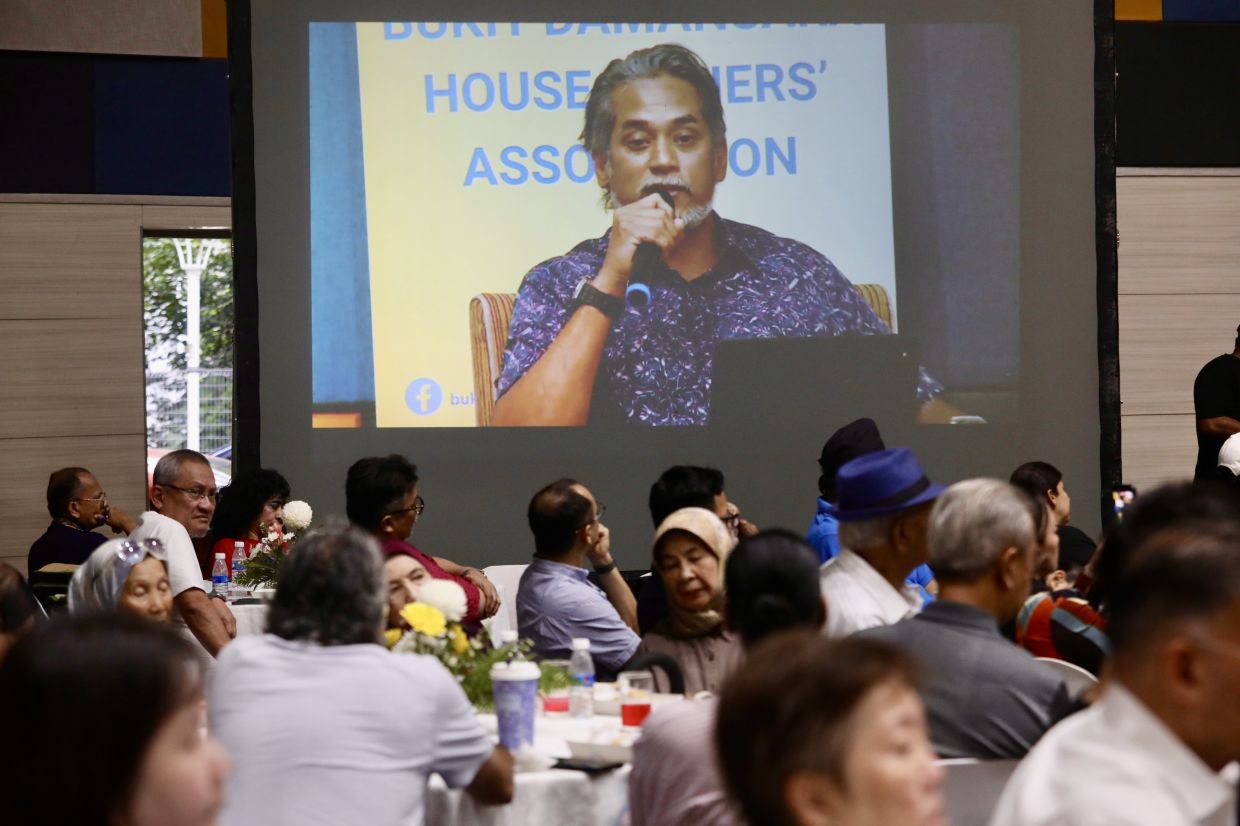
Around 400 residents of Bukit Damansara crowded into a community dialogue session this week to voice strong opposition to a controversial semi-detached house renovation project, demanding that Kuala Lumpur City Hall immediately rescind the construction permit that authorises the addition of an extra floor to the property.
The town hall, held at Pusat Komuniti Bukit Damansara under the banner "Your Voice Matters," marked the inaugural community engagement event since Khairy Jamaluddin assumed the presidency of the Bukit Damansara Home Owners' Association in early August. The three-hour session drew representatives from City Hall's Planning Department and local police, underscoring the gravity of resident frustrations that have accumulated over months of procedural delays and conflicting regulatory decisions.
The core grievance centres on a renovation project that fundamentally alters the character of a residential row. A resident identified as A. Zakki, speaking on behalf of the opposition movement, explained that the original double-storey semi-detached structure was designed in harmony with neighbouring properties, but the approved plan would transform it into a three-storey building. This conversion, residents argue, disrupts the architectural consistency that defines the neighbourhood's identity and desirability. Zakki detailed the timeline of bureaucratic manoeuvres: City Hall granted approval in December 2025, which triggered immediate resident objections. By January 2026, authorities issued a stop-work order in response to community pressure, seemingly resolving the dispute. However, roughly two months prior to this town hall, around June 2026, the same permit was inexplicably re-approved, allowing construction to resume and progress to approximately 10 per cent completion with structural pillars already erected.
Beyond aesthetic concerns, residents have documented tangible structural damage to adjacent properties. Zakki reported that construction vibrations and work methods have caused visible cracks to appear in neighbouring houses, creating both safety apprehension and property value concerns among households immediately surrounding the project site. The association's signature campaign gathered 19 signatures from neighbours unified against the development, providing quantifiable evidence of opposition within the directly affected area. The residents' central demand is straightforward: City Hall should withdraw the construction permit immediately and with no further delays or reversals.
Rosli Nordin, the executive director of City Hall's Planning Department town planner division, offered a measured response, committing only that the municipality would take note of the issues raised by residents without explicitly pledging to revisit the permit decision. This cautious approach likely frustrated attendees expecting more concrete commitments, particularly given the stop-work order issued just months earlier, which suggested official recognition of legitimate community concerns.
The town hall agenda extended beyond the renovation dispute to encompass broader neighbourhood infrastructure challenges that have accumulated over time. Traffic congestion emerged as a persistent problem, particularly during school drop-off hours between 7 and 7.30 am and afternoon pick-up periods from 2 to 4 pm in the vicinity of SK Bukit Damansara and Stella Maris International School Damansara. Deputy police chief Supt Ahmad Firdaus Mustafia Kamal indicated that authorities are addressing the situation, though his statement lacked specificity about enforcement measures or timeline. Ameirul Azraie Mustadza, chairman of SK Bukit Damansara's Parent-Teacher Association, acknowledged the ongoing challenge and revealed that while the school has repeatedly advised parents against double-parking, funding constraints prevent engagement of traffic enforcement volunteers from Rela. The school has written to traffic police requesting consistent daily monitoring rather than sporadic enforcement operations.
Water infrastructure emerged as another significant concern, with multiple residents calling on Air Selangor to undertake comprehensive inspections of the aging pipeline network throughout Bukit Damansara following several pipe burst incidents. These failures disrupt water supply to households and indicate deteriorating underground infrastructure requiring systematic replacement rather than reactive repairs. An Air Selangor representative acknowledged awareness of the burst incidents and outlined plans to progressively replace the ageing distribution network, though no specific timeline or phasing schedule was disclosed.
Khairy characterised the town hall as a mechanism for bridging the communications gap between residents and decision-makers, describing it as an open forum where grassroots concerns could be articulated directly to officials with authority to implement solutions. He pledged to personally follow up on the issues surfaced during the session, committing to help expedite problem resolution through his position and networks. However, the effectiveness of such intermediary roles depends heavily on the political weight Khairy can exert within City Hall's bureaucratic hierarchy and the willingness of department heads to reverse or modify decisions already made public.
The Bukit Damansara situation exemplifies broader tensions in Malaysian urban governance, where residential communities increasingly demand meaningful consultation before projects that affect neighbourhood character are approved, yet planning procedures often proceed with minimal neighbour engagement until conflicts escalate. The renovation permit's oscillation between approval and suspension and back to approval raises questions about the consistency and transparency of decision-making at City Hall. For residents, such reversals suggest that permits are vulnerable to reversal only when political pressure mounts, rather than being based on fixed technical or community consultation criteria established upfront.
For Malaysian homeowners beyond Bukit Damansara, this case signals both the potential and limitations of community association activism. Organised resident movements can successfully mobilise official attention and prompt emergency reviews, but translating temporary halts into permanent reversals requires sustained engagement and political allies within municipal structures. The involvement of Khairy, a figure with national political prominence, may have elevated the case's visibility, yet the absence of explicit commitments from City Hall officials regarding the permit suggests that proximity to political power is insufficient without corresponding departmental accountability mechanisms.

