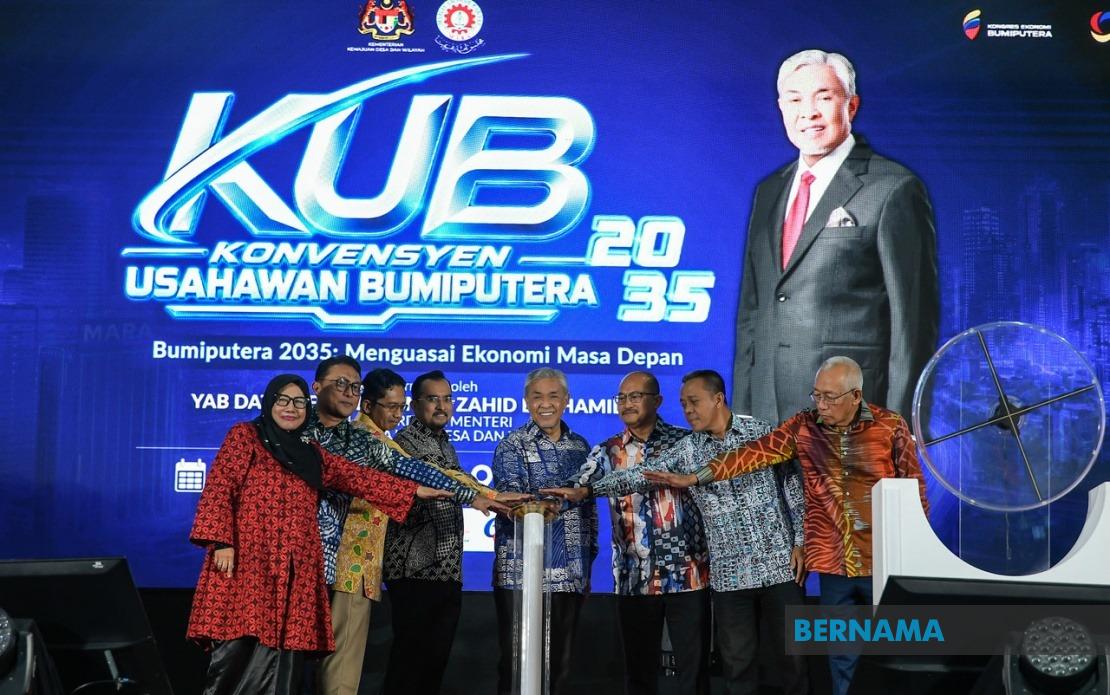
Deputy Prime Minister Datuk Seri Dr Ahmad Zahid Hamidi has issued a stark call for Malaysia's Bumiputera business community to fundamentally shift their approach, moving decisively from passive participation in economic activities towards genuine ownership and meaningful control. Speaking at the closing ceremony of the Bumiputera Entrepreneurs Convention (KUB) 2035 Declaration in Alor Setar on August 27, Ahmad Zahid framed the challenge as a defining moment for indigenous entrepreneurs, arguing that decades of building mere participation have yielded insufficient long-term benefits. The path forward demands courage and ambition from business owners willing to compete at higher levels and capture greater value within their respective sectors.
The Deputy Prime Minister, who concurrently serves as Rural and Regional Development Minister, acknowledged the government's ongoing commitment to supporting Bumiputera entrepreneurs through targeted policies and resource allocation. However, he emphasised that state facilitation alone cannot substitute for entrepreneurial initiative. While authorities would continue expanding access to opportunities, refining the business ecosystem, and removing structural barriers, the ultimate responsibility for growth rests with business owners themselves. This framing reflects a subtle policy recalibration, recognising that traditional support mechanisms may have inadvertently created dependency rather than fostering independent capability and market resilience.
Ahmad Zahid identified three critical transformations required to reshape Bumiputera entrepreneurship by 2035. The first involves consolidating the fragmented support infrastructure that currently disperses financing, training programmes, and market access through disconnected channels operated by various government agencies and private entities. This fragmentation, he argued, forces entrepreneurs to navigate a bewildering maze of bureaucratic touchpoints, reducing efficiency and creating unnecessary friction. By integrating these disparate support mechanisms into a cohesive ecosystem, businesses could access comprehensive assistance through streamlined pathways, enabling faster growth trajectories and reducing administrative burden.
The second transformation entails a philosophical shift within the entrepreneurship development sector itself. Rather than perpetually manufacturing new entrepreneurs through entry-level training and incubation, the focus must pivot towards developing and scaling existing businesses that have already demonstrated viability. This recognises that quality matters more than quantity when measuring entrepreneurial success. Many Bumiputera entrepreneurs have proven their operational competence but lack access to growth capital, advanced management training, or sophisticated market intelligence. Concentrating resources on nurturing these established businesses could yield substantially higher returns than spreading efforts thinly across numerous nascent ventures.
The third pillar emphasises ensuring that Malaysia's broader economic expansion directly strengthens local enterprises rather than primarily benefiting multinational corporations or non-Bumiputera competitors. This approach suggests procurement policies, regulatory frameworks, and investment priorities should be recalibrated to ensure Bumiputera companies capture meaningful shares of national economic growth. Such thinking reflects international best practices observed in other Southeast Asian economies where indigenous entrepreneurship has been systematically protected and supported during development transitions.
The current fragmentation Ahmad Zahid described remains deeply problematic for Bumiputera entrepreneurs navigating Malaysia's complex business landscape. Securing financing often requires separate applications through different institutions, each with distinct criteria and timelines. Simultaneously, accessing relevant training programmes demands engagement with separate agencies, while identifying suitable market opportunities requires connections to yet another ecosystem of trade bodies and promotion entities. This fragmentation wastes entrepreneurial time and resources, diverting management attention from core business operations towards administrative compliance.
Integrating these support systems could unlock significant efficiency gains. Imagine a unified Bumiputera entrepreneurship platform where business owners submit comprehensive profiles, accessing financing, tailored advisory services, market matching, and regulatory guidance through a single digital gateway. Such integration would reduce transaction costs, accelerate decision-making timelines, and enable better matching between business needs and available support mechanisms. International examples from Singapore's enterprise development programmes and South Korea's small-medium enterprise support infrastructure demonstrate how coordinated ecosystems generate superior outcomes compared to fragmented approaches.
The transition from participation to ownership carries profound implications for Malaysia's long-term economic structure. Historically, Bumiputera participation has often meant minority stakes in joint ventures controlled by foreign or non-Bumiputera partners, limited managerial authority in majority-owned enterprises, or exclusive access to protected market segments without developing competitive capabilities. Ahmad Zahid's emphasis on ownership suggests a commitment to enabling Bumiputera entrepreneurs to lead enterprises, control strategic decisions, and capture proportionate value creation. This ownership model builds generational wealth differently than participation arrangements, creating family enterprises and institutional investors capable of competing globally.
Scaling operations requires overcoming several interconnected challenges beyond simple financing access. Growing businesses must navigate increasingly complex regulatory environments, establish supply chain relationships at larger volumes, recruit and retain skilled talent, and maintain operational quality during rapid expansion. Many Bumiputera entrepreneurs possess strong foundational expertise but lack exposure to organisational management at scale. Specialised advisory services addressing these specific growth challenges, rather than generic entrepreneurship training, could meaningfully accelerate business development.
The 2035 timeframe Ahmad Zahid referenced carries strategic significance. It provides a concrete target for measuring progress while allowing sufficient time for systemic reforms to demonstrate impact. This roughly thirteen-year horizon aligns with Malaysia's broader developmental ambitions, including the transition towards higher-value economic sectors and the strengthening of domestic capabilities across manufacturing, services, and technology domains. If Bumiputera entrepreneurs successfully transition to ownership and scale models, they could substantially contribute to these national objectives while building sustainable competitive advantages in regional markets.
Sector-specific approaches may prove essential given the diversity within Malaysia's Bumiputera business community. Manufacturing enterprises face different scaling challenges than service providers, while technology startups operate under entirely different competitive dynamics than construction firms. Rather than prescriptive policies applied uniformly, targeted support addressing sector-specific needs—including industry-relevant financing instruments, regulatory guidance tailored to sectoral requirements, and networks connecting businesses with strategic suppliers or customers—could generate superior outcomes. Such specialisation would represent a maturation of Bumiputera entrepreneurship support from one-size-fits-all approaches towards sophisticated, differentiated strategies reflecting business reality.
International experience suggests that family enterprise governance becomes critical as Bumiputera businesses scale beyond founder-led operations. Professionalising management structures, establishing clear succession planning, and separating family dynamics from business decisions remain challenging areas for many rapidly growing enterprises. Incorporating governance education into entrepreneur development programmes, potentially through mentorship arrangements with established multinational or regional businesses, could help navigate these complexities successfully. Such knowledge transfer strengthens institutional resilience and positions businesses for multi-generational sustainability.
The Deputy Prime Minister's vision ultimately reflects recognition that Bumiputera entrepreneurship's next phase demands different support approaches than the initial decades emphasised. Building sustainable, competitive, internationally-engaged enterprises requires moving beyond protective mechanisms and entry barriers towards genuine capability development, sophisticated ecosystem integration, and institutional strengthening. Success will depend on entrepreneurs embracing genuine competitive challenges while government support systems evolve to facilitate rather than substitute for business initiative. This collaborative model, if effectively implemented, could establish Bumiputera enterprises as cornerstone institutions within Malaysia's regional economic architecture.

