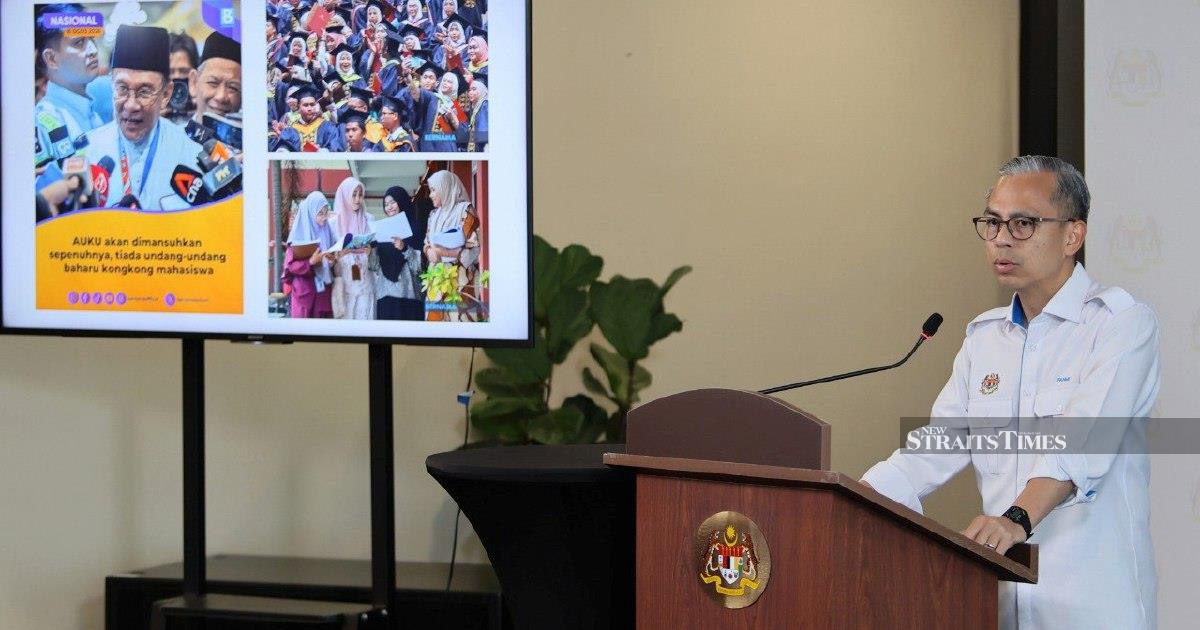
PUTRAJAYA: The cabinet has not deliberated on Prime Minister Datuk Seri Anwar Ibrahim's remarks concerning Taiwan, according to government spokesman Datuk Seri Fahmi Fadzil, a statement that may signal the administration's desire to move past the diplomatic incident without collective ministerial engagement.
The prime minister's comments drew stern criticism from Taipei, underscoring the sensitivities surrounding any official Malaysian references to cross-strait relations. Such statements carry particular weight in the region, where neighbouring nations maintain a careful diplomatic balance with both Beijing and the democratic government in Taiwan.
Fahmi's clarification suggests the government is taking a measured approach to the controversy. By emphasizing that no formal cabinet discussion occurred, the spokesperson appears to be containing the matter within the office of the prime minister rather than escalating it to broader ministerial debate. This tactic often serves to minimize the official profile of contentious statements and reduce their potential to trigger broader diplomatic fallout.
Malaysia's position on cross-strait affairs has long required careful navigation. As a nation with substantial economic ties to mainland China alongside important democratic partnerships in the region, Malaysian governments typically avoid pronouncements that could be construed as taking sides on the Taiwan question. The fact that Anwar's remarks warranted a rebuke from Taipei indicates they likely touched on sensitivities regarding Taiwan's international status or relations with China.
For Malaysian readers, the matter reflects the complex foreign policy landscape that any government must manage. The country faces constant pressure to demonstrate consistency in its international relationships while avoiding statements that antagonize any major stakeholder. Taiwan, despite its limited formal diplomatic relations with Malaysia, maintains significant commercial interests and people-to-people connections that make relations strategically important.
The diplomatic friction highlights a recurring challenge for Malaysian leadership when addressing regional geopolitical questions. Senior officials must balance rhetorical freedom with the practical constraints of maintaining workable relationships with multiple powerful nations and entities. Anwar's remarks, whatever their specific content, evidently crossed a line that prompted Taipei to register its displeasure through official channels.
By declining to take the matter to cabinet level, the government has effectively ring-fenced the situation. This approach avoids creating the impression of a broader policy shift or a cabinet consensus on Taiwan matters. Instead, it frames the remarks as the prime minister's personal statements, which may be revisited or contextualized without requiring a collective cabinet reversal of position.
For Southeast Asian nations more broadly, Malaysia's handling of this episode carries instructive weight. The region's major powers must routinely manage incidents involving Taiwan without allowing such episodes to destabilize their broader diplomatic architecture. Malaysia's strategy of containment through limited official acknowledgement represents a pragmatic, if cautious, approach to crisis management in cross-strait matters.
The incident also underscores how easily diplomatic statements can create unintended consequences in an era where remarks receive instantaneous global distribution and interpretation. Senior officials must remain cognisant that comments on politically loaded topics—particularly Taiwan's status—will be dissected carefully by interested parties across the region and internationally.
Government spokespeople like Fahmi play a crucial role in such situations, tasked with providing clarifications that neither repudiate their leader nor inflame matters further. His statement that the cabinet did not discuss the remarks represents a careful calibration intended to allow the controversy to subside without formal government recalibration of Malaysia's Taiwan policies.
Moving forward, the incident illustrates the enduring importance of strategic communication discipline among Malaysia's top officials when addressing matters touching on China-Taiwan relations. As Malaysia deepens its economic engagement across the region while maintaining crucial partnerships, statements affecting this relationship will continue to warrant careful consideration before public release.

