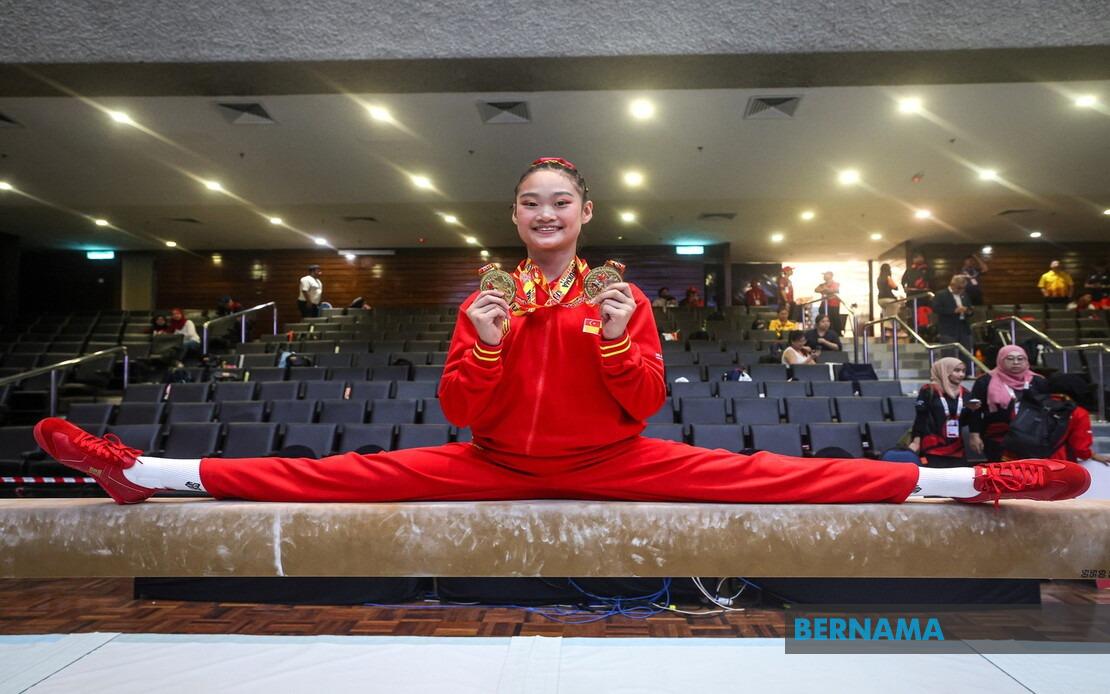
Selangor's rising gymnastics star Cadence Teh Zi Qi delivered a commanding performance at the Malaysia Games 2026 in Bangi today, securing dual gold medals in artistic gymnastics and reasserting her position as the nation's premier all-around competitor. The 17-year-old claimed the women's individual all-around title with a commanding score of 48.550 points before combining with five teammates to capture the team gold for the host state at Dewan Canselor Tun Abdul Razak on the Universiti Kebangsaan Malaysia campus.
Teh's all-around victory demonstrated her technical breadth across the four apparatus disciplines that define elite gymnastics competition. Her scoring reflected a balanced strength portfolio, with vault delivering 12.050 points, uneven bars contributing 11.400, balance beam yielding her strongest apparatus showing at 13.350, and floor exercise finishing at 11.750. This comprehensive scoreline underscores the developmental maturity of a gymnast who must excel across diverse technical and artistic demands rather than specialising in one event alone.
The competition for the all-around crown revealed a significant performance gap between Malaysia's leading gymnasts and the wider field. Sarawak's Aurin Zulkarnain secured the silver medal with 44.500 points, placing her nearly four points behind Teh's total. The bronze medal was shared between Federal Territories' Annabelle Ho Syin Yee and Penang's Amanda Ching Lee Wern, both finishing on 42.250 points. This distribution suggests that while competitive depth exists within Malaysian gymnastics, Teh operates at a distinctly elevated technical level that positions her advantageously for continental and international competition.
Selangor's team achievement reflected the collective strength of its gymnastics programme. Alongside Teh, the championship squad comprised Nicole Wong Ziyi, Airisha Zuraidi, Wong Zi Qi, Leong Yee Shean, and Haifa Izzazi Mohd Faizul. Together they accumulated 169.300 points, establishing a commanding eight-point margin over Federal Territories, whose team posted 166.300 points. Johor rounded out the podium with a bronze-medal total of 157.000 points. The substantial gap between first and third place reflects Selangor's concentration of national talent, a pattern that raises questions about talent distribution and development infrastructure across other Malaysian states.
Despite her victory, Teh offered candid reflection on her performance and the mental challenges inherent in competitive gymnastics. She acknowledged a difficult opening apparatus, falling once during the uneven bars rotation—a disappointment that could have derailed her entire all-around pursuit. Rather than allowing this setback to compound anxiety, she demonstrated the psychological resilience required at elite levels, steadying her approach through the remaining disciplines. She attributed the uneven bars difficulties to nerve-induced disconnection from her body mechanics, a phenomenon experienced by gymnasts across all competitive levels when anxiety elevates.
Teh's recovery across the latter apparatus rotations proved decisive. The balance beam rotation yielded one of her highest individual scores, suggesting she successfully managed her psychological state and executed more complex skill combinations with precision. Her floor exercise performance met her baseline expectations, and she made a strategic choice regarding vault difficulty. Rather than executing a higher-difficulty Yurchenko-family vault, Teh opted for a Tsukahara pike—a decision reflecting either a conservative approach to managing her overall fatigue load or a tactical choice to secure vault points without unnecessary risk in a competition she was winning.
Looking ahead to her technical progression, Teh confirmed that her balance beam routine has been upgraded to match the difficulty standard she plans to present at the 2026 Asian Games in Doha. This forward-planning approach indicates serious preparation for continental competition and suggests Malaysian gymnastics leadership believes she can contend meaningfully at that level. For Malaysian spectators, the Asian Games represent the next significant international benchmark for Teh's development and will provide clearer indication of how her technical level and competitive readiness compare to gymnasts from China, Japan, South Korea, and other high-performing Asian nations.
Teh's own assessment identified two priority areas for continued development beyond the technical skill progression evident in her beam routine. First, she recognised that nervous system management during competition remains an ongoing challenge, with unintended falls and disconnection from proprioceptive awareness representing tangible vulnerabilities. Second, maintaining focus throughout multi-apparatus competitions demands mental discipline that she acknowledges requires further refinement. These observations reflect mature self-awareness, as many younger athletes either lack this perspective or struggle to articulate the psychological dimensions of elite sport performance.
The gymnast faces an immediate return to competition with three apparatus finals scheduled across tomorrow and Sunday. The uneven bars final offers opportunity for redemption following today's fall, while the balance beam and floor exercise finals provide platforms to showcase the technical elements and consistency that formed her all-around foundation. These apparatus-specific competitions often carry different psychological dimensions than all-around events, allowing specialists to focus exclusively on their strongest events rather than managing multiple apparatus rotations within a single competition day.
Teh's double-gold achievement at SUKMA 2026 establishes her as the standard-bearer for Malaysian women's artistic gymnastics at the current moment. Her technical level, competitive maturity, and capacity to perform under pressure position her as a meaningful representative of Malaysian talent on the continental stage. The challenge for Malaysian gymnastics development now becomes elevating the broader competitive cohort—ensuring that states beyond Selangor develop capable performers who can narrow the gap evident in today's competition, while creating systemic support that allows athletes like Teh to translate SUKMA success into meaningful contributions at Asian Games and potentially beyond.

