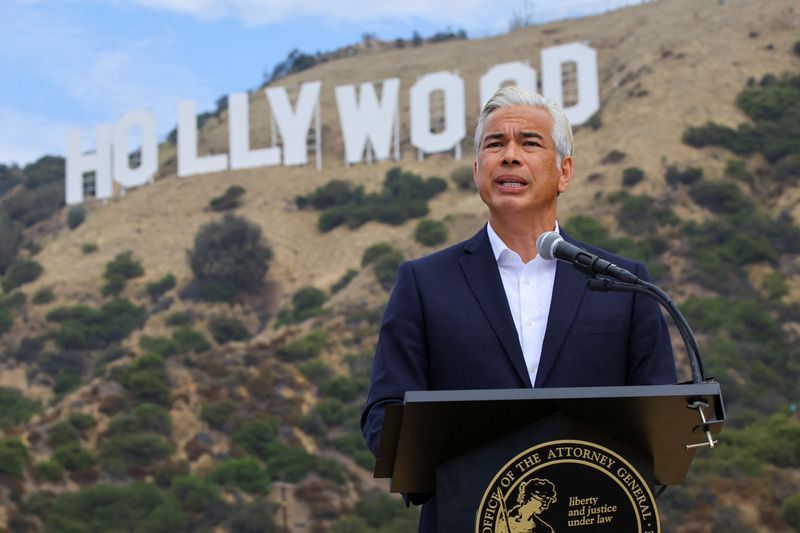
A coalition of 12 states, spearheaded by California, has moved to block one of entertainment's most consequential recent transactions. On July 13, attorneys general from California, Arizona, Colorado, Connecticut, Massachusetts, Minnesota, Nevada, New Jersey, New Mexico, New York, Oregon, and Washington filed suit in Oakland federal court challenging Paramount's $110 billion plan to acquire Warner Bros Discovery. The litigation directly threatens Chief Executive David Ellison's strategy to position Paramount as a formidable challenger to streaming titans Netflix and Disney by consolidating the traditional media landscape.
The lawsuit hinges on a straightforward but sweeping antitrust argument: the merger would concentrate too much content distribution power in a single corporate entity. According to the states' complaint, the combined company would control approximately 27 percent of the theatrical film distribution market, 30 percent of blockbuster film releases, and 27 percent of basic cable channels nationally. With those market positions, the states contend that Paramount-Warner Bros Discovery would be positioned to extract excessive returns from downstream buyers—theaters, cable distributors, and ultimately consumers. The complaint employs stark language to convey the magnitude of consolidation, noting that for every dollar these entertainment sectors generate in America, the merged entity would retain more than 25 cents.
The filing represents a notable departure from federal antitrust enforcement, which approved the transaction last month despite ongoing debate about its competitive implications. California Attorney General Rob Bonta framed the states' action as essential protection for ordinary families and small businesses, while Oregon Attorney General Dan Rayfield emphasized the need to defend local film industries against consolidation pressures. The states argue that harm flowing from reduced competition would cascade through the entertainment ecosystem—limiting theatrical releases, constraining programming diversity on cable television, and ultimately driving up prices for consumers while suppressing wages for entertainment workers including writers, actors, and film crews.
Political divisions surrounding the case illuminate deeper tensions in how American antitrust policy has evolved. All 12 states bringing the lawsuit have Democratic attorneys general, while prominent Republican counterparts declined to join the coalition despite participating in parallel antitrust actions against concert promoter Live Nation and broadcaster Tegna. This partisan split partly reflects divergent views on business consolidation, but also highlights how antitrust enforcement has become entangled with broader political narratives about corporate influence and economic fairness. Some analysts note that Democratic-led states may view aggressive antitrust challenges as a mechanism to counter what they perceive as regulatory leniency from the Trump administration, particularly given that Paramount CEO Ellison's father, Oracle co-founder Larry Ellison, maintains close ties to President Donald Trump.
Paramount's response has been defensive on legal grounds while optimistic on merits. The company contends that the states have mischaracterized competition within entertainment, arguing that the lawsuit distorts established antitrust precedent. Paramount emphasizes that the merged company would be positioned not to reduce content but to expand production. The company has committed to investing in theatrical films, promising approximately 30 annual releases from combined studios. Additionally, Paramount projects that integration would eliminate $6 billion in redundant corporate functions, marketing expenses, and infrastructure costs—savings theoretically available for reinvestment in content creation. However, the states dismiss these commitments as unenforceable promises that would not prevent the merged entity from leveraging its market position to raise prices and compromise quality even while maintaining release schedules.
The lawsuit threatens significant financial consequences for Paramount regardless of ultimate resolution. The company has committed to paying Warner Bros Discovery shareholders approximately $650 million quarterly if the transaction fails to close before October, creating mounting pressure as litigation proceeds. Historical patterns suggest that similar antitrust challenges before federal courts require an average of eight months for judicial determination, meaning that even a Paramount victory would involve substantial delays, legal costs, and market uncertainty. These financial pressures complicate Paramount's strategic position, as extended delays could necessitate renegotiating financing arrangements, destabilize the company's stock valuation, or render the entire transaction economically unfeasible despite legal approval.
The entertainment industry's labor components have emerged as an important dimension of the dispute. Writers, actors, and technical crews employed across both companies have expressed concerns that consolidation would reduce competitive demand for their services, potentially suppressing employment opportunities and wages. While Paramount argues that integration would expand production, opponents counter that eliminating competitive tension between the two studios would give the merged entity less incentive to bid aggressively for talent or greenlight diverse projects. This dimension resonates across labor-friendly constituencies that have historically supported Democratic-led enforcement priorities, adding grassroots dimension to what might otherwise appear as abstract antitrust technicality.
Theater operators and cable distribution companies have similarly opposed the transaction, though from distinct competitive vantage points. Multiplex chains worry that a consolidated Paramount-Warner Bros Discovery could reduce the number of theatrical releases available for exhibition, strengthening the studio's negotiating leverage over screen allocation and rental terms. Cable pay-TV distributors fear similar dynamics regarding carriage of major networks including CNN, MTV, HGTV, Cartoon Network, and Nickelodeon. Without competitive alternatives, these distributors would lack leverage to resist rate increases or demand programming diversity. The states argue that these concerns justify antitrust intervention, since consumers ultimately bear the cost of reduced competition through higher subscription fees and limited viewing options.
The litigation also reflects mounting skepticism toward entertainment consolidation among state-level policymakers. While federal regulators focused narrowly on narrow competitive metrics, state attorneys general have adopted broader frameworks encompassing employment, consumer welfare, and cultural consequences of market concentration. This divergence between federal and state enforcement philosophies creates uncertainty about whether approval from the Department of Justice sufficiently insulates the transaction. Historically, state challenges have occasionally succeeded in blocking or substantially modifying transactions that federal authorities cleared, though outcomes depend substantially on which judges oversee litigation and how aggressively they interpret antitrust statutes.
Market reactions have been modest but positive for the transaction's prospects. Paramount shares gained 2.9 percent following the lawsuit announcement, while Warner Bros Discovery rose 2.6 percent—patterns suggesting investors view litigation as a manageable obstacle rather than fatal threat. Industry analysts offer more cautious assessments, with some describing the state challenge as the merger's most credible legal threat to date. Paolo Pescatore, analyst at PP Foresight, characterized the lawsuit as a major setback for Paramount, noting that even a successful legal defense would impose substantial costs through delays, management distraction, and market uncertainty. The extended timeline also creates risk that financing arrangements, executive commitments, or strategic rationales could shift sufficiently to make the transaction unviable even absent judicial prohibition.
For Malaysian and Southeast Asian observers, the litigation carries implications extending beyond American borders. Media consolidation trends that advance in the United States often subsequently influence corporate strategy across Asia-Pacific markets, where American entertainment conglomerates maintain substantial content production, distribution, and licensing interests. A precedent establishing that state attorneys general can successfully challenge entertainment mergers despite federal approval might embolden competition authorities across Southeast Asia to scrutinize similar transactions affecting regional markets. Additionally, the politicization of antitrust enforcement evident in American state-level litigation mirrors emerging patterns in other democracies, including Malaysia, where competition policy increasingly intersects with broader political narratives about corporate accountability and protection of local industries.

