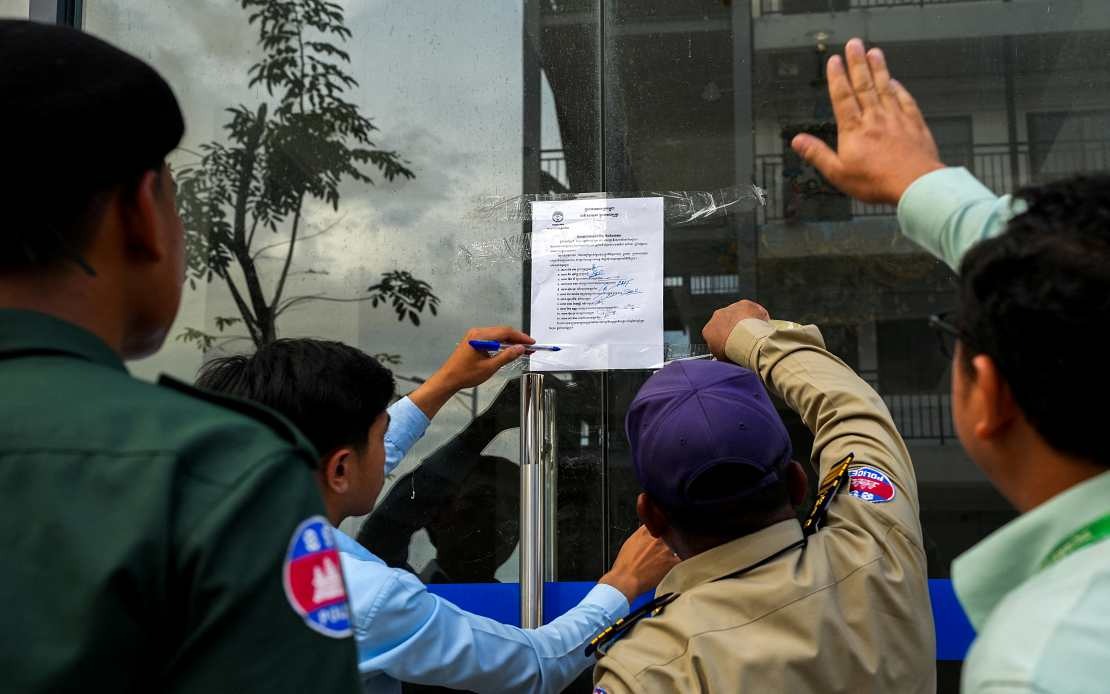
Cambodia has expelled over 16,000 foreign nationals suspected of orchestrating online scams during the opening six months of 2026, marking a substantial escalation in the kingdom's battle against organised cybercrime. Police Lieutenant General Sok Veasna, who heads the General Department of Immigration, disclosed the figures at a mid-year policy review on Tuesday, revealing that these deportations formed part of a broader wave that saw 45,000 foreigners removed from the country. The enforcement surge reflects mounting pressure on Southeast Asia's digital infrastructure and growing international concern about transnational crime networks exploiting the region's relative regulatory gaps.
The crackdown represents a dramatic shift in Cambodia's approach to cybercrime, which has become increasingly visible to neighbouring countries and trading partners. Lieutenant General Sok Veasna confirmed that all individuals deported in connection with online fraud operations face permanent entry bans, a move designed to prevent recidivism and signal zero tolerance. This blanket prohibition underscores the seriousness with which Phnom Penh now treats the issue, though observers note that such measures must be coupled with sustained investigative capacity to prove genuinely transformative.
The timing of Cambodia's intensified campaign coincides with the April promulgation of the Law on Combating Online Scams, legislation that establishes severe penalties targeting the architects and masterminds behind illicit operations. The new legal framework distinguishes between foot soldiers in these networks and the senior figures who orchestrate schemes, reflecting international best practice in tackling organised cyber-fraud. This legislative development signals a commitment to moving beyond surface-level enforcement toward dismantling the hierarchical structures through which scammers operate across borders.
However, experts caution that deportations alone cannot resolve the deeper vulnerabilities that make Cambodia attractive to international scam operations. Thong Mengdavid, deputy director at the China-ASEAN Studies Centre of the Cambodia University of Technology and Science, acknowledges the positive symbolism of mass expulsions in rehabilitation efforts, yet emphasises that such tactics address symptoms rather than root causes. The underlying architecture enabling these networks—corrupt officials protecting operations, local complicity in money laundering, and gaps in inter-agency coordination—must be confronted directly for progress to prove sustainable.
The presence of foreign cyber-scam suspects in Cambodia has inflicted reputational damage extending far beyond the kingdom itself, affecting regional perceptions of Southeast Asian governance and security standards. Malaysian and other regional investors have expressed concern about the stability of digital commerce and the rule of law when such networks operate with apparent impunity. Cambodia's deportation drive aims partly to restore confidence among international partners that the nation takes financial crimes and regulatory oversight seriously.
These criminal networks typically operate through layers of intermediaries, with foreign operatives managing specific functions while local facilitators provide logistics, recruitment, and protection. The relationship between cyber-scammers and human trafficking networks—often overlapping in Cambodia's criminal ecosystem—compounds the challenge. Many individuals drawn into these operations arrive through coercive recruitment or debt-bondage arrangements, complicating the prosecution narrative and suggesting that comprehensive responses must incorporate labour trafficking interventions.
The scale of deportations in the first half of 2026 reflects not merely enforcement intensity but also the sheer volume of suspects Cambodia's immigration authorities have been able to identify and process. This administrative capacity, while impressive, raises questions about intelligence quality and whether expulsion lists target the most significant offenders or simply those easiest to locate and apprehend. The sustainability of operations depends on whether Cambodia maintains this pace while simultaneously investigating the local networks that enable external criminal groups to function.
Regional observers note that cyber-scam operations frequently migrate to alternative jurisdictions once enforcement pressure intensifies, shifting the burden to neighbouring countries without equivalent countermeasures. Thailand, Laos, and Myanmar have experienced similar influxes of scammers displaced from elsewhere in Southeast Asia. Cambodia's crackdown must therefore be coordinated with ASEAN partners to prevent displacement rather than elimination of these networks, requiring intelligence sharing and harmonised legal frameworks that remain under development.
The permanent exclusion of deportees signals Cambodia's determination to prevent established criminal operatives from rebuilding operations through re-entry. This policy option requires robust border management and biometric tracking systems capable of identifying attempted re-entry by previously deported individuals. Success hinges on whether Cambodia's immigration infrastructure can sustain such vigilance without creating excessive friction for legitimate travel and commerce.
Beyond enforcement, Cambodia's long-term challenge involves addressing the economic vulnerabilities and lack of opportunity that make certain populations susceptible to recruitment into cyber-scam enterprises. Foreign operatives depend on local accomplices willing to provide banking services, logistics, and cover—recruitment that targets desperate or ethically flexible individuals. Without complementary development interventions and legitimate employment pathways, enforcement alone risks becoming an endless cycle.
The Law on Combating Online Scams represents an important institutional response, yet its effectiveness depends on consistent application, adequate prosecutorial capacity, and judicial independence. Cambodia's track record on complex financial crimes prosecution has been mixed, and observers question whether the courts possess resources and expertise to convict high-level organisers rather than merely processing lower-tier operatives. International technical assistance and capacity building will likely prove essential to translate new legislation into sustained convictions.
For Malaysian stakeholders and regional partners, Cambodia's campaign carries dual implications. The removal of foreign scammers from Cambodian territory may reduce transnational fraud pressure on Malaysian citizens and businesses, particularly those targeted by operations previously based in Phnom Penh. Conversely, if the campaign pushes criminal operations across regional borders without dismantling underlying networks, pressure may shift to other vulnerable jurisdictions. Coordinated regional responses, intelligence partnerships, and harmonised prosecution strategies will ultimately determine whether Cambodia's deportation surge produces meaningful disruption or merely temporary displacement of criminal activity.
Moving forward, Cambodia's success will be measured not by deportation numbers alone but by demonstrable reduction in operational capacity among organised cyber-scam networks and restored international confidence in the kingdom's commitment to the rule of law and financial integrity.

