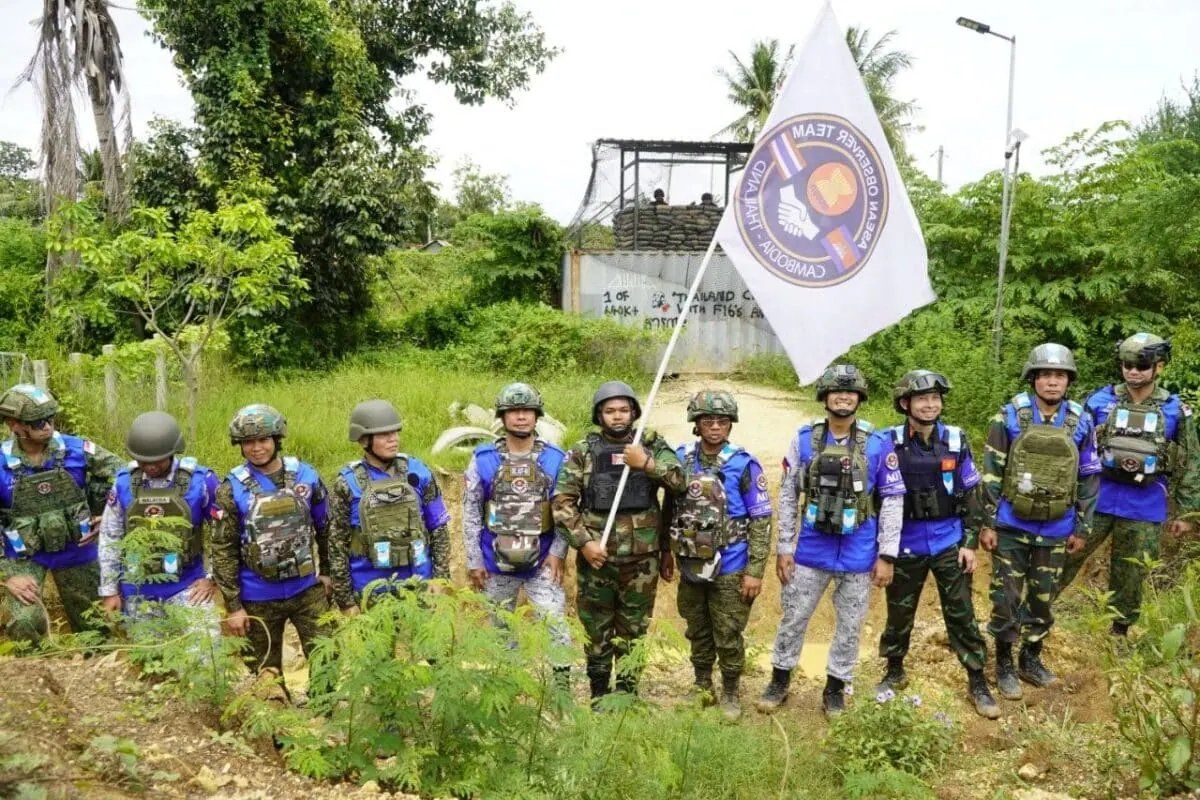
Cambodia has escalated its pushback against Thai denials of territorial encroachment by shifting the dispute from a bilateral argument to one observed and verified by independent third parties. Information Minister Neth Pheaktra's response on Monday to Thailand's Joint Information Center director Air Chief Marshal Prapas Sornchaidee represents a strategic pivot away from competing narratives toward an appeal to neutral documentation of physical changes along their shared frontier.
Thailand's position, articulated through its military command, maintains that no policy of invasion or occupation exists and that Bangkok's activities—including road construction and military infrastructure—serve only to protect troops and civilians while safeguarding what it considers Thai sovereign territory. Prapas acknowledged the principle that international boundaries cannot be determined through military presence alone, conceding that maps, evidence and the Joint Boundary Commission constitute the proper mechanism for settlement. This rhetorical alignment with Cambodia's legal position masks a deeper disagreement over which country controls disputed areas and whether physical occupation can be justified by security rationales.
Pheaktra's strategy hinges on the unprecedented presence of Asean observers and international monitors now documenting conditions that Cambodia maintains constitute Thai intrusion. The Asean Observer Team in Cambodia, headed by a Philippine official, recently inspected three affected zones in Banteay Meanchey province, recording shipping containers, razor wire barriers and military structures across multiple locations. At Boeung Trakuon in Kouk Romiet commune, alone, observers documented 44 containers at 14 separate sites, where Cambodia reports 7,873 residents from 1,869 households remain displaced. Two additional locations—Chouk Chey and Prey Chan villages—contained a further 72 containers distributed across 10 positions, bringing the combined total to 116 containers at 24 sites housing approximately 13,259 displaced Cambodians, including over 3,400 children.
The significance of this shift lies not in the physical evidence itself, but rather in Cambodia's ability to reference independent corroboration. When only Cambodian authorities documented encroachment, Thailand could dismiss allegations as propaganda. With Asean monitors, foreign diplomats and UN investigators now confirming the existence of containers, fortifications and displaced persons, Cambodia transitions from making unilateral claims to pointing toward internationally verified observations. Pheaktra emphasized this transformation: "The eyes of third parties" now witness conditions previously reported only by Phnom Penh, fundamentally altering the evidentiary landscape of the dispute.
UN Special Rapporteur on human rights in Cambodia Tom Andrews' July mission provided additional weight to Cambodia's position. Following his visits to displaced communities and border areas, Andrews documented that approximately 650,000 Cambodians were displaced during the conflict, with more than 20,000 remaining unable to return to their homes. Significantly, Andrews noted that returnees cited Thai security force occupation as the barrier preventing their homecoming. While Andrews' mandate concerns human rights rather than sovereignty determination, his observations add a humanitarian dimension to Cambodia's territorial claims and create an international record of displacement causation.
Cambodia's framing presents third-party observation as essential counterweight to Thai security claims. By arguing that shipping containers cannot serve as border markers, barbed wire cannot substitute for treaties, and trenches cannot replace boundary maps, Pheaktra articulates a principle that physical infrastructure, however extensive, cannot legitimize territorial acquisition. This formulation appears designed to preempt any suggestion that Thai military control on the ground should be treated as de facto sovereignty, a concern particularly acute given the historical pattern of border disputes where the controlling power claims legitimacy through occupation.
Thailand's response indicates no willingness to halt security measures or alter the physical situation unilaterally. Prapas stated that Bangkok would continue protecting what it considers its territory regardless of Cambodian demands, effectively signalling that the dispute cannot be resolved through either country's unilateral declarations. This hardened stance reflects the nationalist sensitivities surrounding border sovereignty in Thailand, where perceived territorial concessions invite domestic political backlash. For Bangkok, backing down from military deployments would imply acknowledgment of Cambodian claims, a position politically untenable for any Thai government.
The legal framework governing this dispute remains contested but theoretically clear. Both nations reference the Franco-Siamese treaties, historical maps, the 2000 Cambodia-Thailand border Memorandum of Understanding, the 2003 Terms of Reference, and the Joint Boundary Commission process as the proper mechanisms for boundary determination. Yet this agreement on procedure masks profound disagreement over substantive application. Thailand apparently believes its interpretation of historical documentation and maps supports its current military positions. Cambodia contests this reading and views Thai occupation as an attempt to establish facts on the ground that will influence future boundary demarcation.
Pheaktra connected the territorial dispute to humanitarian obligations under the 27 December ceasefire agreement, specifically Point 4, which mandates that affected civilians return safely to their homes without obstruction. By framing the container barriers and fortifications as obstacles to civilian return, Cambodia transforms the territorial dispute from an abstract legal question into a humanitarian crisis requiring immediate resolution. This linkage appeals to international pressure on human rights grounds while maintaining Cambodia's sovereignty argument. The logic operates as follows: if Thailand truly controls this territory legitimately, why cannot Cambodian civilians return? Thai occupation therefore implies unjust displacement rather than legitimate sovereignty.
The Malaysian and broader Southeast Asian interest in this dispute extends beyond bilateral relations to question whether military occupation and infrastructure constitute effective territorial claims within the Asean framework. If Thailand's security measures succeed in preventing Cambodian return and establishment of authority, a precedent emerges that force, rather than negotiation and legal process, determines borders. Conversely, if Cambodia succeeds in mobilizing third-party observation to prevent fait accompli settlement, it establishes that international oversight constrains unilateral territorial assertion. The involvement of Asean monitors, UN officials and diplomatic observers thus carries implications transcending the Cambodia-Thailand frontier.
For resolution, Cambodia appears to be betting that sustained third-party documentation and international attention will eventually pressure Thailand toward serious boundary demarcation negotiations. The strategy assumes that Thailand fears reputational damage and Asean criticism more than it values maintenance of current military positions. However, this assumption remains untested; Thailand may calculate that international observation, while troublesome, does not impose sufficient cost to warrant territorial concessions. The dispute thus appears locked at an impasse where Cambodia leverages external verification while Thailand relies on ground control, neither side possessing leverage sufficient to force the other toward compromise on boundary determination.

