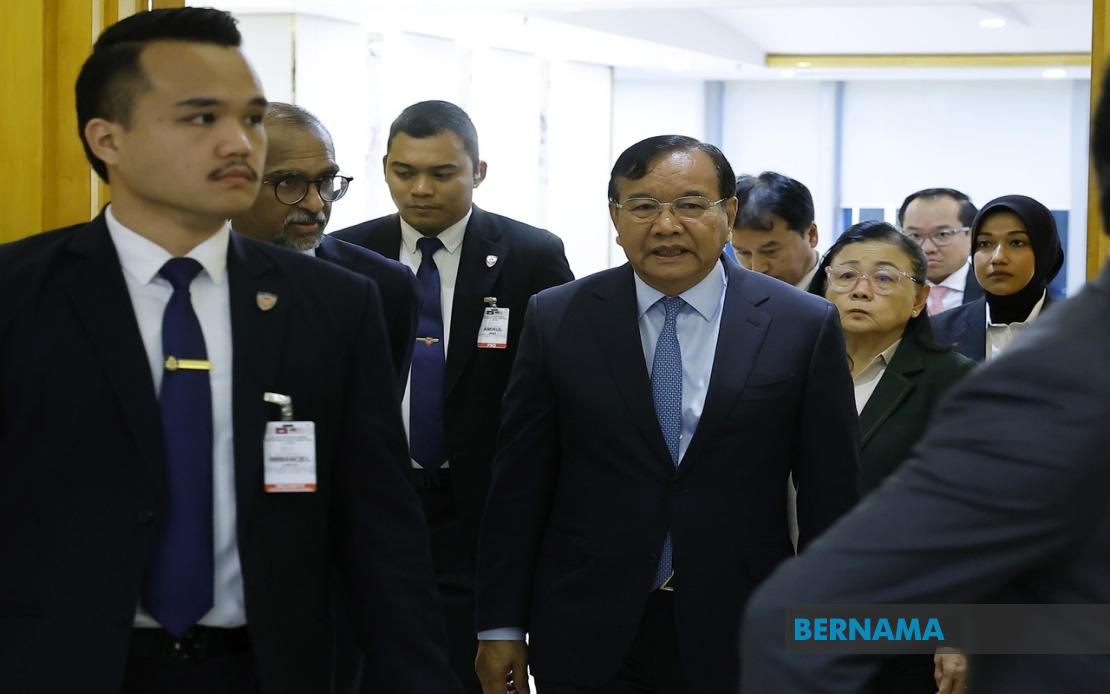
Cambodian Deputy Prime Minister and Foreign Minister Prak Sokhonn returned home on Sunday afternoon following a two-day diplomatic mission to Malaysia that underscored the deepening ties between the neighbouring Southeast Asian nations. Sokhonn and his entourage boarded a commercial flight from Kuala Lumpur International Airport Terminal 1 at 4.45 pm, with Datuk Rozainor Ramli, Malaysia's chief ceremony officer, extending official farewell courtesies on behalf of the Malaysian Government.
The visit, which commenced on Monday, carried symbolic weight as both countries look ahead to a significant milestone: the 70th anniversary of formal diplomatic relations between Malaysia and Cambodia in 2027. The timing of Sokhonn's journey reflected deliberate planning by both governments to lay groundwork for what promises to be a major celebration of their shared history and partnership. This forward-looking approach suggests that bilateral engagement will intensify over the coming years, with 2027 serving as both a commemorative marker and a catalyst for deeper cooperation.
During his stay, Sokhonn met with Malaysian Prime Minister Datuk Seri Anwar Ibrahim at the Prime Minister's Office, where the two leaders reaffirmed their commitment to the enduring relationship between their nations. The discussions went beyond ceremonial pleasantries, focusing on concrete areas for expanded collaboration. Both sides identified digital economy development, artificial intelligence applications, the halal industry, food security mechanisms, and human capital development as priority domains for enhanced strategic engagement. These sectors reflect contemporary challenges and opportunities facing Southeast Asia, positioning Malaysia-Cambodia cooperation at the forefront of regional economic transformation.
A landmark achievement of the visit was the co-chaired 3rd Malaysia-Cambodia Joint Commission for Bilateral Cooperation meeting held in Kuala Lumpur, jointly led by Sokhonn and Malaysian Foreign Minister Datuk Seri Mohamad Hasan. The significance of this gathering cannot be overstated: it marked the formal resumption of this bilateral mechanism after a 20-year gap, indicating a decisive shift in diplomatic engagement between the two countries. The revival of this institutional framework suggests that both governments are committed to institutionalising their cooperation and creating sustained channels for dialogue at multiple levels beyond ad-hoc meetings.
Economic indicators underscore the vitality of the Malaysia-Cambodia relationship and its growth trajectory. During 2025, bilateral trade between the two nations expanded dramatically, rising 27.4 per cent year-on-year to reach RM5 billion, equivalent to approximately USD1.17 billion. This expansion demonstrates strong market demand and deepening commercial integration. Malaysia's export performance has been particularly robust, with exports to Cambodia totalling RM4.13 billion or USD970 million, while imports from Cambodia reached RM880 million or USD200 million. The trade surplus reflects Malaysia's competitive advantage in certain product categories and sectors, yet the healthy import flows indicate that Cambodian producers are also finding receptive markets in Malaysia.
Beyond trade metrics, Malaysia maintains substantial direct investment presence in Cambodia, underscoring confidence in the kingdom's economic prospects and stability. As of 2024, Malaysian cumulative investments in Cambodia totalled USD3.20 billion, equivalent to RM13.07 billion, distributed across 162 registered projects. This investment portfolio positions Malaysia as Cambodia's third-largest foreign investor, a distinction that carries considerable economic and strategic implications. Malaysian investors have demonstrated sustained commitment to the Cambodian market, suggesting that bilateral economic relationships have moved beyond transactional exchanges to encompass longer-term productive capacity development and partnership.
For Malaysian readers and policymakers, this visit carries several implications. First, it signals Malaysia's active engagement in deepening regional ties beyond established frameworks, contributing to broader ASEAN cohesion and economic integration. Second, the emphasis on emerging sectors such as digital economy and artificial intelligence suggests that both governments are positioning their bilateral relationship to capitalise on future growth opportunities rather than relying solely on traditional trade patterns. Third, Malaysia's investment position in Cambodia and growing bilateral trade present substantial opportunities for Malaysian businesses seeking expansion within the wider Indochinese region.
The successful conclusion of Sokhonn's visit and the revival of the joint commission mechanism reflect a shared interest in sustaining momentum in bilateral relations. The identification of strategic sectors for enhanced cooperation provides a concrete roadmap for officials tasked with implementing agreements and facilitating practical collaboration. As both nations prepare for the 70th anniversary of diplomatic relations in 2027, the foundation laid during this visit will likely support scaled-up engagement across government, business, and civil society levels.
From a broader Southeast Asian perspective, the Malaysia-Cambodia rapprochement contributes to regional stability and multilateral cohesion. Both nations are engaged in ASEAN frameworks and participate in various regional economic and political initiatives. Strengthened bilateral ties support the collective interests of the bloc and demonstrate that despite periodic tensions or divergences in regional politics, sustained dialogue and institutional mechanisms can overcome obstacles and generate mutual benefits. The resumption of the joint commission after two decades illustrates this principle in action.

