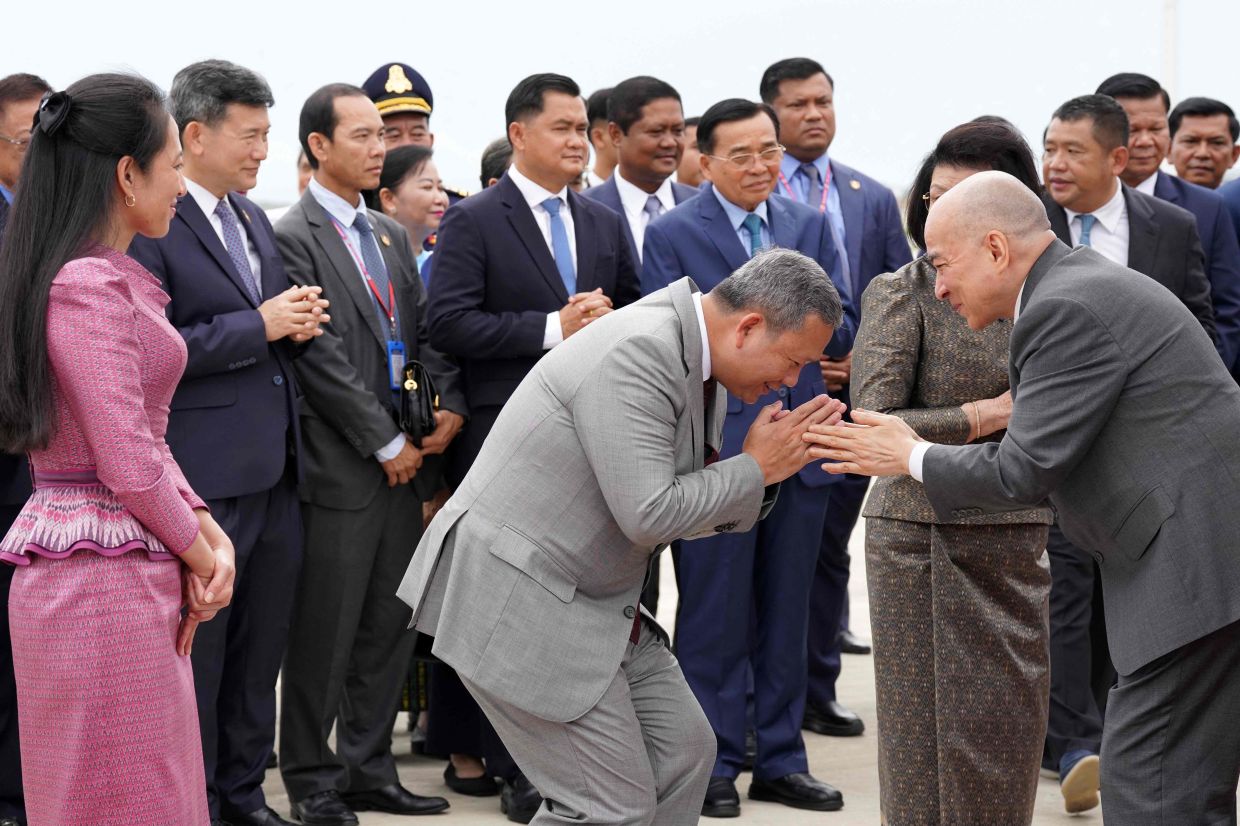
Cambodia's King Norodom Sihamoni arrived back in Phnom Penh on Friday afternoon after spending over three months in China undergoing treatment for prostate cancer, marking an important moment for the Southeast Asian kingdom's political leadership. The 73-year-old monarch, who departed for Beijing earlier in the year for health assessments before disclosing his cancer diagnosis in April, received care from Chinese medical specialists and underwent what the Royal Palace described as successful surgical intervention. His return to the capital was marked by an official reception involving prominent Cambodian dignitaries, underscoring the significance of his homecoming for the nation's governance and institutional continuity.
The palace had issued a statement on Tuesday preceding his arrival, indicating that the sovereign's medical condition had shown considerable improvement following the extended course of treatment administered in the Chinese capital. This disclosure came after a lengthy recovery period, demonstrating the comprehensive nature of the healthcare intervention he received. The timing of his return and the palace's emphasis on his improved health status reflect the importance placed on reassuring both the Cambodian public and international observers about the stability of the monarchy during a period when the head of state required medical attention abroad.
Among those greeting the king at Phnom Penh International Airport were influential figures in Cambodia's contemporary political landscape, including Hun Sen, the former longtime prime minister who shaped much of the nation's recent history, and Hun Manet, his son who currently holds the position of prime minister. Hun Sen subsequently posted on his Facebook account confirming the monarch's safe arrival and shared footage of the airport reception, a gesture that amplified public awareness of the significant moment. This presence of senior officials and the transparent communication through social media platforms reflects the coordinated approach undertaken by Cambodia's leadership to manage the narrative surrounding the king's health situation and demonstrate governmental stability.
The decision to seek medical treatment in China rather than elsewhere highlights Cambodia's deepening relationship with Beijing, a trend increasingly visible across Southeast Asian capitals as healthcare expertise and accessibility from major regional powers become competitive advantages. For Cambodia specifically, the choice of Chinese medical facilities aligns with the broader pattern of political and economic alignment that has characterised Phnom Penh's foreign policy orientation in recent years. This healthcare dimension adds another layer to Cambodia-China relations, extending beyond traditional diplomatic and economic cooperation into the sphere of state health management.
King Sihamoni's medical journey also echoes a significant historical parallel within his own family. His predecessor and father, King Norodom Sihanouk, similarly traveled to Beijing for cancer treatment before subsequently abdicating in 2004, a decision that directly resulted in Sihamoni's assumption of the throne at that time. The late King Sihanouk, who died in 2012 at an advanced age, had established a precedent for seeking medical care in the Chinese capital. This historical context adds nuance to the current situation, as it demonstrates that cross-border medical treatment for Cambodia's royal family is not unprecedented, yet simultaneously underscores the importance of the king's recovery given the institutional implications of any prolonged health challenges.
Sihamoni's accession to the throne in 2004 represented a notable transition for Cambodia, as he brought a distinctly different background compared to his predecessors. Before becoming sovereign, he spent the majority of his adult life pursuing an artistic career while resident outside Cambodia, demonstrating considerable intellectual and cultural cosmopolitanism. His linguistic capabilities in Khmer, French, Czech and English reflect his international upbringing and education, skills that have shaped his approach to the monarchy since his enthronement. This background has influenced how he has engaged with modernisation efforts within the royal institution while maintaining the symbolic and ceremonial functions central to Cambodia's constitutional framework.
The king's extended absence from Cambodia during his medical treatment necessarily raised questions about the continuity of state functions and ceremonial responsibilities typically associated with the monarchy. While Cambodia's government continued its administrative operations under Prime Minister Hun Manet's leadership, the repatriation of the sovereign to Phnom Penh restores the full complement of constitutional and ceremonial authority to the nation's political system. For Southeast Asian observers, the situation underscored both the importance of stable succession planning and the operational resilience of governmental institutions during periods when heads of state require extended healthcare interventions.
The palace's repeated communications about the king's improving health throughout his treatment period appear designed to preempt speculation and maintain public confidence in the institution. By providing regular updates and confirming the success of medical interventions, the Royal Palace engaged in proactive health diplomacy that reassured stakeholders about the continuity of the monarchy. This approach contrasts with other contexts where royal health matters might remain shrouded in opacity, suggesting a more transparent framework for managing institutional confidence during medical crises affecting high-level state figures.
For Malaysia and other Southeast Asian nations, Cambodia's experience with cross-border medical treatment for senior state figures reflects broader regional patterns regarding access to healthcare expertise. The incident illustrates how geopolitical relationships increasingly intersect with health security and medical accessibility, particularly for ageing leaders across the region. As populations age and chronic diseases become more prevalent among political elites, the management of high-level health matters will likely remain an important dimension of regional diplomatic relations and institutional stability.
The successful conclusion of King Sihamoni's medical treatment and his return to Cambodia represent positive developments for the kingdom's institutional continuity and governance framework. His restoration to his full duties as reigning monarch provides reassurance about the stability of Cambodia's political system during a period of broader regional geopolitical and economic transitions. Going forward, the incident may prompt reflection among regional governments about succession planning, health security infrastructure for senior officials, and the diplomatic dimensions of medical treatment for heads of state in an increasingly interconnected Southeast Asia.

