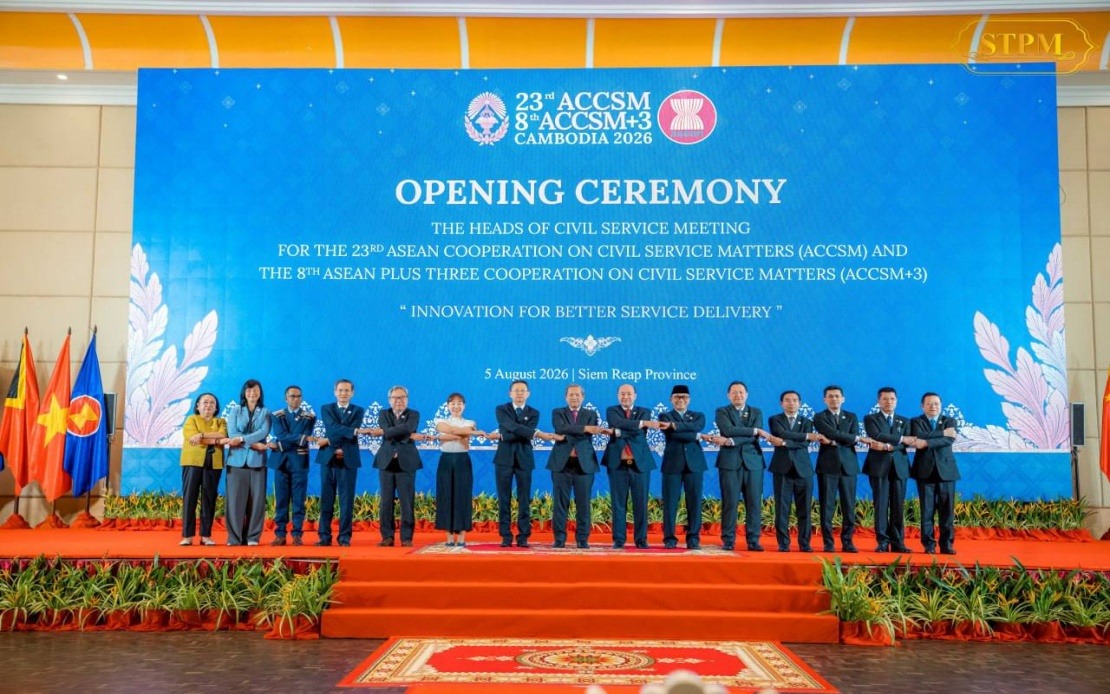
Cambodian Prime Minister Hun Manet has called on ASEAN nations to embed artificial intelligence and digital innovation into their public service frameworks, but with a crucial caveat: technological advancement must serve citizens' genuine needs rather than becoming an end in itself. Speaking at the 23rd ASEAN Cooperation on Civil Service Matters (ACCSM) and the 8th ASEAN Plus Three Cooperation on Civil Service Matters (ACCSM+3) held in Siem Reap from August 3 to 5, Hun Manet articulated a vision for transforming the region's governance structures through technology while maintaining focus on human welfare and equitable development.
The conference, structured around the theme "Innovation for Better Service Delivery", provided a platform for Hun Manet to emphasise that ASEAN's digital transformation agenda must extend beyond the mere acquisition and implementation of cutting-edge technologies. Instead, he stressed that innovation frameworks should be grounded in realistic assessments of what institutions and their human resources can sustain. This perspective reflects growing recognition within Southeast Asian policymaking circles that technology adoption without corresponding capacity-building creates dependencies and risks leaving populations further marginalised.
Hun Manet's intervention addresses a critical tension within the region. While ASEAN governments are increasingly investing in AI and digital modernisation to streamline administration, reduce corruption, and improve service accessibility, the pace and manner of implementation vary dramatically across member states. Cambodia, Laos, Myanmar and other less industrialised economies face different technological capacities and infrastructure constraints compared to Singapore, Thailand, and Vietnam. The Cambodian leader's emphasis on sustainable, pace-appropriate adoption reflects pragmatism about these structural realities.
The Prime Minister articulated a commitment to narrowing development gaps that have long characterised ASEAN's internal dynamics. He underscored that technology transfer and digital integration must occur at speeds that each country can genuinely absorb and build upon, rather than adopting international best practices wholesale without domestic adaptation. This stance carries particular weight for middle-income and lower-income ASEAN members, where rushed digitalisation without adequate institutional preparation often creates parallel systems—modern technological infrastructure alongside dysfunctional governance processes—rather than genuine transformation.
Beyond efficiency metrics, Hun Manet situated innovation within ASEAN's broader resilience agenda. The region confronts overlapping crises: intensifying climate-related disasters, persistent economic imbalances that create disparities in development outcomes, and poverty concentrations that affect hundreds of millions. These multifaceted challenges, he argued, cannot be solved by individual nations working in isolation. Instead, ASEAN requires coordinated, collaborative responses grounded in shared learning and mutual institutional strengthening. Digital innovation and improved public services become tools for collective problem-solving rather than competitive national advantages.
The emphasis on institutional capacity and human resource development reflects lessons learned across Southeast Asia's public sector modernisation efforts. Countries that invested primarily in infrastructure and technology without simultaneously developing civil service skills, establishing clear accountability mechanisms, or redesigning workflows often experienced disappointing returns on their investments. Conversely, nations that combined technological upgrades with comprehensive training programmes, incentive structures, and process reengineering achieved more substantial improvements in citizen satisfaction and administrative efficiency.
Hun Manet's call for ACCSM to function as a vital platform for mutual learning and policy harmonisation directly addresses fragmentation that has historically impeded regional progress. Currently, ASEAN member states frequently pursue parallel digitalisation strategies with limited cross-border coordination. This fragmentation increases costs through duplicated efforts, creates incompatibilities between systems, and prevents smaller countries from accessing economies of scale in technology procurement and implementation. Establishing common standards and shared capacity-building initiatives could substantially reduce expenditures while improving outcomes.
For Malaysia, Hun Manet's framing carries particular relevance. As one of ASEAN's more technologically advanced economies with sophisticated digital infrastructure in urban centres, Malaysia faces distinct challenges in ensuring that AI-driven public service improvements benefit peripheral regions and lower-income populations equitably. The Cambodian perspective on sustainable, inclusive innovation provides a useful counterweight to potentially top-down, technology-first approaches. Malaysian policymakers might consider whether their own digitalisation strategies adequately account for digital literacy gaps, internet access disparities, and the particular vulnerabilities of older citizens and rural communities to rapid service transformation.
The ACCSM+3 framework, which includes dialogue partnerships with China, Japan, and South Korea, enables ASEAN to draw on external expertise while maintaining regional ownership of digitalisation agendas. These larger economies have accumulated substantial experience with AI implementation in governance, citizen services, and regulatory frameworks. However, as Hun Manet's remarks suggest, direct replication of their models risks creating unsuitable systems for ASEAN's diverse contexts. The challenge lies in extracting generalizable principles while respecting local institutional realities and developmental trajectories.
AI's integration into public administration across ASEAN will likely accelerate regardless of cautionary voices, driven by fiscal pressures to improve efficiency and citizen expectations shaped by private-sector digital services. The real policy question is whether governments will manage this transition thoughtfully or reactively. Hun Manet's appeal for an intentional, inclusive approach—prioritising institutional strengthening, human resource development, knowledge sharing, and equitable geographic distribution of benefits—outlines a path more likely to generate durable improvements in governance outcomes and public satisfaction across the region.
The timing of this intervention matters. As ASEAN nations allocate resources for post-pandemic recovery and longer-term development, decisions about public sector digitalisation will shape governance trajectories for decades. Establishing principles around inclusive innovation, sustainable capacity development, and regional collaboration now could prevent costly false starts and ensure that technological advancement becomes a genuine tool for serving citizen needs rather than a performative gesture toward modernity.

