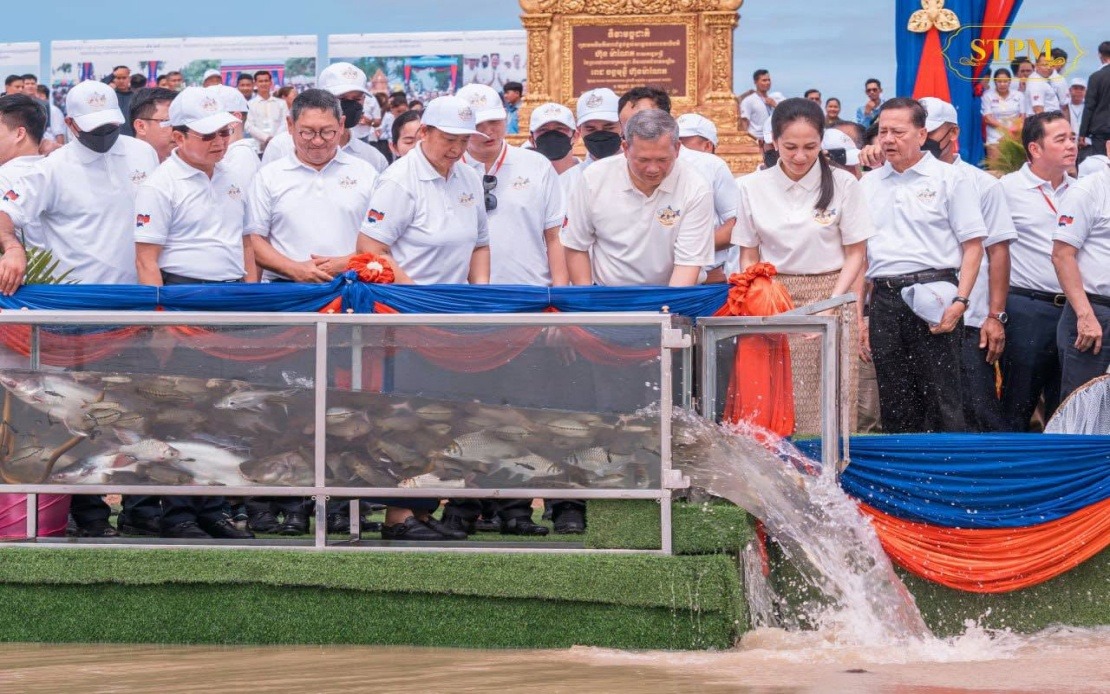
Cambodian Prime Minister Hun Manet has directed law enforcement to intensify operations against illegal fishing in designated spawning grounds, signalling a renewed commitment to protecting the nation's aquatic resources. The directive emerged during ceremonies marking National Fish Day in Svay Rieng Province, where Hun Manet outlined the strategic importance of marine conservation to Cambodia's economic and food security framework. The order underscores growing concern across Southeast Asia regarding the depletion of fish stocks and ecosystem degradation caused by unsustainable harvesting practices.
Hun Manet emphasized that Cambodia's fishing sector underpins the survival of thousands of communities throughout the country, making resource protection a matter of national priority rather than environmental luxury. He framed aquatic ecosystems as fundamental infrastructure for rural livelihoods, particularly in provinces where alternative income sources remain limited. This framing reflects a broader regional challenge: balancing immediate economic needs against long-term resource sustainability in economies heavily dependent on natural resource extraction.
The Prime Minister revealed that military units positioned around Tonle Sap, Southeast Asia's largest freshwater lake, have been mobilized to combat what authorities characterize as natural resource crimes. Over the preceding two years, these forces have targeted illegal activities spanning both terrestrial and marine environments. Hun Manet's acknowledgment that Cambodia has relied on military deployment for environmental enforcement reveals deeper institutional gaps within the country's civilian law enforcement apparatus, a structural problem not uncommon across the region.
Critically, Hun Manet stated the government's long-term objective is reducing dependence on military forces for environmental protection, pointing instead toward developing specialized civilian law enforcement capacity. This admission underscores the resource constraints facing Cambodia's regulatory institutions. The absence of adequately trained and equipped environmental officers has forced authorities to repurpose military personnel for conservation work—an approach that diverts military resources from border security and other strategic priorities while remaining temporally unsustainable.
The Prime Minister specifically condemned large-scale clam dredging operations, ordering their immediate cessation. This targeting of specific destructive practices demonstrates tactical prioritization within broader enforcement strategy. Clam dredging degrades seafloor habitats, disrupts breeding cycles, and destroys fishing grounds where artisanal fishermen traditionally operate. The sector has become synonymous with environmental degradation across Southeast Asia, where industrial-scale extraction has displaced small-scale operators and decimated localized fish populations.
Hun Manet articulated a conceptual framework positioning agriculture and fisheries as complementary pillars of national sustenance. He characterized agriculture as providing the nation's foundational nutrition while describing fisheries as the primary protein source. This metaphorical language—describing agriculture as the "nation's stomach" and fisheries as its "source of protein"—conveys the existential importance these sectors hold within Cambodia's food security architecture. For Malaysian observers, this framework parallels regional dependencies on aquatic resources, where fish protein consumption exceeds that of most developed economies.
The enforcement initiative specifically targets illegal fishing during spawning seasons, when reproductive aggregations make fish populations particularly vulnerable to overexploitation. This seasonal focus reflects scientific understanding of fishery biology and demonstrates that Cambodian authorities recognize the temporal dynamics of resource depletion. Protecting breeding grounds during peak reproduction periods theoretically allows remaining populations to replenish, though enforcement effectiveness remains questionable given institutional constraints.
In a symbolic gesture accompanying the policy announcement, authorities released 1.5 million fish and aquatic organisms into the Vai Ko River within Svay Rieng Province. This restocking initiative, while generating positive imagery around conservation commitment, raises questions about long-term impact. Fish restocking programs across Southeast Asia produce mixed results; survival rates frequently disappoint expectations, and the practice sometimes masks failure to address underlying habitat destruction and pollution.
The policy announcement arrives amid broader Southeast Asian concern regarding transnational illegal fishing networks. Cambodia's Tonle Sap and coastal zones have attracted significant attention from enforcement agencies and conservation organizations documenting industrial-scale poaching operations often involving foreign vessels and networks. Hun Manet's mobilization of military forces signals recognition that current civilian capacity cannot adequately respond to these sophisticated criminal enterprises. The problem extends beyond Cambodia's borders; vessels operating under various flags conduct illegal extraction in disputed maritime zones and shared fisheries throughout the region.
For Malaysian stakeholders, Cambodia's enforcement challenges carry indirect implications. Shared fisheries, migratory species, and the interconnected nature of Southeast Asian marine ecosystems mean that resource depletion in one nation affects neighboring countries. Additionally, organized illegal fishing networks frequently operate across multiple jurisdictions, creating enforcement complications requiring regional coordination mechanisms that remain underdeveloped across ASEAN.
Hun Manet's emphasis on food security reflects Cambodia's vulnerability to disruptions in protein supply. Unlike more diversified economies, Cambodia's fishing sector remains essential to feeding its population affordably. Climate change, including altered precipitation patterns affecting Tonle Sap's seasonal cycles, compounds pressure on aquatic ecosystems already stressed by overharvesting. This vulnerability pattern repeats across Southeast Asia, where rapid population growth and limited alternative protein sources create competing pressures on marine and freshwater resources.
The sustainability of Hun Manet's enforcement strategy depends substantially on institutional development. Building civilian environmental law enforcement capacity requires investment in training, equipment, and institutional credibility—commitments extending beyond single policy announcements. Regional examples demonstrate that enforcement success requires not only political will but sustained financial commitment and technical expertise that many Southeast Asian governments struggle to maintain.
Moving forward, Cambodia's marine resource protection depends on complementary policies addressing habitat degradation, pollution, and ecosystem restoration alongside enforcement against illegal activities. Without simultaneous improvements to aquatic habitat quality and pollution management, enforcement against fishing alone provides incomplete solutions. Regional cooperation, technology transfer, and capacity building from developed economies and international organizations could accelerate Cambodia's institutional development, benefiting not only its citizens but the broader Southeast Asian ecosystem that transcends political boundaries.

