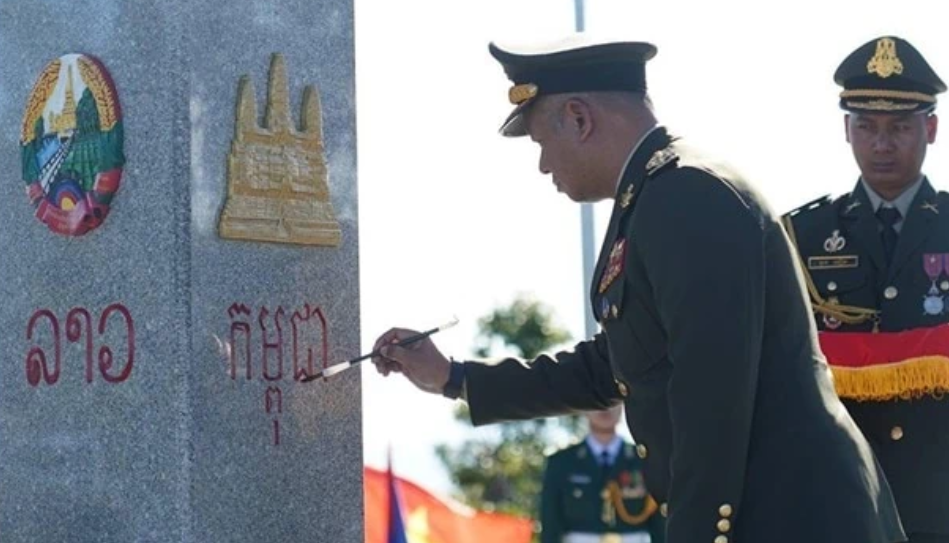
Prime Minister Hun Manet has doubled down on Cambodia's ambitious plan to construct a direct road connection into the remote 'Dragon's Tail' area where Cambodia, Laos and Vietnam converge, positioning the infrastructure project as a matter of national sovereignty and territorial management. Speaking in Stung Treng province this week, the Cambodian leader acknowledged that the challenging topography of the kingdom's northeastern frontier has long hindered access to this isolated region, but argued that geographic difficulty cannot be allowed to undermine the state's ability to exercise direct control over its territory. The proposed Route 78½ would traverse from Banlung in Ratanakiri province to Cambodia's northeastern extremity, establishing what Manet described as an indispensable Cambodian pathway to the tri-border point.
Currently, residents and officials seeking to reach the Dragon's Tail often must transit through Vietnamese territory due to the lack of viable overland routes on the Cambodian side, a situation that Manet framed as diplomatically and strategically unacceptable. His insistence that Cambodia establish its own direct access reflects a broader geopolitical calculation—that physical connectivity translates into tangible state presence and control. The prime minister employed compelling rhetoric to describe the imperative, stating that Cambodia must complete the route regardless of distance or difficulty, emphasizing that Cambodian citizens should traverse Cambodian soil to reach their nation's borders rather than relying on neighbouring countries for access to their own territory.
Manet's broader vision extends well beyond the singular Dragon's Tail project. During his address, he articulated a comprehensive development philosophy for Cambodia's four northeastern provinces—Stung Treng, Ratanakiri, Mondulkiri and Kratie—that positions transportation infrastructure as the foundation for economic transformation and population settlement in chronically underdeveloped areas. Using a biological metaphor, the prime minister compared roads to blood vessels coursing through a body, arguing that wherever transport networks expand, economic vitality and social development inevitably follow. This conceptual framing suggests that Manet views infrastructure investment not merely as technical necessity but as a catalyst for transforming the northeast's economic and demographic profile, drawing migrants and entrepreneurs into regions that have remained marginalised since Cambodia's civil war concluded in 1998.
The political context surrounding these infrastructure initiatives carries particular significance for understanding Cambodia's current regional posture. The government's renewed commitment to developing the northeast emerges directly from Cambodia's formal withdrawal from the Cambodia-Laos-Vietnam Development Triangle Area in September 2024, a trilateral framework that had operated since 1999 to coordinate development initiatives across three countries' shared border zones. The CLV-DTA encompassed thirteen provinces across the three nations—four Cambodian, four Laotian and five Vietnamese—and was ostensibly designed to improve infrastructure, facilitate trade, and enhance living standards in remote communities historically disconnected from economic opportunities.
Cambodia's exit from this arrangement followed intense domestic controversy and public demonstrations, with critics expressing deep concerns about territorial sovereignty and the potential implications of coordinated cross-border development initiatives. Some opposition voices suggested that participation in the framework could jeopardise Cambodia's territorial integrity or subtly advance Vietnamese interests within Cambodian territory, allegations that the government consistently and forcefully rejected throughout the debate. The sensitivity surrounding these territorial questions reflects longstanding anxieties within Cambodia regarding its relationship with Vietnam and historical disputes over border demarcation, fears that periodically resurface when cross-border cooperation is proposed.
Manet directly addressed this lingering controversy during his provincial speech, acknowledging that critics had characterised the CLV-DTA as a mechanism through which Cambodia might lose its four northeastern provinces. Rather than dismissing such concerns as baseless, the prime minister pivoted strategically, arguing that whether or not the trilateral framework continued operating, developing these four provinces remained a foundational government objective. This rhetorical move effectively separated Cambodia's commitment to regional development from its withdrawal from the multilateral arrangement, suggesting that Phnom Penh can pursue infrastructure advancement and economic opportunity without compromising sovereignty or territorial prerogatives.
The Route 78½ project and broader northeast development strategy should be understood as Manet's substantive response to concerns that Cambodia's withdrawal from the CLV-DTA would leave remote border regions economically stagnant and geopolitically vulnerable. By aggressively promoting domestic-led infrastructure initiatives, the government arguably seeks to demonstrate that Cambodia can develop its periphery more effectively through unilateral action than through multilateral cooperation frameworks. The emphasis on direct Cambodian routes to the tri-border region carries symbolic weight beyond its practical transportation benefits, signalling that the state intends to exercise unambiguous sovereign authority over its territory regardless of external partnerships or regional arrangements.
From a Southeast Asian perspective, Cambodia's northeast infrastructure push reflects broader regional dynamics around border management and development. The tri-border area and wider Mekong region remain zones of significant geopolitical attention, with various powers—including China—maintaining interest in connectivity projects and economic integration across Southeast Asia. Cambodia's decision to prioritise national-led development over multilateral frameworks aligns with broader trends toward asserting independent control over strategic infrastructure and territorial matters, a posture increasingly common throughout Southeast Asia.
The practical implementation challenges confronting Route 78½ should not be minimised. Building and maintaining all-weather road access through rugged terrain inhabited by sparse populations presents substantial engineering, financial and logistical obstacles. Yet for Manet's government, the project's symbolic and strategic value may ultimately transcend its immediate economic utility. Successfully completing a direct road to the Dragon's Tail would constitute tangible proof of Cambodia's capacity to exercise sovereign control over remote territory and establish direct physical linkages between the centre and periphery. For a country with complex historical relationships with its neighbours, particularly Vietnam, such demonstrations of territorial authority carry disproportionate political significance.

