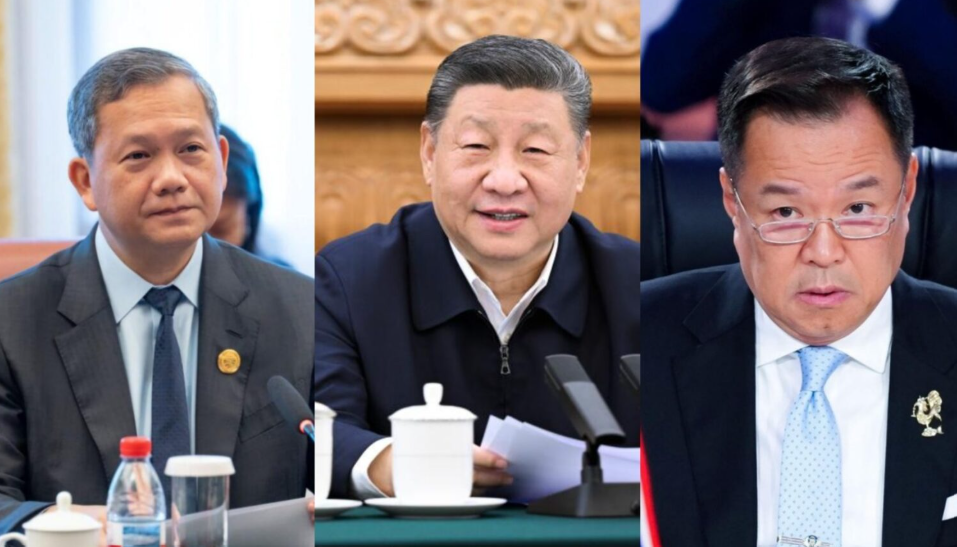
Cambodia and Thailand's leaders are heading to Shanghai this month for what appears to be a carefully choreographed diplomatic moment, but whether the gathering will actually advance their stalled border negotiations remains uncertain. Prime Ministers Hun Manet and Anutin Chanvirakul have both accepted invitations from Chinese President Xi Jinping to attend the opening of the World AI Conference 2026 on July 17. The event presents an unusual opportunity for high-level engagement at a moment when the two Southeast Asian neighbours have not sat down for formal border talks since December 2025, despite mounting pressure from analysts and regional observers for progress.
The Cambodian delegation heading to Shanghai from July 15-17 reflects the seriousness with which Phnom Penh is treating the visit. Foreign Minister Prak Sokhonn and Defence Minister Tea Seiha will accompany Hun Manet, signalling that security and diplomatic matters are on the agenda. The inclusion of Sun Chanthol, first vice-chairman of the Council for the Development of Cambodia, underscores the broader economic dimensions of the relationship. Thailand's contingent will be similarly high-profile, with Foreign Minister Sihasak Phuangketkeow joining Anutin. Both leaders are scheduled for separate bilateral meetings with Xi and Chinese Premier Li Qiang, suggesting Beijing intends to address each country's concerns individually before any joint discussions.
For Cambodia, the visit reinforces what Phnom Penh describes as the deepening of its relationship with Beijing through the Comprehensive Strategic Partnership of Cooperation framework and the Diamond Cooperation Initiative. Official statements emphasise the commitment to building what they term an all-weather Cambodia-China Community with a Shared Future. These formulations are particularly significant given Cambodia's heavy economic dependence on Chinese investment and infrastructure projects. The language reflects how deeply entwined the two nations have become across multiple sectors, from manufacturing to banking to telecommunications. For Phnom Penh, maintaining favour with Beijing remains a strategic priority that shapes its foreign policy calculations across the entire region.
Thailand similarly frames its Shanghai engagement in terms of strengthening the bilateral Comprehensive Strategic Cooperative Partnership with China. However, Bangkok's relationship with Beijing carries different complexities given Thailand's historical alignment with the United States and its position within multiple overlapping regional security frameworks. The visit signals Thailand's desire to balance these relationships while also recognising China's economic indispensability. For both nations, the Shanghai conference serves as an occasion to demonstrate commitment to China while managing broader geopolitical positioning.
The elephant in the room, however, is whether this diplomatic setting will actually translate into movement on Cambodia's border grievances. The two leaders encountered each other briefly at the ASEAN Future Forum in Hanoi in early June, where they exchanged handshakes for the cameras but conducted no substantive discussions addressing their territorial disputes. This pattern of polite gestures without concrete progress has characterised their recent interactions, suggesting that deeper obstacles prevent meaningful engagement. Multiple areas of Cambodian territory remain under Thai military control, with approximately 20,000 Cambodian civilians unable to return to their homes. The humanitarian dimension of this dispute underscores why Cambodia views resolution as increasingly urgent.
China's potential leverage in this situation derives from its position as the largest trading partner and investor for both nations. Beijing has demonstrated willingness to broker agreements between quarrelling neighbours, most notably through the Fuxian Consensus reached in December 2025, which established a framework for peaceful resolution. That earlier consensus included commitments from both sides to engage through diplomatic channels and utilise the Joint Boundary Commission as the mechanism for substantive negotiations. Yet these declarations have not translated into implementation, raising questions about the enforceability of Chinese-mediated agreements and the domestic political constraints affecting both governments.
According to Kin Phea, director of the Royal Academy of Cambodia's International Relations Institute, Thailand's military establishment represents the primary obstacle to progress. Phea argues that while Thailand's civilian government agreed to measures aimed at de-escalation and eventual resolution, the military has not implemented these commitments and continues to carry out actions that encroach on Cambodian sovereign territory. This analysis points to a fundamental problem: civilian leadership in Bangkok may lack the authority to control or direct military decisions regarding border areas. Such civil-military friction is not uncommon in Thailand's political landscape, where the armed forces have historically wielded considerable autonomy in security matters.
Phea's prescription for Chinese action is explicit and ambitious. He contends that Beijing should move beyond the passive role of observer or mediator to become what he calls an active arbitrator, using its considerable influence to compel both nations toward concrete steps. Specifically, this would involve pressuring Thailand to withdraw military forces from occupied Cambodian territory and return to the negotiating table. It would also require Beijing to insist on meaningful engagement within the Joint Boundary Commission framework rather than the current pattern of stalled processes. Such an approach would test whether China is willing to exert pressure on one of its strategic partners, even when that partner's interests diverge from Beijing's preferred outcome.
The timing of these Shanghai meetings coincides with broader regional challenges affecting Southeast Asia's stability. Border tensions between Cambodia and Thailand have the potential to escalate into more serious confrontation, particularly if nationalist sentiment becomes inflamed or if miscalculation occurs during military operations. Other regional actors, including Vietnam and Laos, have historical interests in the Cambodia-Thailand border situation. Any significant escalation could draw in wider Southeast Asian concerns and potentially complicate China's regional diplomacy. From Beijing's perspective, a stable Mekong River region serves its interests more effectively than a zone marked by territorial friction and potential conflict.
The economic dimensions of potential resolution also merit consideration. Both Cambodia and Thailand benefit substantially from cross-border trade and investment flows. Border stability would facilitate commerce, tourism, and people-to-people interactions that generate mutual benefits. Cambodia particularly depends on market access and investment from multiple sources, and ongoing territorial disputes create uncertainty that deters some investors. Thailand similarly benefits from regional stability that allows its own Belt and Road participation and broader economic engagement to proceed smoothly. These shared interests theoretically create incentives for resolution, yet they have not yet proven sufficient to overcome the political obstacles that maintain the current standoff.
The Shanghai conference ultimately represents a test of Chinese regional diplomacy. Can Beijing use its economic weight and diplomatic standing to transform a summit atmosphere into concrete progress on border issues? Or will the event follow the pattern of previous high-level meetings, producing pleasant rhetoric but little substantive movement? The composition of each delegation and the scheduled bilateral meetings suggest that Beijing intends to address the matter seriously. However, the underlying structural problems—particularly Thailand's military autonomy and Cambodia's vulnerability—may constrain how much pressure China is willing or able to apply. For Malaysian observers and policymakers, this situation exemplifies the challenges facing Southeast Asian nations when they attempt to resolve internal disputes while managing relationships with major external powers whose interests may not fully align with regional stability.

