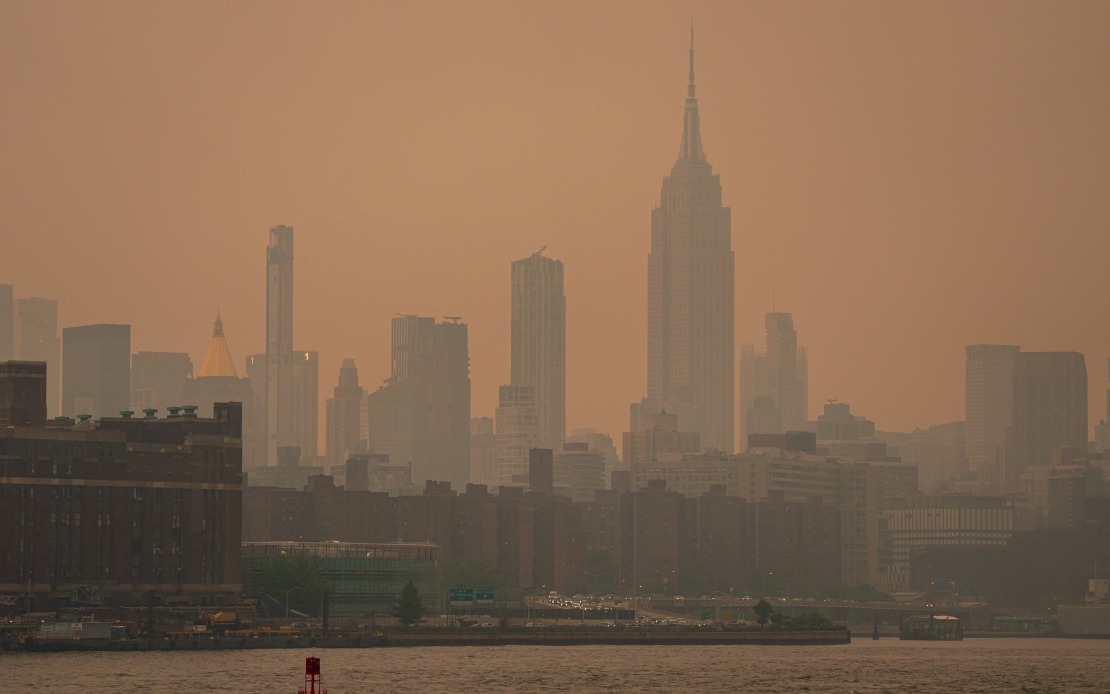
Mexican President Claudia Sheinbaum's journey to attend Sunday's Argentina-Spain World Cup final in East Rutherford, New Jersey encountered significant disruption when smoke blanketing New York—generated by ongoing wildfires in Canada—forced the cancellation of her scheduled commercial flight from Cancún. The initial two-hour delay on Saturday ultimately escalated into a complete cancellation, obliging the Mexican government to arrange alternative transport through a Defence Ministry aircraft that departed overnight to ensure the president could participate in the prestigious sporting event.
The deterioration of air quality across the northeastern United States has become an increasingly pressing concern throughout recent weeks, as smoke from Canadian wildfires drifts southward across the border. New York has been particularly affected, with visibility reduced and air quality indices climbing into hazardous ranges on multiple occasions. This environmental disruption has rippled through various sectors, affecting not only diplomatic travel but also regular commercial operations and public health across the region. The incident underscores how transnational environmental challenges can unexpectedly impact high-level political engagements and international relations.
Sheinbaum's attendance at the World Cup final carries particular diplomatic significance, as she received an invitation directly from United States President Donald Trump. This personal gesture reflects efforts to maintain high-level engagement despite underlying tensions between the two neighbouring nations. The inclusion of the Mexican president alongside Canadian Prime Minister Mark Carney demonstrates the trilateral nature of the 2026 World Cup hosting arrangement, with all three nations serving as co-hosts for the tournament. Such shared hosting arrangements require ongoing diplomatic coordination and symbolic gestures of unity among leadership.
The relationship between Mexico and the United States has remained complicated in recent months, with substantive disagreements over trade policy and security matters creating friction between the neighbouring governments. These underlying tensions make positive diplomatic engagement particularly valuable for both capitals. The World Cup final attendance, though disrupted by environmental factors, represents a rare opportunity for face-to-face dialogue between Sheinbaum and Trump in a relaxed, celebratory context rather than through tense bilateral negotiations. Such informal interactions can sometimes help ease broader diplomatic relationships, even if formal policy positions remain contested.
Prior to this World Cup final meeting, Sheinbaum had encountered Trump only once previously in an official capacity—during the tournament draw ceremony held in Washington last December. That limited interaction underscores how infrequent direct engagement between the Mexican and American leadership has been. The World Cup provides a convenient diplomatic platform, allowing leaders to demonstrate solidarity around sports and international cooperation while potentially laying groundwork for future discussions on contentious bilateral issues. For Sheinbaum, relatively new to her presidency, such opportunities carry additional weight in establishing her profile and relationship with the American administration.
The deployment of Mexico's Defence Ministry aircraft to resolve the travel disruption illustrates how governments activate alternative resources when standard commercial infrastructure proves inadequate. This governmental coordination—though operationally straightforward—nonetheless required rapid decision-making and resource mobilization to ensure the president could fulfill her international commitments. The overnight flight solution, while unconventional for a head of state, ultimately succeeded in circumventing the environmental obstacle that had grounded commercial aviation.
Canadian wildfires have emerged as a significant regional environmental crisis with transnational implications. The smoke plumes crossing the Canada-United States border represent a tangible example of how environmental degradation in one jurisdiction affects neighbouring regions, regardless of political boundaries. For Malaysia and other Southeast Asian nations monitoring global climate patterns, the Canadian wildfire situation offers relevant lessons about preparedness for transnational air quality challenges, particularly given similar experiences with regional haze in Southeast Asia.
The incident also highlights the vulnerability of diplomatic schedules to environmental disruptions—a consideration that will likely grow more significant as climate variability increases globally. Leaders, delegations, and international delegations increasingly face unpredictable weather and air quality conditions that necessitate flexible planning and backup arrangements. The World Cup final, as a fixed event requiring physical presence, became vulnerable to environmental circumstances beyond any participant's control.
For Malaysia's perspective on regional sports diplomacy and hosting arrangements, Sheinbaum's participation despite logistical complications demonstrates the importance that nations place on World Cup engagement. As a non-participating nation in the current World Cup but with potential future interests in sporting diplomacy and regional cooperation, Malaysia can observe how established powers manage international sporting commitments amid practical challenges. The trilateral hosting arrangement between Mexico, Canada, and the United States also offers insights into collaborative tournament management that could inform future Southeast Asian hosting considerations.
The successful rerouting of the Mexican president's travel ultimately achieved its objective, ensuring that Mexico maintained representation at the World Cup final despite environmental obstacles. The incident, while administratively disruptive, did not result in complete failure to participate—a testament to governmental capacity to improvise solutions when conventional approaches become unavailable. Nevertheless, the disruption itself served as a reminder of how climate-related events can unexpectedly impact high-level international engagements and the importance of maintaining flexible diplomatic protocols.

