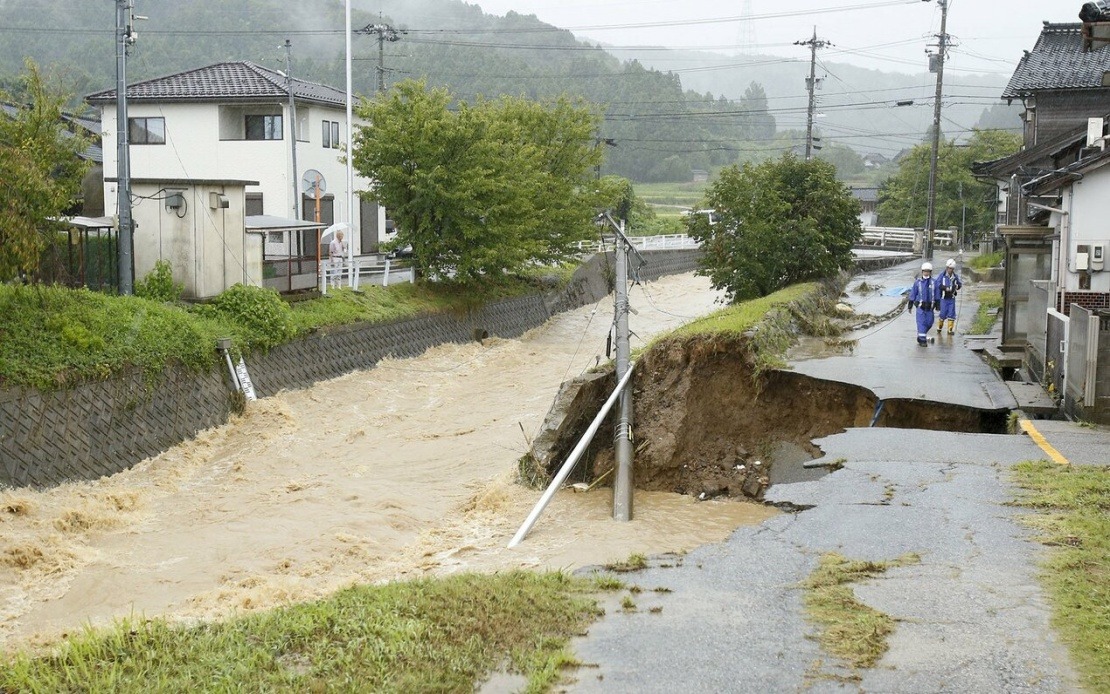
A deluge of unprecedented proportions descended on central Japan on Thursday, unleashing a cascade of natural disasters across multiple prefectures in the nation's heartland. Heavy downpours sparked widespread flooding and landslides, with motorists trapped in submerged vehicles and emergency services stretched thin responding to urgent distress calls. The Japan Meteorological Agency responded to the escalating crisis by issuing its maximum alert level—a Level 5 warning—signalling that catastrophic conditions were either already unfolding or posed an imminent threat to life and infrastructure.
The geographical heart of the disaster centred on Ishikawa and Toyama prefectures, where the most severe weather concentrated. Five municipalities bore the brunt of the emergency: Himi in Toyama Prefecture, and Hakui, Shika, Hodatsushimizu and Nakanoto in Ishikawa Prefecture. Collectively, authorities ordered approximately 180,000 residents across these communities to implement immediate safety measures, with evacuation orders issued for the most vulnerable neighbourhoods. Local officials urged residents to heed official guidance carefully and remain especially alert to the risk of sudden earth movements and debris flows, which posed perhaps the gravest threat to lives in mountainous and semi-mountainous zones.
Eyewitness accounts from those still in the affected areas painted a picture of water overwhelming infrastructure designed to contain it. A firefighter in his fifties stationed in Himi contacted news services to describe a river bursting its banks and multiple vehicles submerged beneath the rushing current. These scenes repeated across the region as waterways swelled far beyond normal levels, transforming roads into rivers and swallowing automobiles whole. Yet despite the scale of destruction and chaos, authorities reported no confirmed deaths during the initial hours of the emergency, a fact attributable both to the evacuation efforts and to residents who sought higher ground preemptively.
The meteorological data underscored just how extraordinary the rainfall had been. Within a twelve-hour window ending at 7:20 am, Himi and Hakui each recorded more than 300 millimetres of rain—a volume that exceeded historical records for those locations. Hodatsushimizu recorded over 200 millimetres during the same period, also setting a new benchmark. These figures represented not merely heavy rain but a statistical anomaly, the type of event agencies typically associate with once-in-a-decade or once-in-a-generation storms. The accumulation of such water in such compressed timeframes overwhelms drainage systems, saturates soils prone to instability, and creates hazardous conditions that persist long after rain ceases.
Meteorologists attributed the catastrophic conditions to a collision of atmospheric systems. A weather front advancing eastward from the Sea of Japan stretched across northern and central regions, while simultaneously a cold-air mass and a low-pressure trough generated conditions of extreme instability. The forecast suggested this dangerous configuration would persist, with the front expected to migrate southward through Friday. The Japan Meteorological Agency projected that over the subsequent twenty-four hours through midday Friday, Hokuriku could experience up to 200 millimetres of additional rainfall, while the Kanto-Koshin and Tokai regions could receive up to 150 millimetres. This continuance meant the crisis would not rapidly resolve; rather, saturated landscapes and compromised infrastructure would face further punishment.
Niigata Prefecture, positioned immediately adjacent to Toyama, also fell within the storm's destructive reach. Though reports from Niigata remained less detailed than those from the epicentre, the neighbouring prefecture's exposure underscored the vast geographical expanse of the weather system. For readers in Southeast Asia, such multi-prefecture impacts illustrate the scale that Japanese weather disasters routinely achieve—an event spanning multiple administrative regions and affecting millions represents an ordinary occurrence in a nation situated along major storm tracks.
This latest calamity arrives in an unsettling sequence. Earlier in August, merely weeks prior, another Level 5 warning was declared across municipalities in Chiba Prefecture, located east of Tokyo. That episode resulted in thirteen fatalities and created scenes of automotive chaos, with approximately 2,500 vehicles abandoned on flooded roads at the peak of the inundation. The recurrence of maximum-alert situations within such a compressed timeframe suggests either that climate patterns are shifting toward greater frequency of extreme events, or that existing infrastructure and warning systems, while sophisticated, remain inadequate to prevent casualties and economic losses when meteorological forces exceed design parameters. The lesson for Japan—and by extension for other nations in seismically and climatically active regions—is sobering: investment in early warning systems and evacuation infrastructure, while life-saving, cannot wholly eliminate disaster's toll when nature produces events of such magnitude.
For Malaysia and Southeast Asian nations, Japanese weather disasters carry particular relevance. The region experiences monsoons and tropical storms of its own, and Japan's technological responses to extreme weather—from early warning systems to emergency communication networks—offer models worthy of study. Moreover, the economic implications of supply chain disruptions caused by Japanese disasters ripple across Asia's manufacturing ecosystem, as Japan remains a critical hub for electronics, automotive components, and precision manufacturing. When central Japan grinds to a halt due to weather, the consequences extend far beyond the affected prefectures.
As Thursday progressed into evening, the full extent of the damage remained incompletely known. Rescue operations continued, with focus shifting toward recovering stranded individuals and assessing structural damage once waters receded. Authorities maintained vigilance against the compounding hazards of saturated soil, weakened foundations, and damaged utility infrastructure. The meteorological agency's forecasts offered no immediate reprieve; the dangerous atmospheric setup would govern Japan's weather through at least Friday, meaning the emergency phase would persist for hours yet. For the 180,000 residents under evacuation, that meant an extended period of displacement, uncertainty, and cautious waiting for official clearance to return to homes that may themselves have sustained damage.

