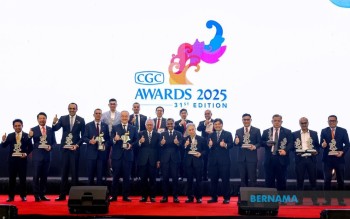
Malaysia's Credit Guarantee Corporation has celebrated the achievements of 32 micro, small and medium enterprises and financial sector participants at the 31st CGC Awards 2025, marking a significant recognition of business resilience across the nation's enterprise landscape. The ceremony in Kuala Lumpur highlighted the critical role that character, discipline and adaptability play in enabling Malaysian businesses to navigate economic challenges and sustain growth over time.
CGC chairman Datuk Mohammed Hussein emphasised during the awards presentation that genuine resilience extends far beyond access to financing alone. He stressed that business owners who demonstrate strong conduct and disciplined decision-making are far more likely to weather difficult periods than those relying solely on capital availability. This observation carries particular weight for Malaysia's diverse business community, where family enterprises and independent operators often operate with limited safety nets compared to larger corporations. The chairman's remarks underscore a fundamental truth that applies across Southeast Asia: entrepreneurial success ultimately depends on the character and adaptability of those driving the enterprise.
The CGC chairman articulated a comprehensive vision for strengthening the entire ecosystem that supports Malaysian enterprise development. His statement that building resilience requires collaboration across banks, government agencies, research institutions and corporate procurement divisions reflects the interconnected nature of modern business support systems. For Malaysia specifically, this means government must continue creating regulatory environments that reduce barriers to entry and operation, while universities and research centres should accelerate the pathway from laboratory innovation to commercial products. Similarly, large corporations must view small suppliers not as expendable cost centres but as integral partners whose stability directly affects supply chain reliability.
Bumiputera enterprise participation received particular attention at the awards ceremony, with CGC reporting substantial increases in support for indigenous Malaysian businesses. The corporation channelled RM223 million in guarantees to 27 Bumiputera companies during the previous year, demonstrating committed action rather than mere rhetoric on inclusive economic growth. This funding translates directly into operational capital for businesses that often face steeper barriers to conventional financing, helping level an uneven playing field while developing entrepreneurial talent within the Bumiputera community. The focus on Bumiputera enterprises aligns with Malaysia's broader economic agenda of ensuring that business opportunities reach beyond established networks.
Environmental, social and governance considerations have become increasingly central to Malaysia's financial development strategy, and CGC's portfolio reflects this shift. The corporation has directed RM1.2 billion in guarantees toward enterprises meeting ESG criteria, exceeding its initial RM1 billion target. This reorientation matters significantly for Malaysian readers because it signals that sustainable business practices are no longer optional extras but core criteria for accessing development financing. Companies investing in renewable energy, waste reduction, labour standards and community engagement now enjoy improved access to credit, creating competitive advantages that will reshape Malaysian business practices across sectors.
The awards recognised financial institutions across multiple categories, reflecting the diverse architecture of Malaysia's banking ecosystem. Alliance Bank Malaysia Bhd and CIMB Islamic Bank Bhd secured the Best Financial Partner award, while conventional banks Public Bank Bhd and Alliance Bank Malaysia Bhd were separately recognised for their support of small enterprises. Islamic banking institutions including CIMB Islamic Bank Bhd, OCBC Al-Amin Bank Bhd and Standard Chartered Saadiq Bhd demonstrated particular commitment to MSME financing through the Islamic financial institution category. Bank Simpanan Nasional and Small Medium Enterprise Development Bank Malaysia Bhd, operating as development financial institutions, provided essential services to enterprises underserved by commercial banking channels.
Maybank Islamic Bhd received a Special Recognition Bumiputera Award, acknowledging its particularly strong contribution to financing indigenous Malaysian enterprises. OCBC Al-Amin Bank Bhd separately earned recognition as the Bumiputera SMEs Award winner, indicating that Islamic banking channels are proving especially effective for reaching Bumiputera business owners. This outcome matters for Malaysian policymakers and entrepreneurs because it demonstrates that religious-based banking models can deliver both commercial viability and inclusive economic outcomes simultaneously. The awards data suggests that Bumiputera enterprises find Islamic banking structures particularly accessible and well-suited to their needs.
Fintech and alternative financing platforms have emerged as significant MSME support channels, with Peoplender Sdn Bhd (Fundaztic) securing the Top Non-FI Partner award. Bank Simpanan Nasional received recognition under the imSME category for developmental financial institutions, while Peoplender won the non-financial institution imSME award. These recognitions acknowledge that traditional banking channels, while essential, cannot exclusively serve Malaysia's entrepreneurial needs. Digital lending platforms and non-bank financial intermediaries now facilitate millions of ringgit in small loans that enable enterprises to manage working capital, purchase inventory and fund seasonal operations. For Malaysian readers, this diversification of financing sources provides a genuine alternative to relying solely on conventional banking relationships.
The ceremony marked the formal launch of two new guarantee schemes representing a combined RM10 billion commitment from Bank Negara Malaysia and CGC. The Portfolio Guarantee and Portfolio Guarantee-i schemes utilise a risk-sharing model in which participating financial institutions retain partial risk exposure while CGC covers significant portions of potential losses. This structure incentivises prudent lending rather than reckless overextension, as banks remain motivated to properly assess borrower capacity. The schemes target approximately 12,100 MSMEs across key economic sectors, with financing structures designed to support business expansion, productivity improvements, sustainability transitions and enhanced competitiveness. For Malaysian entrepreneurs, this represents tangible expansion of affordable credit access during a period of economic transition and technological disruption.
The timing of these guarantee schemes reflects Malaysia's broader economic priorities during a period of technological disruption and global supply chain reconfiguration. By facilitating up to RM10 billion in guaranteed financing, Bank Negara Malaysia and CGC are essentially betting that Malaysian enterprises can successfully navigate the transition toward higher-value production, digital transformation and sustainable operations. The schemes acknowledge that many MSMEs lack sufficient collateral or track records to access conventional financing despite possessing genuine business potential and market demand for their products or services. This recognition of the gap between entrepreneurial capability and conventional lending criteria has important implications for Malaysia's ability to develop competitive advantage in regional and global markets.
CGC's commitment to its 2030 strategic agenda emphasises deepening impact on MSMEs, advancing financial inclusion and supporting sustainable economic development through continued ecosystem collaboration. This framework moves beyond viewing guarantee institutions as passive risk-absorbers toward positioning them as active participants in enterprise ecosystem development. The corporation aims to deepen relationships with financial institutions, government agencies, corporate buyers and entrepreneurs themselves, creating a genuinely collaborative support infrastructure. For Malaysia, this evolution is critical because MSME development ultimately determines whether the nation can build sustainable, inclusive prosperity that reaches beyond Kuala Lumpur and established business networks into secondary cities and rural areas where economic potential remains underdeveloped.
The awards and scheme launches carry particular significance for Southeast Asian readers beyond Malaysia because they illustrate how a developing nation is systematically addressing MSME financing gaps through coordinated public-sector action. Many neighbouring countries face similar challenges in extending credit access to small enterprises, and Malaysia's approach combining guarantee mechanisms, Islamic financing, fintech integration and ESG criteria may offer replicable lessons. The emphasis on Bumiputera participation also reflects Malaysia's distinctive commitment to indigenous economic development, a priority that resonates across the region among nations pursuing inclusive growth alongside market-oriented development.

