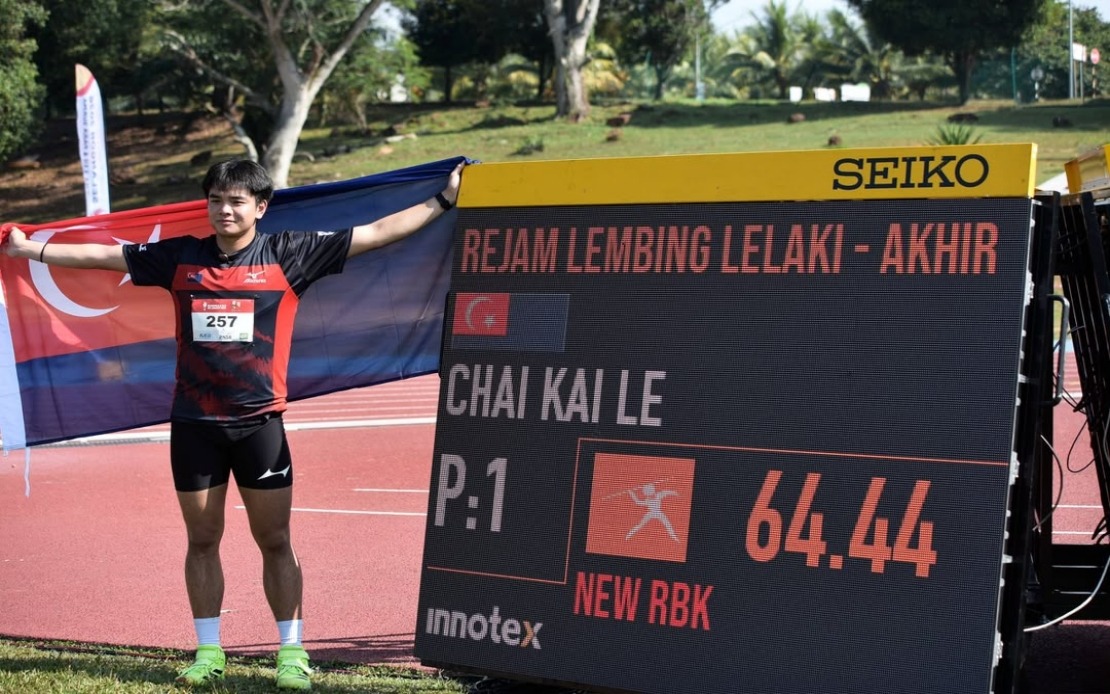
Johor's 18-year-old javelin specialist Chai Kai Le has made his mark on Malaysian athletics history by obliterating a quarter-century-old Games record at the Selangor 2026 SUKMA edition held at the Universiti Putra Malaysia Sports Centre in Serdang. His winning throw of 64.44 metres on his second attempt decisively surpassed the previous benchmark of 62.33 metres, which had stood unchallenged since Sarawak's Kho Mei Kuan established it during the 2000 Games in Penang. The achievement marks a significant moment for Malaysian javelin, demonstrating genuine progress in the sport at the domestic level and suggesting that emerging talent in the discipline is reaching new competitive heights.
Kai Le's performance places him among the elite javelin throwers in Southeast Asia's regional athletics community, particularly impressive given his relative youth and the trajectory of his development. His superior technique and physical conditioning were evident throughout the competition, with his nearest domestic rival, Penang's Tan Chun Wei, finishing approximately four metres behind with a silver-medal effort of 60.43 metres. Bronze went to Kai Le's Johor teammate Mohd Noor Iman Norman, whose 59.04-metre throw maintained strong performances from the state contingent and underlined Johor's current dominance in the men's javelin category at the Games.
In discussions with journalists following his victory, Kai Le revealed that his record-breaking accomplishment had formed part of his preparation strategy for SUKMA throughout the preceding two years. The athlete's methodical approach to competition indicates a level of maturity and professional mindset that extends beyond typical teenage competitors, suggesting potential for further development at international competitions. His confidence stemmed partly from his existing national under-20 record of 65.65 metres, which provided a foundation for targeting the Games record that ultimately fell to him in Serdang.
Despite his successful winning throw, Kai Le acknowledged that his subsequent performance during the competition was affected by physical limitations. He explained that a technical error during his second throw resulted in lower back discomfort and fatigue, compelling him to adopt a conservative approach for the remainder of the event. Rather than risk exacerbating the injury, the teenager focused his remaining efforts on injury management and recovery, a pragmatic decision that prioritized long-term athletic career considerations over maximizing individual throw distances. This approach demonstrates tactical awareness and discipline uncommon in young athletes navigating high-pressure competitive environments.
The race walk events at SUKMA 2026 also provided compelling narratives of athletic achievement and progression. Penang's Mohammad Aiman Haikal Sahrudin captured the men's 10,000-metre race walk title, crossing the finish line in 47 minutes 28.84 seconds to secure Malaysia's gold medal position in the discipline. The margin separating him from his closest challenger proved decisive but not overwhelming, with Kelantan's Ahmad Farish Irfan Ahmad Fahmi claiming silver in 47 minutes 37.17 seconds, just over nine seconds behind the winning time.
Khor Jing Hong, representing the Federal Territories, completed the medal podium with a bronze-medal performance of 47 minutes 49.27 seconds. The performance demonstrated competitive depth across Malaysian states in the women's race walk discipline, though the rankings reflected Penang's continuing strength in endurance walking events. Notably, Mohammad Aiman's victory represented meaningful progress from his previous Games appearance, where he had secured only a silver medal in the same event at the Sarawak 2024 SUKMA edition.
Mohammad Aiman, aged 18 and hailing from Kampung Tanah Liat in Penang, articulated ambitious goals extending beyond his SUKMA success. His primary objective involves securing selection for Malaysia's national team structure, positioning himself for potential representation at the 2027 Southeast Asian Games in Bangkok. The athlete recognized that his immediate focus would shift toward the 20,000-metre race walk discipline, as the 10,000-metre event does not feature on the SEA Games programme. This strategic reorientation of his competitive energy demonstrates understanding of the pathways required for advancement to regional and international athletics platforms.
The SUKMA 2026 athletics programme at UPM Sports Centre has served as a showcase for emerging Malaysian talent across multiple disciplines, with performances in javelin and race walking particularly notable. The Games continue their traditional function as a domestic platform for identifying athletes capable of competing at regional levels, while simultaneously providing competitive experience to established performers seeking to refine their techniques and strategies. The quality of performances across field and track events suggests that investment in Malaysian athletics development, particularly at the state coaching and facilities level, is generating measurable returns.
For Malaysia's athletics administration, the emergence of competitors like Kai Le and Mohammad Aiman offers encouraging signs regarding the pipeline of talent available for future regional competitions. The substantial margin by which Kai Le surpassed the previous javelin record indicates that technical improvements and conditioning standards continue advancing, potentially setting the stage for further breakthroughs. Similarly, the competitive depth evident in race walking across multiple states demonstrates that distance endurance events remain an area of relative Malaysian strength within Southeast Asian athletics.
The implications of these SUKMA 2026 performances extend beyond immediate medal counts to broader questions about Malaysia's positioning in regional athletics. The Southeast Asian Games remain the primary benchmark for competitive performance, and Games like SUKMA serve as crucial stepping stones in athlete development pathways. Young competitors such as Kai Le and Mohammad Aiman represent the generation that will shape Malaysian athletics performance at the 2027 SEA Games and beyond, making their current trajectory and tactical awareness particularly significant for national sporting objectives.
Looking forward, the success demonstrated at SUKMA 2026 should inform continued investment in coaching, facility development, and athlete support systems across Malaysian states. The competition has highlighted specific areas of strength, particularly in javelin and race walking, which merit sustained attention and resource allocation. As these young athletes progress toward regional and potentially international competition, their performances in Serdang will likely serve as reference points for future achievement and benchmarks against which coaching effectiveness can be measured.

