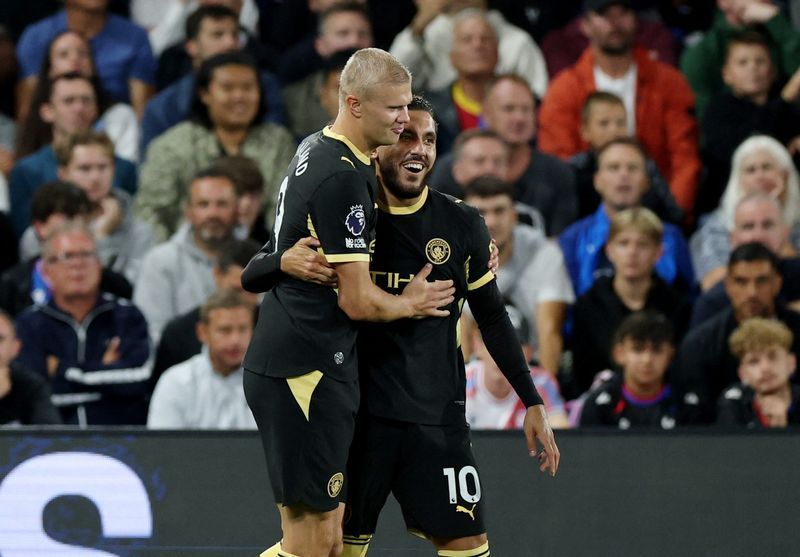
Manchester City made a resounding statement with a 4-1 demolition of Crystal Palace on Friday night, maintaining their flawless record in the English Premier League with a second consecutive victory. The comprehensive nature of the win, sealed by a brace from both Rayan Cherki and Erling Haaland, underscores the depth and potency of City's attacking options under Enzo Maresca as the campaign enters its early stages.
Although Palace offered spirited resistance in the opening exchanges, City's superiority became apparent following Haaland's opening goal in the seventeenth minute. The Norwegian international rose majestically to meet an Antoine Semenyo cross and directed a looping header past Dean Henderson, demonstrating the aerial prowess that has defined his contribution to City's attacking arsenal. This early breakthrough set the tone for what would become a compelling showcase of City's offensive capabilities, though the south London side refused to capitulate entirely.
The match developed into an open contest with genuine chances at both ends during the opening period. Phil Foden squandered an opportunity to extend City's lead when he spooned an effort over the bar in the twenty-first minute, while Crystal Palace's Eddie Nketiah spurned a gilt-edged chance early in the second half that might have altered the trajectory of the contest. These missed opportunities highlighted that despite City's dominance in possession, their Palace counterparts remained capable of threatening on the break.
The French playmaker Cherki proved to be the catalyst for City's decisive second-half acceleration. In the fifty-fourth minute, he demonstrated his technical excellence by dancing through the Palace defence and calmly finishing past Henderson to double City's advantage. For Malaysian football enthusiasts, Cherki's performances at this level represent the emerging quality of European football's younger generation, with his creativity and composure suggesting a player destined for the continental elite.
Palace briefly reignited hopes of a comeback two minutes later when Yeremy Pino's free kick produced an extraordinarily unfortunate sequence for City's Gianluigi Donnarumma. The ball struck the crossbar, ricocheted off the goalkeeper's back, hit the post, and somehow trickled across the line—a goal that represented shocking misfortune rather than tactical breakthrough. Nevertheless, such setbacks rarely derail sides of City's quality and stability.
Any prospect of a Palace revival evaporated when Cherki struck again in the fifty-ninth minute with a deflected effort that nonetheless carried finality. The Frenchman's second goal of the evening essentially concluded the contest as a genuine contest, leaving Palace to trudge through the remaining half-hour knowing the outcome had been determined. Cherki's influence throughout the evening illustrated why City invested significantly in his development, with his technical repertoire and football intelligence establishing him as a central component of Maresca's vision.
Haaland applied the final flourish to City's dominance when he collected a pass from Foden in the eighty-fifth minute and unleashed a characteristically powerful left-foot finish into the net. The Norwegian's return to goalscoring form, having now contributed three goals from their opening two matches, provides reassurance that City's championship credentials remain formidable despite the alterations to their squad this summer. His movement, positioning, and clinical finishing continue to define modern elite-level strikemanship.
Maresca demonstrated tactical astuteness in managing the latter stages, shuffling his attacking options and rotating roles to maintain offensive verve while managing workload. The manager acknowledged that initial nerves about Palace's intensity and the challenging surface gradually gave way to City's superior control and organisation. His specific praise for Cherki and Haaland recognised their matching contributions, while his observations about Foden's positioning and adaptability suggested ongoing refinement of the English winger's role within the team's structure.
Maresca's comment that Foden appeared considerably more comfortable operating centrally behind Haaland than on the wing provides insight into how City intends to deploy their extensive attacking resources throughout the campaign. This flexibility—the ability to reconfigure attacking options without diminishing effectiveness—represents a significant competitive advantage, particularly in the gruelling Premier League calendar where squad rotation becomes inevitable.
City now enters a week's respite before confronting newly-promoted Coventry City, a fixture likely to provide limited resistance. However, the subsequent challenge assumes considerably greater significance when they travel to Old Trafford for their opening Manchester derby against Manchester United. Such encounters, regardless of league position or form, carry historical weight and intensity that transcends ordinary match statistics, ensuring that Maresca's squad will require unwavering focus to maintain their unbeaten start.
For Southeast Asian observers monitoring Manchester City's campaign, these early results suggest that despite the managerial transition from Pep Guardiola to Maresca, the club's fundamental capacity to dominate opponents through superior technical execution and intelligent positioning remains entirely intact. The partnership between Haaland's predatory finishing and Cherki's creative orchestration promises an exhilarating attacking formula that could define City's season, while their defensive solidity—with only one goal conceded across two matches—indicates a comprehensive squad capable of challenging for the Premier League title once again.

