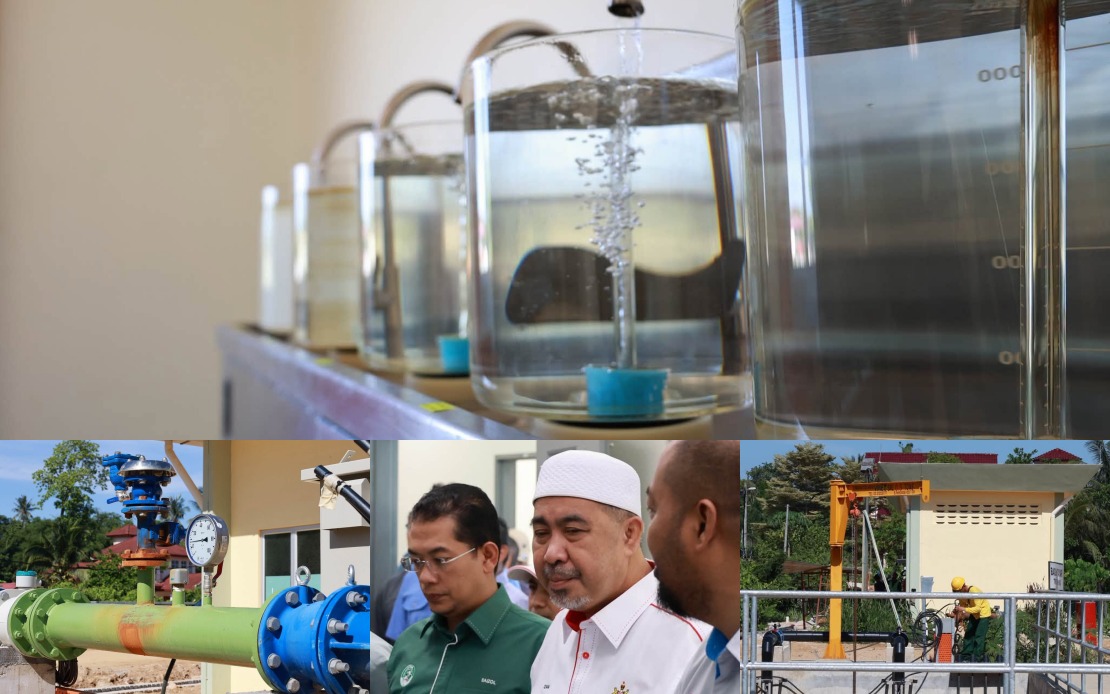
Kelantan's long-awaited Chicha 2 Water Treatment Plant in Pasir Hor is on track to begin operations this September, marking a significant milestone in the state's efforts to address persistent water supply challenges that have plagued residents for years. The RM54.98 million infrastructure project, which broke ground in 2024, has achieved 97 percent physical completion and is expected to transform water access for more than 13,000 consumers across multiple districts in the northern state.
The facility's arrival carries particular significance given Kelantan's well-documented struggles with water supply reliability and quality. According to Datuk Dr Izani Husin, chairman of the State Public Works, Infrastructure, Water and Rural Development Committee, the treatment plant will service communities in Pasir Hor, Telipot, Kota Seribong, Mulong and Tunjong—areas that have experienced recurring supply disruptions. The scale of anticipated benefit extends beyond immediate water delivery; officials estimate the plant's activation will reactivate approximately 10,000 dormant consumer accounts in the region, indicating a substantial population currently without reliable treated water access.
The Chicha 2 WTP's operational capacity of 20 million litres per day represents a carefully calibrated addition to Kelantan's water infrastructure network. Rather than relying on surface water sources, the facility employs an innovative groundwater extraction methodology, drawing water from depths of approximately 100 metres through a deep-bore excavation process. This approach reduces vulnerability to seasonal variations and surface contamination that have historically affected Kelantan's water security, though groundwater dependency introduces its own long-term sustainability considerations that water managers will need to monitor.
A distinctive feature of the Chicha 2 WTP is its deployment of aeration-based water treatment technology—a first implementation within Kelantan's existing water infrastructure portfolio. The aeration system enhances water quality by removing dissolved gases, iron content, and other impurities, generating high-quality treated water suitable for domestic consumption. Dr Izani indicated that this methodology holds potential for replication across other treatment facilities in the state, suggesting that the Chicha 2 project may establish a template for future water infrastructure development in Kelantan and potentially across Southeast Asia's water-stressed regions.
The temporal alignment of the Chicha 2 WTP's completion with broader state-level water management ambitions underscores a more comprehensive strategic vision. Kelantan authorities have articulated a target to fully resolve the state's water supply deficiencies by 2030, contingent on successful implementation of multiple concurrent infrastructure initiatives and construction of additional treatment plants. This phased approach acknowledges that water scarcity solutions require sustained investment across diverse technical, infrastructural, and financial domains rather than singular project deliverables.
Key to Kelantan's water crisis has been the state's persistently elevated non-revenue water rate, currently exceeding 50 percent—meaning more than half of treated water is lost before reaching consumers. This represents a critical efficiency problem with financial and environmental implications. The primary culprits include aging pipeline networks plagued by chronic leaks, subsurface pipe ruptures, and malfunctioning water meters that fail to register consumption accurately. These infrastructure deficiencies have consumed resources and constrained service expansion, creating a vicious cycle where limited water availability perpetuates investment pressures.
The Chicha 2 WTP occupies a 1.84-hectare footprint, a compact installation reflecting efficient site utilisation and urban integration considerations. The plant's spatial efficiency enables deployment within densely settled areas without requiring extensive land acquisition or displacement—a practical advantage for water infrastructure in developed regions where available land remains constrained. This design characteristic may influence feasibility assessments for future treatment plants in similarly space-limited contexts.
Kelantan's water supply challenges carry particular resonance for Malaysian policymakers and development strategists, as the state's experiences exemplify broader vulnerabilities affecting multiple jurisdictions across Southeast Asia. Rapid urbanisation, climate variability, aging infrastructure, and inadequate non-revenue water management plague water systems throughout the region. The Chicha 2 WTP's technological and managerial approaches therefore offer instructive lessons applicable beyond Kelantan's borders.
For the immediate 13,000-plus consumers anticipating September service commencement, the plant's operational launch promises tangible improvements in water reliability and quality. The prospect of restoring service to 10,000 dormant accounts suggests substantial populations have endured extended periods without piped water access, relying instead on alternative and often inferior supply sources. Service restoration will likely deliver measurable quality-of-life improvements alongside public health benefits through reliable access to treated water.
State authorities have framed their response to Kelantan's water crisis as a multi-year undertaking requiring sustained public patience and confidence. Dr Izani's acknowledgment that resolution will proceed incrementally rather than comprehensively reflects realistic appraisal of infrastructure challenges' complexity. The emphasis on phased implementation suggests that subsequent projects beyond Chicha 2 remain in planning or early construction stages, indicating a prolonged transition period before the 2030 target becomes attainable.
Looking forward, Kelantan's water infrastructure trajectory will depend on sustained funding, technological adaptation, and operational efficiency improvements addressing the non-revenue water problem. The Chicha 2 WTP represents meaningful progress, but represents one component within a larger remedial framework. Success in reducing the non-revenue water rate from current levels above 50 percent toward more sustainable benchmarks will ultimately determine whether the state achieves comprehensive water security by 2030.

