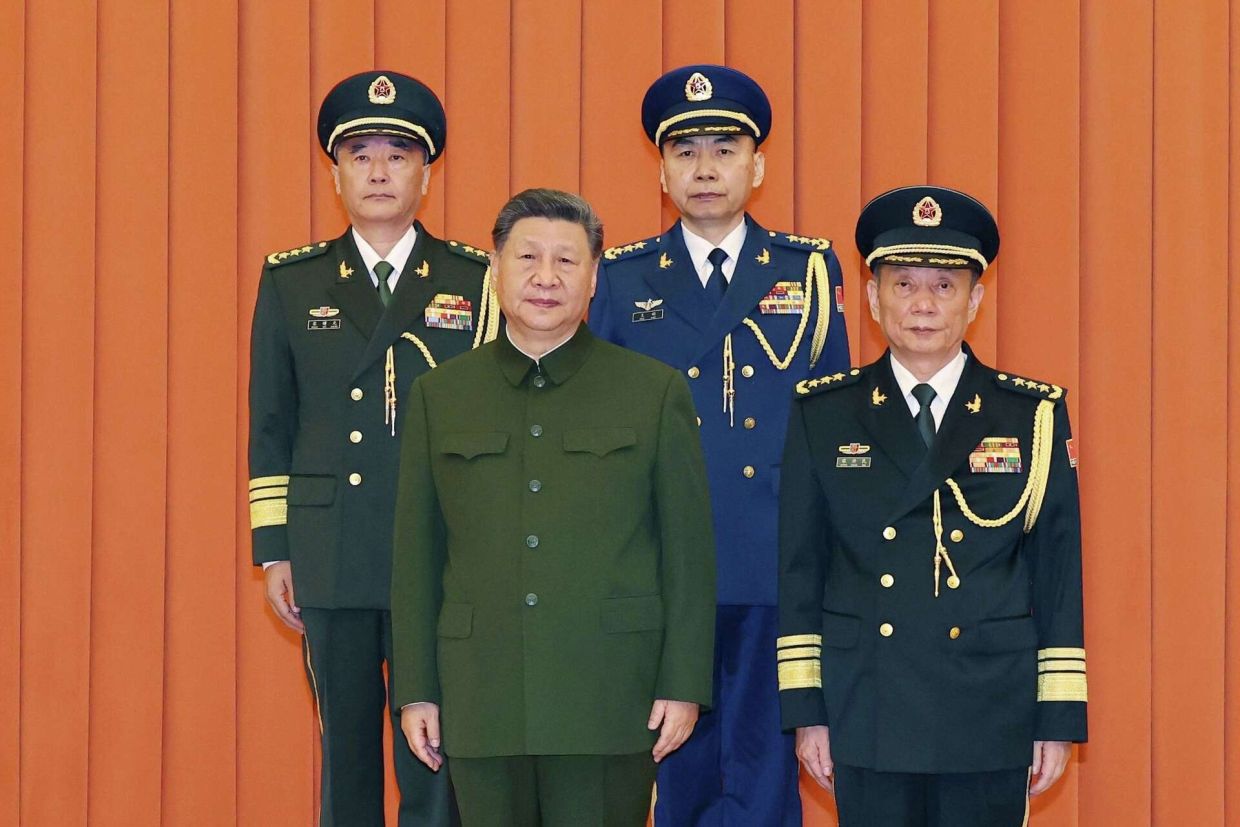
China's military command has announced the promotion of two senior officers to the rank of general, a development that analysts view as a potential precursor to significant structural changes within the armed forces. The elevation of Zhang Shuguang and air force commander Wang Gang took place during a formal ceremony presided over by Xi Jinping on Friday, July 3. The timing and scope of these promotions suggest that Beijing is manoeuvring to fill critical positions within its military hierarchy that have been left vacant by an extensive anti-corruption investigation.
Xi Jinping, who simultaneously holds the title of military chairman, has been instrumental in driving the sweeping anti-corruption campaign that has substantially reduced the number of active officers in China's highest military echelon. This purge represents one of the most significant internal reshuffles within the People's Liberation Army in recent decades. The promotions announced this week should be understood within the context of this broader consolidation effort, where the removal of implicated officials has created a need to identify and advance trusted replacements capable of steering the military forward.
Zhang Shuguang's appointment carries particular significance beyond his promotion to general. He has been simultaneously named to head the Central Military Commission's investigative division, the body responsible for rooting out corruption within the armed forces. This dual responsibility places him at the epicentre of the anti-corruption machinery, suggesting that Xi's leadership trusts him with overseeing the continuation and deepening of investigations into military misconduct. The position effectively makes him a gatekeeper for internal military discipline and loyalty verification, a role that carries enormous influence over the force's internal politics.
The Central Military Commission, comprising seven positions at full strength, has been effectively hollowed out by the ongoing anti-corruption drive. Currently, only two members remain actively engaged in their duties: Xi Jinping, who chairs the commission, and Vice Chair Zhang Shengmin. This dramatic reduction in the commission's functioning capacity reflects the scale of the purge. Two former vice chairs, including the military's most senior general, have been removed or rendered inactive through the investigations. Such attrition at the very top of the command structure would ordinarily create significant institutional risk and potential leadership vacuums.
The promotions of Zhang Shuguang and Wang Gang appear strategically designed to begin addressing these vacant positions. Both officers are now positioned as candidates to assume the remaining vacancies on the seven-member commission. However, China's military leadership structure operates on five-year terms, and observers expect that a comprehensive reorganisation and reconstitution of the full commission will be announced in autumn of next year, coinciding with the conclusion of the current commission's mandate. This timeline suggests that the current round of promotions may represent only the opening moves in a larger reconfiguration process.
The anti-corruption campaign within China's military must be understood as serving multiple objectives simultaneously. On one level, it represents a legitimate effort to root out financial misconduct and abuse of power within the armed forces. However, analysts also view the purge as a mechanism through which Xi Jinping has consolidated personal control over the military apparatus. By removing senior officers who might harbour independent power bases or allegiances to rival factions within the Communist Party, Xi has effectively remoulded the armed forces into an instrument more directly responsive to his personal authority. The promotions of trusted officers like Zhang Shuguang reinforce this centralisation dynamic.
For Malaysia and other Southeast Asian nations, these military leadership changes warrant close attention. The health and stability of China's military command structure directly affects the strategic calculations that Beijing makes regarding regional security issues, maritime disputes, and great power competition in Asia. A military leadership that is well-consolidated and unified under Xi's personal authority may present a more predictable, if potentially more assertive, strategic actor. Conversely, ongoing internal instability or factional tensions could create unpredictability in how China projects power and exercises influence across the Indo-Pacific region.
The timing of these promotions also coincides with a period of heightened great power tension, including growing U.S.-China friction and increased attention to disputes in the South China Sea, where Malaysian maritime interests intersect directly with broader Chinese strategic ambitions. The strengthening of Xi's control over the military through personnel changes suggests that future military decisions in this region will reflect his personal strategic vision with minimal institutional countervailing influence. This has implications for how regional states navigate their relationships with Beijing and calibrate their own security partnerships and strategic hedging strategies.
The broader pattern of military restructuring under Xi represents a conscious effort to align the armed forces more tightly with Communist Party control and, more specifically, with Xi's personal leadership. The integration of anti-corruption oversight into the promotion process ensures that advancement through military ranks now depends not merely on professional competence but also on demonstrated loyalty to the leadership's anti-corruption agenda. This represents a subtle but significant shift in how the military bureaucracy functions and what qualities leaders must possess to advance within it.
Looking ahead, the expected announcement of a fully reconstituted Central Military Commission in late 2026 will provide the most comprehensive picture of how thoroughly Xi has reshaped senior military leadership. The current wave of promotions, while significant, should be viewed as interim arrangements pending that larger reorganisation. Until that point, the military's command structure will remain in a transitional state, with implications for decision-making effectiveness and strategic clarity. Regional observers will watch carefully to see whether the new military leadership maintains continuity in strategic approach or signals any shifts in China's posture toward its neighbours.

