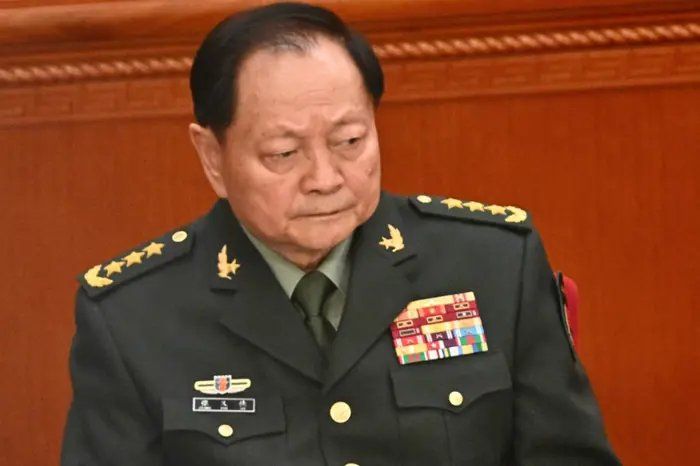
China's political establishment has formally removed Zhang Youxia from his role as vice chairman of the Central Military Commission, one of the country's most powerful military positions, according to official announcements made through state media on Friday. The decision came seven months after authorities first disclosed that the high-ranking officer was under investigation for what government sources characterised as "serious violations of discipline and the law"—phraseology commonly employed in Chinese official discourse to denote corruption allegations. The removal underscores the continuing volatility within China's military hierarchy and reflects the regime's ongoing campaign against graft at senior levels of government and the armed forces.
Zhang's ousting carries particular significance given his standing within the Chinese military establishment. As the more senior of two vice chairmen serving on the Central Military Commission, he held the rank of China's highest-positioned general, commanding considerable influence over defence policy and military operations. His tenure at this level had spanned years, during which he wielded substantial authority over strategic decisions affecting the People's Liberation Army. The commission itself functions as the apex institution overseeing all military matters in the People's Republic, making vice chairmanships among the most coveted and influential positions within the defence apparatus.
The formal announcement came through Xinhua, the state-run news agency, which reported that China's parliament standing committee had voted to terminate Zhang's appointment. The procedural mechanism through which his removal was processed—a parliamentary standing committee meeting—underscores the formal nature of the action, suggesting this was not merely a quiet reassignment but an official denunciation. State media coverage of such parliamentary decisions typically signals that leadership has already reached consensus on the matter, and the public announcement serves to legitimise the outcome through institutional procedure.
Alongside Zhang's removal, the authorities also dismissed Liu Zhenli, another prominent military figure who served as chief of staff of the joint staff department under the commission's purview. Liu's position, though nominally subordinate to Zhang's, carried operational weight, as the joint staff department manages combat planning and coordinates military strategy across various service branches. The simultaneous removal of both men suggests that investigators uncovered evidence of wrongdoing that implicated multiple layers of the military's command structure, potentially pointing to a broader pattern of misconduct rather than isolated incidents.
The investigation into Zhang and Liu was first made public in January, when the defence ministry announced their suspected involvement in "serious violations of discipline and the law." This disclosure to state media, rather than a sudden and unexpected arrest, followed a pattern established under President Xi Jinping's tenure: announcing investigations into senior officials serves several purposes simultaneously. It signals to the broader bureaucracy that no one is immune from scrutiny, demonstrates the leadership's commitment to rooting out corruption, and provides a grace period during which the accused may surrender or otherwise cooperate with investigators—an approach designed to manage elite anxieties about sudden, destabilising purges.
The timing and nature of these removals reflect the anti-corruption drive that has become a defining feature of Xi Jinping's governance model since he assumed power. Unlike previous administrations that tolerated substantial graft at senior levels, Xi's regime has made high-profile prosecutions of corrupt officials a cornerstone of its legitimacy narrative. Military figures, despite their institutional power, have not been exempt from this campaign. Several senior defence officials have faced investigation and removal over the past decade, signalling that military rank offers no protection against accountability mechanisms when the leadership deems corruption sufficiently serious.
What has surprised observers, however, is Zhang's particular vulnerability. For several years, analysts watching China's leadership dynamics had perceived him as enjoying proximity to Xi himself, suggesting he occupied a position of relative trust within the top ranks. The deterioration of his standing therefore represents an unexpected shift in factional alignments within the military command. Such reversals can indicate broader recalibrations in the distribution of power among factions vying for influence over defence policy and resource allocation. Zhang's removal may signal changing preferences within the leadership regarding which military figures and which strategic orientations will receive favour going forward.
The implications for Malaysia and Southeast Asia merit careful consideration. Changes in China's military leadership structure inevitably influence the region's security calculus, particularly regarding operations in the South China Sea, where Beijing maintains expansive territorial claims that overlap with those of several Southeast Asian nations. A military command structure undergoing leadership transitions may experience periods of uncertainty regarding the implementation and escalation of existing policies. Alternatively, new leaders could introduce different operational philosophies or strategic emphases. Malaysian defence analysts, in particular, monitor such transitions closely given their direct implications for maritime security and the management of competing claims in disputed waters.
The removal of these officials also underscores the complex relationship between China's civilian political leadership and its military establishment. While the Communist Party maintains formal supremacy, the military commands vast resources and operational autonomy. Personnel changes at the highest levels of military command therefore represent moments when civilian leaders reinforce their authority and ensure that military institutions remain subordinate to party direction. The public handling of Zhang and Liu's cases serves partly this function, demonstrating that even those holding the most prestigious military positions remain answerable to civilian oversight mechanisms.
Moving forward, observers will watch for the appointment of successors and the policy directions they champion. Military leadership transitions in China typically occur within carefully orchestrated frameworks designed to maintain institutional continuity while introducing fresh personnel and potentially adjusted priorities. The identity and background of those selected to fill the vice chairmanships vacated by Zhang and Liu will provide early signals regarding the regime's strategic intentions for the coming period. Regional governments, including Malaysia, will scrutinise these appointments for indications of whether military-to-military engagement patterns and approaches to maritime disputes will shift appreciably from recent practice.

