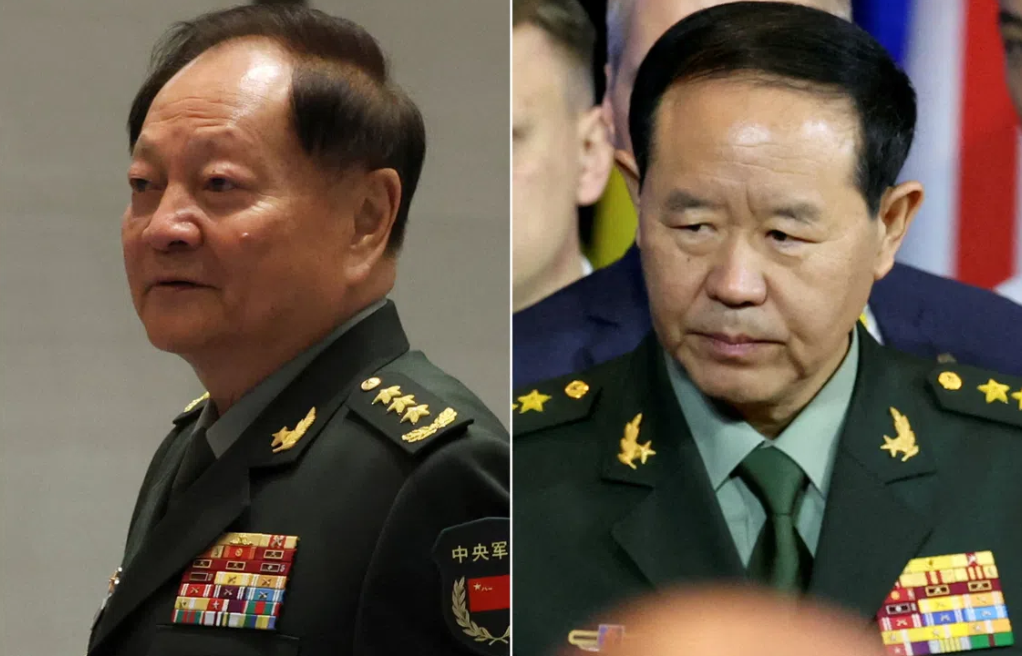
Beijing has stripped two prominent military figures from the state Central Military Commission in a significant reshuffling of China's top defence leadership. Vice-Chairman Zhang Youxia and Joint Staff Department Chief Liu Zhenli have been removed following investigations alleging serious breaches of discipline and law, according to state media Xinhua. The personnel changes, announced on Friday through the Standing Committee of the National People's Congress, signal a continued hardening of President Xi Jinping's grip over the military hierarchy.
The departure of Zhang and Liu fundamentally alters the composition of what was previously a seven-member commission. With their removal, only two active serving members remain on the body alongside Xi himself—a dramatic contraction of the institution's leadership bench. Zhang's position as vice-chairman made him the second-highest-ranking officer in China's military command structure, reporting directly to Xi. His removal represents one of the most senior departures since the anti-corruption campaign began over a decade ago.
China maintains a dual institutional framework for military governance, with parallel Communist Party and state structures that nominally operate separately but function as a unified system. While Friday's announcement formally concerns their removal from the state commission, both men retain theoretical positions within the Communist Party's parallel military command body—though sources suggest their influence has been fundamentally compromised. The distinction between the two bodies has become increasingly nominal in recent years as Xi has consolidated control over both mechanisms.
The military has emerged as perhaps the most vulnerable institution to Xi's broader anti-corruption initiative, which commenced in 2012. What began as selective investigations targeting lower-ranking officials has evolved into a sweeping campaign that has systematically dismantled entire networks within the defence establishment. Over the past decade, scores of senior commanders and generals have faced investigation, removal, or public disgrace. The armed forces have proven particularly susceptible to these purges, suggesting either endemic corruption or the strategic prioritisation of military loyalty over operational experience.
Xi's emphasis on deepening anti-corruption work within military ranks intensified last month when he addressed Communist Party leadership on the necessity of intensifying the fight. This rhetorical escalation typically precedes waves of removals and provides political cover for what many observers view as consolidation of personal power. The timing of Zhang and Liu's removal, shortly after this directive, indicates coordinated action rather than ad hoc responses to isolated misconduct. For the broader military institution, such predictability creates an atmosphere of uncertainty that may affect operational decision-making and institutional morale.
Beyond the two primary removals, the parliament's updated roster eliminated four additional senior figures with military connections. Lieutenant General Zhong Shaojun, formerly overseeing the CMC's General Office, and General Ju Qiansheng, who previously commanded the Strategic Support Force, both lost their seats. Additionally, the purge extended to civilian leadership circles, encompassing Gao Shiwen, the former mayor of Nanchang in southern China who had previously served at state aerospace and defence corporation CASIC. These simultaneous removals suggest a coordinated campaign addressing suspected corruption across both military and defence-industrial sectors.
Separately, Zhao Zongqi, who commanded the Western Theatre Command during the 2020 China-India border clashes, was stripped of his advisory body membership by China's political consultative conference on Wednesday. His removal carries particular significance given his recent tenure overseeing border operations during a period of elevated Sino-Indian tensions. The dismissal raises questions about whether he is being held accountable for the military confrontation itself or whether factional disputes within Beijing's defence establishment are being resolved through the anti-corruption apparatus. Military figures associated with contentious policy decisions or regional conflicts may find themselves vulnerable to career-ending purges.
For Southeast Asian observers, these purges within China's military command structure carry substantial implications. A military leadership in flux, with senior positions held by relatively junior or untested commanders, creates uncertainty regarding operational decision-making and strategic consistency. The Strategic Support Force, which handles cyber operations and emerging military technologies, has been particularly targeted by anti-corruption campaigns. Whether this reflects genuine corruption or represents efforts to reshape the force's strategic orientation remains unclear.
The aggressive pace of these removals raises analytical questions about whether the anti-corruption campaign continues to serve its original stated purpose or has evolved into an instrument of factional competition within the Communist Party. Xi's consolidation of military control appears complete, with alternative power centres within the defence establishment substantially neutralised. However, the resulting military leadership, populated increasingly by officers selected primarily for loyalty rather than seniority or experience, may operate differently from the technocratic military hierarchy of previous decades.
For regional powers including Malaysia and other ASEAN members, the transformation within China's military command structure warrants close observation. Military leadership transitions often precede shifts in strategic posture or operational doctrine. A military establishment undergoing internal purges may prioritise demonstrating resolve and capability to compensate for perceived institutional weakness. Maritime security, border management, and regional military exercises may all be affected as new commanders seek to establish credibility within China's leadership hierarchy and prove their commitment to national strategic objectives.

