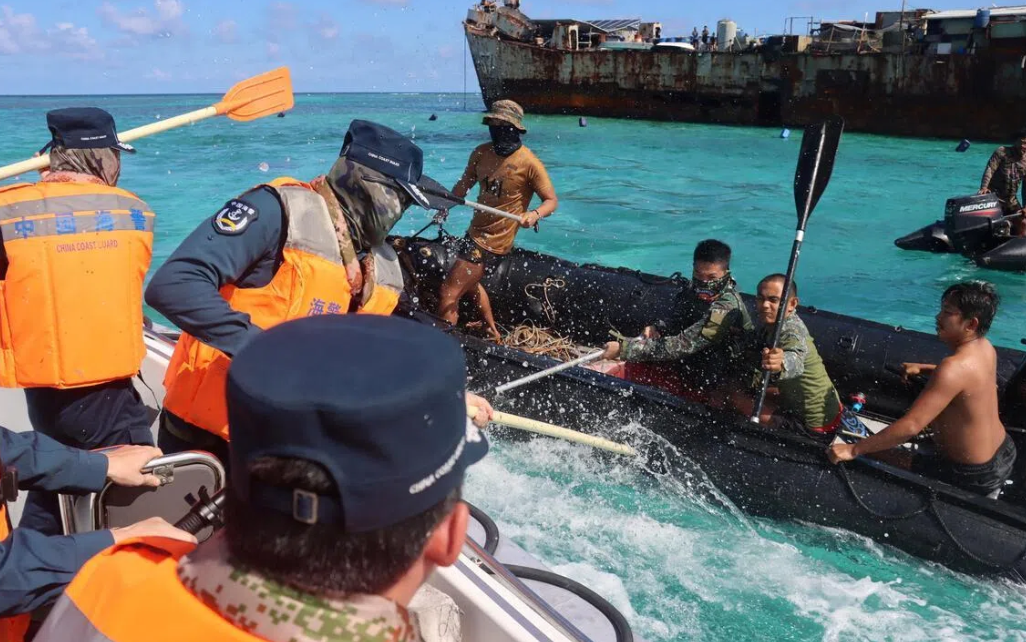
Diplomatic tensions escalated sharply across the South China Sea on Tuesday when China formally summoned the Philippine ambassador to Beijing, following a violent encounter between Chinese maritime forces and Filipino personnel at a strategically important contested reef. The incident, which occurred on Monday at the Second Thomas Shoal—known to China as Ren'ai Reef—has reignited one of Asia's most sensitive geopolitical flashpoints and drawn immediate rebuke from the United States and its Pacific allies.
According to Manila's account of events, Chinese Coast Guard personnel wielded batons against Filipino sailors as they attempted to approach a Philippine-occupied vessel grounded at the shoal. The vessel in question has long functioned as a de facto Philippine military outpost in the disputed waters, serving as a tangible expression of Manila's territorial claims in a region where multiple countries assert overlapping sovereign rights. China's foreign ministry responded dismissively to these allegations, characterizing the Philippine version of events as a deliberate distortion designed to shift blame and provoke international sympathy. Beijing insisted that Filipino forces initiated the confrontation through what it termed deliberate provocation at the reef.
The underlying territorial dispute remains intractable despite a 2016 international arbitration ruling that comprehensively rejected China's sweeping claims over nearly the entire South China Sea. Although Beijing was not a party to the arbitration proceedings, the tribunal's judgment struck down the legal foundation for China's expansive nine-dash line that encompasses approximately 90 per cent of the disputed waters. Nevertheless, China has shown no inclination to modify its territorial assertions or constrain its operational activities in the region. The waterway represents one of the world's most economically vital sea lanes, with annual trade valued in the trillions of dollars flowing through its passages, making control over these waters strategically invaluable for any regional power.
Philippine territorial claims, while more modest in scope than Beijing's assertions, directly collide with Chinese positions in several locations. The Second Thomas Shoal has emerged as perhaps the most volatile contact point between these competing claims, with documented incidents occurring with troubling regularity over the past decade. The pattern of escalating confrontations reflects how the absence of binding conflict-resolution mechanisms and the presence of heavily armed maritime enforcement vessels create conditions where minor provocations can rapidly deteriorate into serious international crises.
The timing of this incident proved particularly significant given the concurrent presence of top-level American diplomatic representation in the region. United States Secretary of State Marco Rubio arrived in Manila on Tuesday to participate in an Association of Southeast Asian Nations summit bringing together the bloc's 11 member states. Rubio issued a pointed op-ed in Philippine publications reaffirming Washington's commitment to freedom of navigation throughout Southeast Asian waters while explicitly warning against allowing regional powers to weaponize trade relationships for geopolitical advantage. His remarks, though carefully crafted in diplomatic language, constituted unmistakable criticism of China's economic coercive practices and assertive maritime behavior.
Washington wasted no time in condemning the South China Sea incident through official channels, characterizing Chinese actions as dangerous and aggressive while expressing solidarity with its long-standing Philippine ally. This immediate American response underscored the degree to which U.S. strategic interests remain firmly anchored to maintaining its influence in Southeast Asia and preventing any single power from achieving hegemonic control over critical shipping lanes. The Biden administration has gradually elevated its rhetorical and military posture toward China's regional activities, framing the issue in terms of rules-based international order and freedom of navigation principles.
Australian Foreign Minister Penny Wong added Australia's voice to international criticism, specifically invoking concerns about destabilizing and dangerous conduct emanating from Beijing. Canberra's intervention reflected growing alignment among Indo-Pacific democracies in responding collectively to what they characterize as Chinese overreach. For Malaysia and other ASEAN nations, however, the dynamics prove considerably more complex, as economic interdependence with China creates powerful incentives for restraint and careful diplomatic positioning that avoids appearing overly hostile toward Beijing.
The ASEAN summit setting provided an opportunity for exploring whether diplomatic dialogue might ease tensions, with indications that Rubio remained open to meeting with Chinese Foreign Minister Wang Yi, also attending the gathering. Previous encounters between American and Chinese diplomatic representatives occurred during an ASEAN meeting in Kuala Lumpur last year and again during the Munich Security Conference in February. These recurring engagements at multilateral venues demonstrate the critical importance that both Washington and Beijing attach to managing their expanding competition through some form of structured dialogue, even when fundamental strategic objectives remain irreconcilable.
For Southeast Asian nations, particularly the Philippines, navigating between a militarily powerful China and an economically influential United States presents an ongoing strategic dilemma without obvious resolution. The South China Sea disputes encapsulate this broader regional tension, forcing ASEAN members to balance historical alliance relationships, security vulnerabilities, and economic realities that bind them increasingly to Chinese markets. The recurrence of such incidents, combined with the absence of effective conflict-prevention mechanisms and clear rules governing maritime operations, suggests that similar confrontations will likely continue testing regional stability and international resolve.

