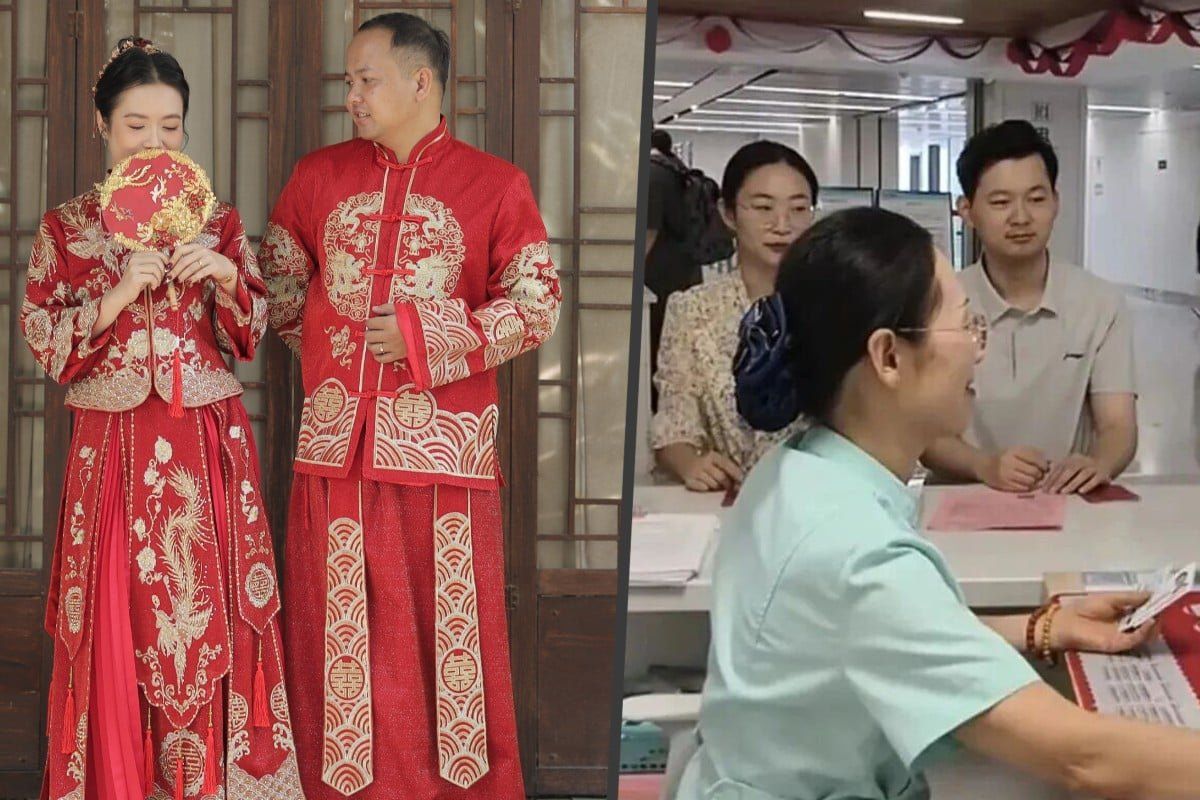
China's government is pursuing an unconventional strategy to reverse its declining marriage rates: making it easier to wed anywhere, anytime. The trend accelerated in August when the Maternal and Child Health Hospital of Linzi District in Zibo City, Shandong province joined a growing roster of non-traditional venues offering marriage registration services. The hospital's pitch is simple—couples can complete their marriage registration, undergo premarital medical examinations, and receive preconception counselling under one roof, eliminating the bureaucratic scatter that once characterised the process. This follows the Postal Savings Bank of China's pioneering move in Tianjin just weeks earlier, which became the nation's first financial institution to offer the service.
The expansion reflects regulatory changes enacted in May last year that fundamentally reshaped how Chinese couples marry. Previously, residents had to register at their hukou—household registration—location, requiring both partners to present official hukou booklets and navigate civil affairs bureaus during standard working hours. The updated regulations scrapped these restrictions, allowing couples to register anywhere and eliminating the need for bulky documentation. This seemingly minor bureaucratic shift opened the door to an explosion of creative marriage venues that would have been unthinkable in China's traditionally rigid administrative system.
The results have been remarkable in scope, if not always in effectiveness. By May this year, China had established more than 500 dedicated marriage registration sites outside conventional civil affairs bureaus, alongside 1,300 outdoor locations partnering with authorities to issue certificates. Couples can now marry in centuries-old temples in Beijing and Nanjing while dressed in traditional attire, exchange vows at Guangzhou Baiyun International Airport with complimentary access to the observation deck, or register at the Shanghai nightclub that partnered with the local civil affairs bureau for ceremonial services. Hefei's metro station became the country's first transport facility to offer the service this August, while temples, public parks, and tourist attractions have collectively transformed marriage registration from a dreary administrative task into an experiential event.
The government's motivation is transparent: China faces a demographic crisis that threatens its economic future. The third quarter of last year showed encouraging signs, with 1.61 million couples registering marriages nationwide—a 22.5 percent year-on-year increase. Full-year 2023 data appeared equally promising at 6.76 million registrations, representing a gain of 657,000 couples compared to 2022. These figures suggest the convenience measures were gaining traction, and official enthusiasm for expanding unconventional venues seemed justified. However, the momentum has dramatically reversed in 2024.
First-half data from this year reveals a sobering reality: marriages declined 7.5 percent year-on-year, with only 3.28 million couples tying the knot. The sharp reversal raises fundamental questions about whether procedural convenience actually addresses the underlying drivers of marital decline in contemporary China. The government's implicit assumption—that bureaucratic friction was discouraging young people from marriage—appears to miss deeper sociological and economic factors that shape demographic behaviour.
Chinese social media has erupted with scepticism about the entire initiative. Online commentators pose pointed questions about the theory driving these efforts. "Do people not get married because they can't find a place to register?" one user asked sardonically, capturing the sentiment that venue accessibility is tangential to actual decision-making. Another mocked the concept of divorce services atop Mount Everest, highlighting the absurdity of treating marriage as purely a convenience problem. The sharpest critiques dig into what actually deters young Chinese from matrimony: the financial prerequisites for housing and children, the expectation of extended family involvement that can generate conflict, and the perceived loss of personal autonomy that marriage traditionally entails in Chinese culture.
These concerns reflect a generational shift in how young Chinese view marriage itself. Observers note that contemporary youth no longer automatically view matrimony as a necessary life milestone, fundamentally altering the calculus around partnership formation. Young people simultaneously fear the financial burdens marriage requires—particularly the astronomical housing costs in major cities—while dreading the family conflicts that extended kinship networks often generate. The traditional cultural expectation that spouses subordinate individual desires to family interests clashes sharply with emerging values of personal freedom and self-determination.
The regional implications of China's marriage crisis extend well beyond its borders. Throughout East Asia, Japan and South Korea face similarly severe demographic challenges, while Southeast Asian nations like Singapore and Vietnam worry about future population sustainability. China's inability to reverse declining marriage rates despite aggressive policy intervention suggests that when young people rationally assess the costs and benefits of matrimony, structural economic factors overwhelm any convenience improvements. For Malaysia and other developing economies competing with China for talent and investment, understanding this dynamic proves crucial.
Malaysia's younger cohorts, while not facing identical pressures as Chinese youth, nonetheless experience comparable anxieties around housing affordability, career uncertainty, and changing social expectations. The divergence between traditional family structures and modern individual aspirations creates tension in many Malaysian households. Observing China's marriage initiatives offers an instructive cautionary tale: policymakers cannot engineer demographic outcomes through procedural innovation alone when the underlying economic and social conditions discourage family formation.
The scale of China's marriage registration expansion—from hospitals and banks to nightclubs and airports—represents one government's earnest attempt to confront a demographic emergency with creative solutions. Yet the 2024 reversal suggests that venue accessibility, however well-intentioned, cannot substitute for addressing the deeper anxieties that shape young adults' intimate choices. As China confronts sustained population decline, the gap between its expanded registration infrastructure and actual marriage behaviour highlights the limits of administrative reform in reshaping fundamental life decisions.

