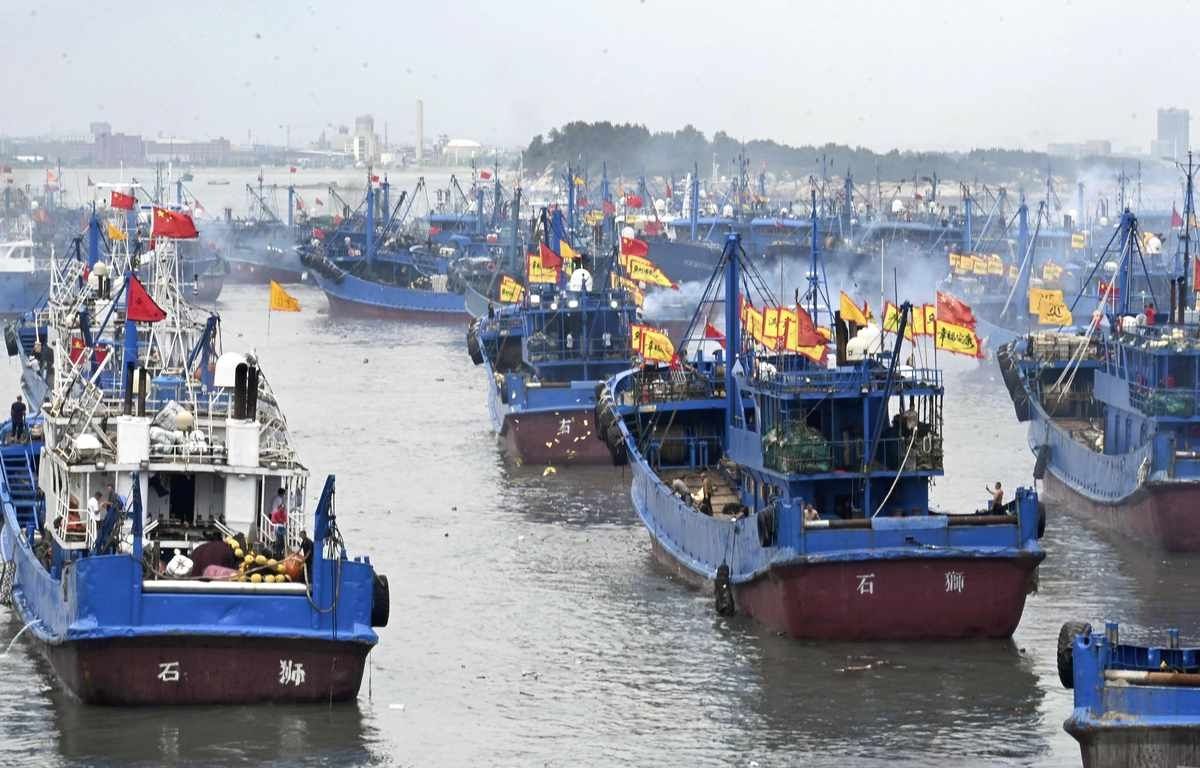
More than 600 fishing vessels departed from the Chinese port city of Shishi on August 16 following the conclusion of China's annual summer fishing moratorium in the East China Sea on August 15. The lifting of the ban, which restricts fishing activities in sensitive waters including those surrounding the Senkaku Islands and the Taiwan Strait, has triggered Japanese vigilance over a region already strained by deteriorating diplomatic relations. The resumption of fishing operations comes at a particularly delicate moment in Sino-Japanese relations, with observers closely scrutinizing Beijing's approach to managing activity in disputed maritime territories that have long been a flashpoint between the two nations.
The departure of fishing vessels from Shishi, a major fishing hub in Fujian Province, reflected customary scenes of festive celebration with vessels adorned with Chinese national flags and traditional red and yellow banners symbolizing wishes for abundant catches and safe journeys. The sound of firecrackers accompanying the departures underscored the cultural significance of the fishing season to local communities dependent on maritime industries. However, beneath these surface-level rituals lies a complex geopolitical dimension that has made such operations a potential trigger for international friction, particularly given the strategic importance of fishing rights and maritime boundary disputes in East Asia.
Historical precedent demonstrates the volatility inherent in these waters. In August 2016, Chinese Coast Guard vessels coordinated with between 200 and 400 fishing boats that converged on the Senkaku Islands area, resulting in documented incursions into Japanese territorial waters. Japan subsequently filed formal protests, characterizing the episode as a deliberate attempt by China to unilaterally escalate tensions in the region. That incident occurred in the aftermath of an arbitral tribunal ruling from The Hague in July 2016 rejecting China's expansive maritime sovereignty claims in the South China Sea, prompting Japanese officials to call for Beijing's acceptance of the decision—a demand some analysts believed prompted the retaliatory fishing vessel incursions.
The past decade has witnessed a subtle yet significant shift in the management and frequency of fishing operations in contested waters surrounding the Senkaku Islands. Chinese local government authorities, particularly in the jurisdiction of Quanzhou which oversees Shishi, have issued informal guidance to fishing communities to avoid "sensitive waters" and prevent incidents that might further deteriorate already fragile bilateral relations. This unofficial restraint has produced measurable results in terms of reduced friction: Japan Coast Guard warnings issued to Chinese fishing vessels found in Senkaku territorial waters plummeted from 81 instances in 2021 to just four in 2025, indicating either reduced incursions or tacit acceptance of Japanese enforcement.
Yet the restraint appears incomplete and conditional rather than permanent. On August 7, authorities in Quanzhou paradoxically called for enhanced surveillance of sensitive waters, a directive that could be interpreted either as reinforcing restrictions or as preparing to monitor fishing activity without necessarily preventing it. More tellingly, a 50-year-old fisherman interviewed at the Shishi docks provided candid insight into the complex incentives facing small-scale operators. While acknowledging that proximity to Japan risks apprehension by Chinese authorities conducting maritime surveillance, he noted that no outright prohibition had been issued against fishing in the Senkaku area, suggesting ambiguity in official policy that permits operational activity provided operators maintain plausible deniability regarding their location.
Perhaps most significantly, a linguistic shift in official government notices reveals potential changes in Beijing's position. Historically, annual fishing moratorium notices issued around May would explicitly stipulate that "fishing operations in sensitive waters such as those of South Korea, North Korea and Japan" would be strictly prevented. However, the notice issued on April 30 this year conspicuously omitted any reference to Japan, instead restricting prohibitions solely to "the interim measures area between China and South Korea." This selective removal of Japan from the list of restricted jurisdictions has prompted diplomatic observers to intensify monitoring efforts, as the alteration potentially signals a recalibration of Chinese policy toward contested Senkaku waters.
The structural ambiguity embedded in current Chinese policy creates space for fishing operations that technically comply with formal restrictions while proceeding toward disputed waters. This approach allows Beijing to maintain diplomatic distance from explicit antagonism while permitting fishing communities to pursue economic activity in resource-rich areas. For Japan, the absence of clear Chinese restrictions creates interpretive challenges and heightens operational uncertainty, as Japanese Coast Guard personnel must determine whether fishing vessel presence represents inadvertent incursion or coordinated activity designed to establish de facto usage rights.
The broader context of maritime dispute resolution in Asia amplifies concerns about the Senkaku situation. The region has witnessed numerous incidents where civilian fishing activities have served as stepping stones for broader maritime claims, particularly following the 2016 arbitral tribunal ruling that rejected Chinese historical claims to the South China Sea. Beijing's apparent willingness to mobilize fishing fleets as instruments of maritime assertion, combined with the coordination between civilian vessels and government maritime agencies observed in 2016, suggests that economic activity and geopolitical positioning remain intertwined in East Asian maritime disputes.
For Southeast Asian nations and Malaysia in particular, developments in the Senkaku dispute carry direct implications for regional stability and maritime norms. The precedent established by how China and Japan manage contested waters influences expectations regarding the South China Sea and other maritime zones where competing claims persist. A recurrence of coordinated fishing fleet operations could embolden similar tactics elsewhere, potentially unsettling the fragile equilibrium that constrains maritime tensions in broader East Asia.
Looking ahead, the coming weeks and months will reveal whether the omission of Japan from seasonal fishing restrictions represents merely bureaucratic revision or signals substantive policy realignment. Japanese authorities have committed to close monitoring of vessel movements and incursion patterns, while Chinese local officials appear positioned to permit fishing operations in disputed waters provided explicit coordination between military and civilian vessels remains opaque. This cat-and-mouse dynamic reflects the deeper challenge facing great powers attempting to manage maritime disputes through informal accommodation rather than binding legal frameworks, leaving ample room for miscalculation and escalation in one of Asia's most strategically sensitive regions.

