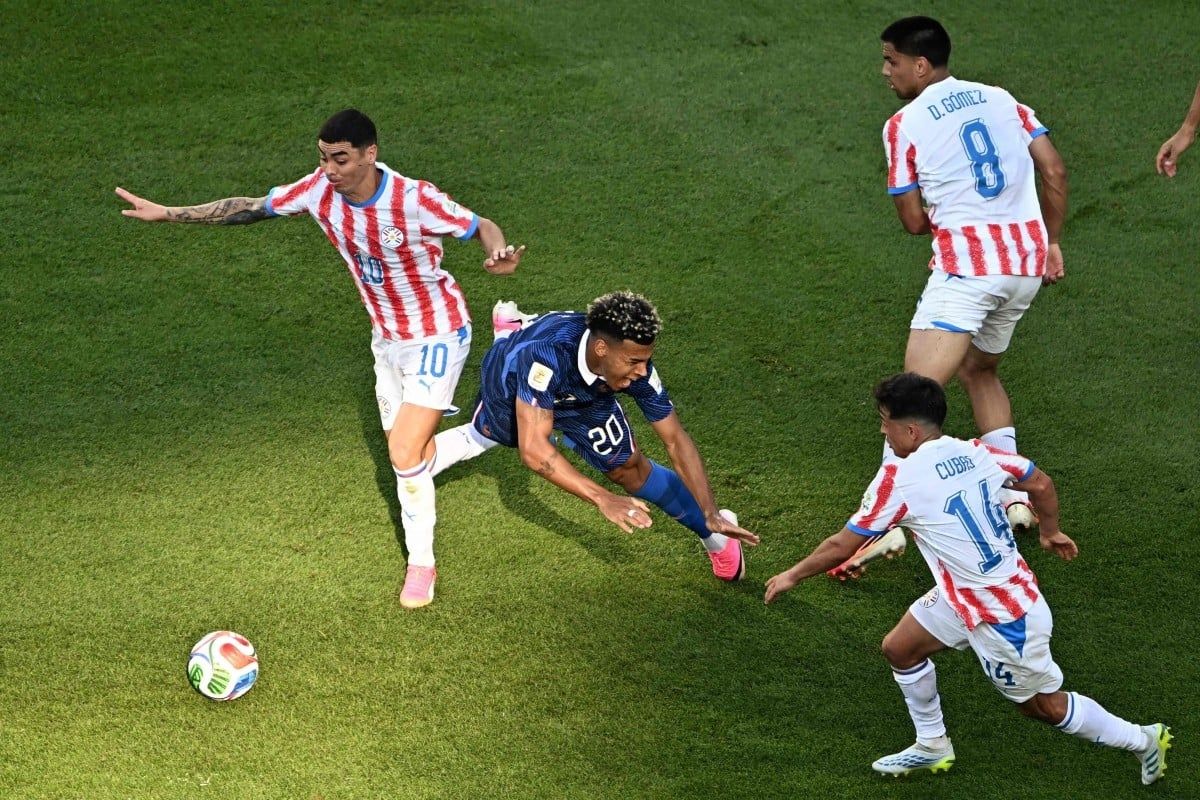
Chinese social media erupted with criticism following Paraguay's World Cup last-16 encounter against France in Philadelphia on Saturday, with observers lambasting both the South American side's aggressive tactics and the match official's permissive approach to discipline. The fixture, decided by Kylian Mbappe's penalty kick with twenty minutes remaining, proved less memorable for the quality of play than for the intensity of physical confrontation that dominated proceedings. Uzbekistan-based referee Ilgiz Tantashev's management of the ninety minutes became the focal point of discussion among Chinese football enthusiasts, particularly those familiar with the considerably stricter standards typically enforced by domestic officiators.
The disparity in refereeing philosophy became strikingly apparent when observers noted that Tantashev issued only four cautions throughout the match, with three directed toward the French side, despite what Chinese commentators characterised as persistent fouling and dangerous play from Paraguay's players. This restraint stood in sharp contrast to the reputation of Ma Ning, the Chinese official widely recognised among supporters for his liberal use of the card system. The comparative leniency sparked considerable online discussion, with Chinese fans suggesting that Paraguay would have finished the encounter significantly depleted had Ma been assigned to oversee proceedings. One prominent social media contributor remarked that under such stewardship, the South American team would likely have been reduced to their goalkeeper by the final whistle.
China's football-watching community expressed particular concern about what they perceived as a systematic failure of match control. Rather than focusing analysis on tactical elements or individual performances, commentary quickly shifted toward examining the structural breakdown in discipline, with Weibo users suggesting that Tantashev's decisions had fundamentally altered the competitive balance. Several observers accused the official of bias, with some implying that his approach appeared designed to facilitate Paraguay's elimination of stronger opposition, a sentiment that intensified when commentators reflected on the South American nation's surprise victory over Germany in the preceding round. The suggestion emerged that Paraguay's subsequent performance, far from demonstrating tactical sophistication, merely reflected the advantage they had accrued through aggressive physical dominance.
Mbappe himself became the primary target of Paraguay's rougher approach, yet the French forward responded with measured professionalism that earned recognition even from critical observers. When asked about the encounter's nature, the French captain acknowledged that his team had anticipated precisely this form of engagement and possessed the capability to respond in kind if necessary. His comments reflected a pragmatic understanding that certain opponents prioritise physicality over technical quality, and that competitive success sometimes requires adaptation beyond conventional stylistic preferences. Mbappe's assertion that France was prepared to "get our hands dirty" and engage in what he termed "ugly football" demonstrated a mature recognition that World Cup football encompasses varied approaches to competition.
France's coaching staff similarly acknowledged the uncomfortable dynamics at play. Didier Deschamps, the fifty-seven-year-old former World Cup-winning manager, provided additional context by revealing that unsporting behaviour extended beyond the playing surface into the technical areas. Deschamps articulated frustration with what he characterised as Paraguay's exhaustive deployment of questionable tactics, dismissing such approaches as fundamentally contrary to the beautiful game's values. His observation that "they pull out every trick in the book" encompassed not merely on-field conduct but also verbal provocation from the opposing bench that violated basic standards of sportsmanship.
The match's closing moments provided further illustration of the simmering tensions. Paraguay goalkeeper Orlando Gill was captured on camera directing a ball forcefully at Mbappe's back following the final whistle, ostensibly in response to the French forward's failure to acknowledge him during the customary post-match courtesies. When subsequently questioned about the incident, Gill attributed his behaviour to the emotional intensity of competitive football and the disappointment of defeat. However, Chinese social media observers proved largely unmoved by this explanation, with commentators suggesting that such conduct reflected poorly not merely on the individual but on the team's overall character and professionalism.
The incident highlighted broader concerns among Chinese fans about standards of player conduct and the responsibility of officials to enforce consequences for unsporting behaviour. Criticism extended beyond Paraguay's tactical approach to encompass what observers viewed as a fundamental abdication of professionalism displayed by the team's personnel. One commenter captured widespread sentiment by suggesting that Paraguay had not merely surrendered the football match but forfeited any claim to respectable conduct, likening their behaviour to childish tantrums rather than the serious professionalism expected of World Cup competitors.
For Malaysian and broader Southeast Asian audiences, the episode offers instructive perspective on how international football standards operate at the elite level. The contrast between Tantashev's officiating philosophy and Ma Ning's documented approach underscores how refereeing styles significantly impact competitive outcomes and overall spectacle quality. Chinese observers' detailed scrutiny of match management reflects broader regional engagement with World Cup analysis, particularly when controversies intersect with questions of fairness and competitive integrity.
The incident also illustrates how social media enables instantaneous comparative analysis across different refereeing jurisdictions and standards. Chinese fans' familiarity with their domestic official's stricter approach provided an immediate benchmark against which Tantashev's performance could be evaluated and found wanting. This democratisation of football analysis, facilitated by digital platforms, means that referee performance receives scrutiny from global audiences equipped with experience of alternative regulatory frameworks and capable of identifying inconsistencies in disciplinary application.
Ultimately, the Paraguay-France encounter transcended its practical outcome to become a platform for broader discussion about competitive standards in elite football. While France's progression to face Morocco in the quarter-finals proceeded as expected from a performance perspective, the match's legacy among Chinese observers centred on questions of officiating integrity and player conduct that extended well beyond the ninety minutes of play. The widespread criticism of both the South American team's approach and the match official's management reflected genuine concern about maintaining professional standards in international competition, particularly when enforcement mechanisms appear insufficient to deter or penalise unsporting behaviour.

