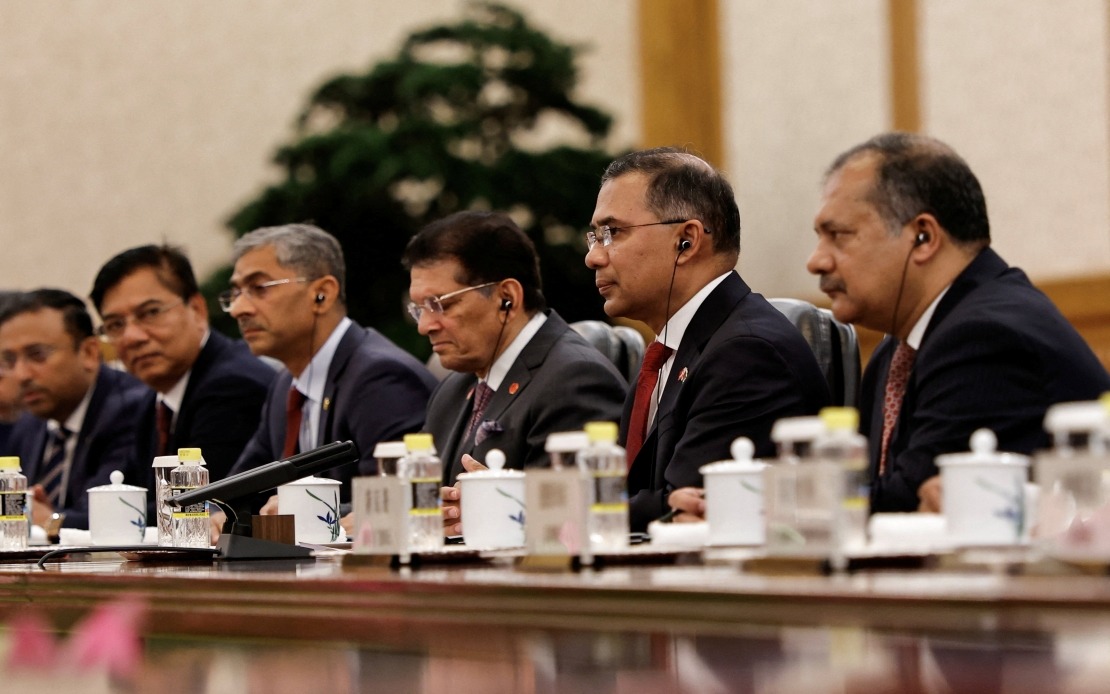
Momentum is building for Chinese capital inflows into Bangladesh following Prime Minister Tarique Rahman's week-long visit to China from June 22 to 26, with twelve state and private enterprises committing to a proposed investment package valued at US$9.2 billion. The scale of these proposals signals a significant deepening of economic ties between the South Asian nation and its largest neighbour, at a time when Bangladesh is actively repositioning its development strategy around attracting foreign direct investment from major trading partners.
The breadth of the proposed projects reflects a deliberate Chinese strategy to embed itself across multiple sectors of Bangladesh's economy. Rather than concentrating resources in a single industry, the investment proposals span energy generation, port modernisation, highway development, waste management and manufacturing—sectors that remain critical bottlenecks constraining Bangladesh's economic growth. This diversified approach suggests Chinese policymakers view Bangladesh not merely as a market for exports or a source of raw materials, but as an emerging manufacturing hub where Chinese firms can establish long-term operational presence and supply chain integration.
The centrepiece of the infrastructure push is the Sichuan Road and Bridge Group's ambitious US$4.5 billion commitment to develop and modernise the Dhaka-Chattogram highway through a public-private partnership arrangement. This flagship project addresses one of Bangladesh's most pressing infrastructure deficits—the critical transport corridor connecting the capital to the country's busiest port. Improved connectivity along this route would facilitate goods movement, reduce logistics costs, and potentially position Bangladesh as a more competitive manufacturing destination for export-oriented production. For Malaysian observers, the project offers insights into how Chinese firms are leveraging infrastructure investment as a lever to open markets and establish commercial footprints.
Port development emerges as another priority area. China Civil Engineering Construction Corporation has offered US$650 million to develop and operate an economic zone at Mongla Port, incorporating warehousing and logistics facilities. Simultaneously, Beijing and Dhaka have agreed to jointly modernise Mongla Port itself, signalling intent to transform this secondary port into a regional logistics hub. Additionally, SF Express, the Chinese logistics giant, plans to invest US$180 million in cold-chain and warehouse infrastructure at Mongla, located approximately 230 kilometres from Dhaka. Collectively, these port-focused initiatives would substantially upgrade Bangladesh's capacity to handle containerised cargo and perishable goods, with ripple effects across Southeast Asia's maritime trade networks.
Energy security features prominently in the investment slate. Shanghai SUS Environment Company proposes allocating US$890 million to construct waste-to-energy plants, addressing both Bangladesh's waste disposal challenges and its energy deficit simultaneously. Separately, China Future Energy Group Holding Limited seeks to commit US$250 million toward gas field exploration and development, tapping Bangladesh's hydrocarbon resources. Huaxin Textile Industry Company Limited plans to establish a 200-megawatt captive solar power plant in the Payra economic zone, coupled with expansions into recycled cotton production and lithium battery manufacturing, requiring US$190 million in capital. These energy plays underscore how Chinese investors view Bangladesh's development trajectory and intend to position themselves as essential infrastructure suppliers.
The environmental and circular economy dimension is striking. Zhongxin Environmental Protection Group has proposed a US$1.65 billion e-waste recycling project anchored in the Payra Port Industrial Zone on the Bay of Bengal, demonstrating how Chinese firms are packaging environmental management as a growth opportunity. Similarly, the waste-to-energy initiatives convert what Bangladesh has historically treated as a municipal liability into a resource stream. For Malaysia's policymakers currently grappling with mounting electronic waste and industrial waste management, Bangladesh's experience may offer cautionary or instructional lessons about managing Chinese-backed waste processing ventures.
Manufacturing diversification represents another strategic vector. Beyond the textile and battery production noted above, Shenzhen Kaifa Technology intends to invest US$250 million in manufacturing electric smart metres, products increasingly essential as Asian utilities modernise their grid infrastructure. The establishment of a dedicated Chinese industrial park in Chattogram—Bangladesh's principal port city—signals intent to cluster Chinese manufacturing operations, creating agglomeration economies that could attract additional Chinese supply chain participants. This industrial park approach mirrors strategies deployed across Southeast Asia, where Chinese firms have systematically established manufacturing bases to serve regional and global markets.
From Bangladesh's perspective, Commerce Minister Khandakar Abdul Muktadir explicitly framed these investments as a mechanism to address the country's widening trade deficit with China. Bangladesh's imports from China substantially exceed exports, a structural imbalance that policymakers view as unsustainable. By incentivising Chinese companies to establish manufacturing and processing operations within Bangladesh, the government hopes to create domestic employment, develop upstream supply chains, and eventually generate export-oriented production that rebalances bilateral trade dynamics. This rationale reflects a sophisticated understanding that foreign direct investment serves dual purposes—both capital provision and market access.
The joint communiqué issued at the conclusion of Tarique's visit emphasised cooperation across trade, e-commerce, industrial and supply chain development, framing the relationship in terms of multilateral trading system commitments. This diplomatic language masks a more concrete reality: China seeks to integrate Bangladesh more deeply into supply chains anchored in Chinese firms, while Bangladesh pursues rapid industrialisation and infrastructure modernisation to elevate its development trajectory. The alignment of interests, though not without tensions, creates conditions favourable for substantial capital flows.
For Malaysia and the broader Southeast Asian region, these developments carry several implications. First, Bangladesh is emerging as a competitor for Chinese manufacturing investment previously concentrated in Vietnam and Thailand. Second, Chinese firms' willingness to finance large-scale infrastructure projects—highways, ports, waste systems—demonstrates how Beijing leverages development finance as a geopolitical and commercial tool. Third, Bangladesh's receptiveness to substantial Chinese presence across critical sectors like ports and energy reflects shifting strategic calculations in South Asia, with implications for regional balance-of-power dynamics. Malaysian policymakers monitoring Chinese investment patterns should note how comprehensively Chinese firms are embedding themselves across multiple economic layers in Bangladesh simultaneously.
The realisation of these proposed investments remains contingent on several factors: Bangladesh's capacity to provide policy stability and regulatory clarity; the commercial viability of individual projects; and the availability of concessional financing or guarantees from Beijing. Not all proposed investments materialise, and some may be restructured or delayed. Nevertheless, the sheer scale and sectoral breadth of the US$9.2 billion proposal indicate a sustained Chinese commitment to deepening economic integration with Bangladesh. For a region where Chinese investment patterns shape competitive dynamics and infrastructure development trajectories, Bangladesh's emerging role as a major recipient of such capital deserves close monitoring.

