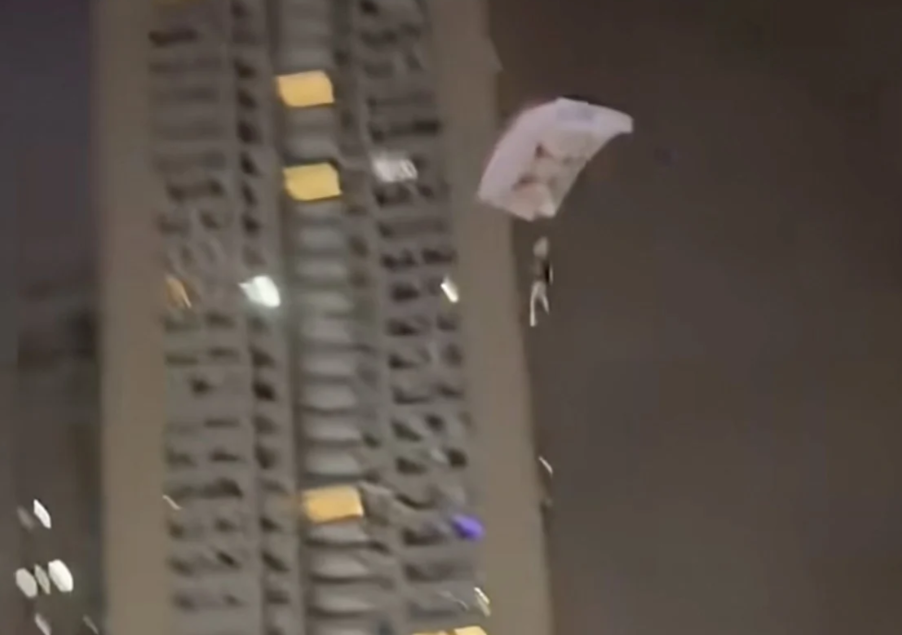
A 23-year-old Sichuan resident has been taken into custody following an audacious nighttime parachute jump from a residential tower that authorities say endangered public safety and disturbed civil order. The incident underscores China's growing struggle with attention-seeking content creators who pursue increasingly perilous stunts to monetise their online presence and expand their follower base.
The man, identified by his surname Ren, executed the jump from the rooftop of a high-rise apartment complex in Chenghua district shortly before midnight on June 30. His stated motivation was straightforward: to generate engagement and traffic across his social media platforms. The following day, he uploaded video footage documenting the entire stunt, which showed him descending dangerously close to adjacent residential structures and trees during his parachute descent. The content was intended to reach his existing audience of approximately 60,000 followers on a major Chinese social media platform.
Police investigators determined that Ren's actions constituted a serious breach of public order regulations and posed considerable hazards to residents and pedestrians below. As punishment under China's administrative detention system, authorities sentenced him to a period of detention lasting up to 15 days. Additionally, he received a permanent ban from accessing social media platforms, effectively severing his ability to continue broadcasting content or maintaining his online community. The enforcement action represents a significant consequence for the aspiring content creator, whose digital presence has been completely restricted.
Ren operated under the social media persona "Parachute Coach Kakaxi," leveraging this professional-sounding handle to build credibility with his audience. Prior to his detention, he had uploaded additional footage showing another rooftop jump conducted in May 2024 from a different residential building. When authorities cross-checked his credentials during their investigation, they discovered a critical discrepancy: despite presenting himself as a qualified parachute coach, Ren had never actually obtained the necessary coaching license. This lack of legitimate certification rendered his entire online presence fraudulent and his activities entirely unauthorised.
China's regulatory framework explicitly prohibits parachuting without government authorisation and restricts such activities to designated, purpose-built zones. Public spaces including downtown buildings, bridges, and densely populated areas are categorically off-limits for any skydiving operations. The Chenghua district police statement issued following Ren's detention emphasised that individuals engaging in parachuting from residential buildings or other high-density population zones would face severe penalties. This warning signal appears aimed not only at Ren but at other would-be content creators contemplating similar risky behaviour.
The detention and social media ban have triggered substantial discussion across mainland Chinese internet forums. Online commentators expressed alarm at both the immediate danger to Ren himself and the broader threat to public safety. One user articulated concerns about potential collisions with ground-level pedestrians, highlighting how Ren's personal ambitions had created serious jeopardy for innocent bystanders. Other observers questioned the influencer's judgment in pursuing online traction at such a tremendous cost to community safety. A third group of netizens argued for even harsher punishments, suggesting that lenient consequences might encourage imitators to undertake similarly reckless stunts.
Ren's case reflects a broader and concerning pattern across China whereby social media personalities undertake increasingly extreme and hazardous activities to capture audience attention in an oversaturated digital landscape. This phenomenon is not isolated to parachuting incidents. In June of this year, Zhejiang province authorities apprehended a driver who had recorded and shared video content showing himself operating a vehicle at 152 kilometres per hour on an expressway—significantly exceeding legal speed limits—while simultaneously using a mobile telephone to film the dangerous driving. The consequences included nine deduction points from his annual 12-point driving record and a monetary fine of 250 yuan, approximately US$35.
The stakes of such behaviour can be considerably higher than administrative penalties or temporary account suspensions. In 2017, a prominent extreme content creator named Wu Yongning died from exhaustion while scaling a 260-metre building in Hunan province during a live-streaming broadcast. Wu had built his following by climbing tall structures without safety equipment, claiming he undertook these dangerous activities to generate income for his mother's medical treatment. His death starkly illustrated how the pursuit of online engagement can culminate in fatal consequences. Wu's legacy served as a cautionary tale that resonated throughout Chinese social media, yet it evidently has not deterred all would-be influencers from attempting equally perilous stunts.
For Malaysian and broader Southeast Asian audiences, the Ren incident provides instructive perspective on how rapidly social media ecosystems can incentivise hazardous behaviour even as platforms implement community guidelines and safety protocols. The case demonstrates that content creators operating across national borders may face dramatically different legal frameworks and enforcement mechanisms depending on their jurisdictions. What might generate engagement in one region could trigger serious criminal or administrative consequences in another. As social media platforms increasingly globalise their user bases, understanding these regulatory disparities becomes essential for content creators and their audiences alike.
The detention also reflects authoritarian governance approaches to digital content regulation, whereby authorities can implement broad restrictions such as permanent social media bans as administrative rather than judicial measures. This contrasts sharply with approaches in liberal democracies, where such blanket bans would likely encounter constitutional or legal obstacles. The incident illustrates how different political systems address the tension between personal expression, platform economics, and public safety—a tension that will likely intensify as digital content creation becomes an increasingly viable income source across Asia.
Moving forward, Ren's case may influence how Chinese platforms moderate extreme sports content and implement verification systems for creator credentials. The revelation that a largely followed influencer operated under fraudulent credentials raises questions about the adequacy of platform vetting procedures. As Southeast Asian platforms expand their regional presence and user bases, similar incidents could prompt regional regulators to establish clearer standards for verifying content creator qualifications and implementing safety guidelines specific to extreme sports and high-risk activities.

