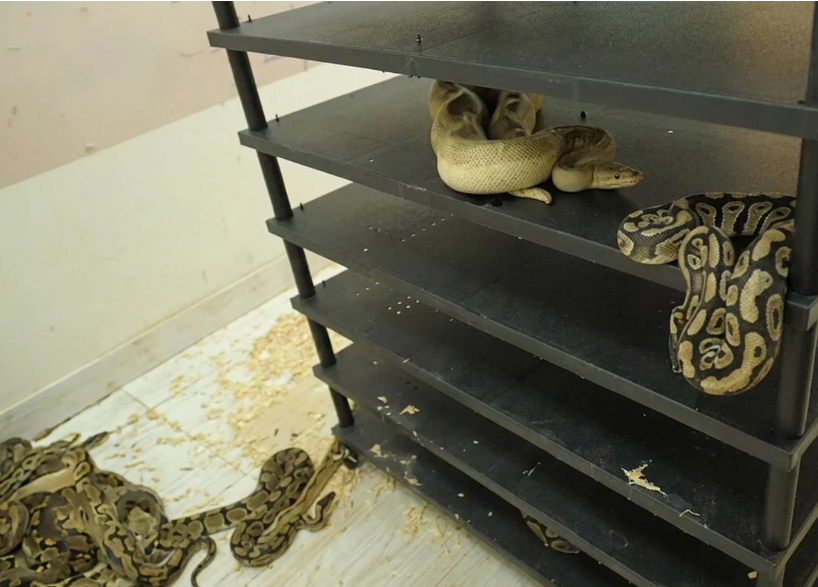
A resident of Taizhou in Zhejiang province has been sentenced to jail for operating an extensive illegal python breeding operation from his home, marking a significant enforcement action against wildlife trafficking in eastern China. The case came to light in June when state broadcaster CCTV highlighted the violation as a serious breach of protections for rare and endangered species. The discovery reveals how sophisticated smuggling networks can operate within urban residential areas, exploiting enforcement gaps and using modern logistics to distribute protected animals across regional borders.
The investigation began unexpectedly in March 2024 when an elderly resident found a large tawny python at the base of a mountain in the locality. The senior citizen's decision to report the discovery to authorities proved pivotal, as police recognized that the species was not indigenous to the region and its presence in early spring—when snakes typically remain dormant—suggested it had escaped captivity. This initial lead would unravel a breeding empire that had eluded detection for a decade.
Investigators theorized that maintaining pythons requires substantial energy expenditure, as the species demands consistent warmth and humidity levels between 20 and 30 degrees Celsius. This insight became the cornerstone of their strategy. Police cross-referenced electricity consumption records from households in areas near where the snake was found, a methodical approach that eventually identified a suspect living alone in the district. The man, surnamed Guo, emerged as the most likely candidate given his unusual energy profile.
Guo's lifestyle provided few apparent explanations for his elevated power consumption. He was unmarried, unemployed, and lived in solitude, characteristics that distinguished his household from typical residences. Surveillance and further investigation revealed that a man named Di visited Guo's apartment with striking regularity, consistently collecting delivery parcels from courier stations. Cross-examination with online retailers exposed the nature of these shipments: thousands of small white mice purchased through e-commerce platforms. These rodents, police determined through inquiries with sellers, were destined for reptile feeders rather than as household pets.
Additional evidence accumulated through digital monitoring of Guo's social media activity. He had posted photographs showcasing snakes and made veiled references to selling pythons, leaving a public trail of his illicit trade. Transaction records further implicated Di, showing that the associate had sold two pythons to another buyer for 1,000 yuan, approximately US$150. The financial transactions, combined with procurement patterns and social media footprints, gave authorities sufficient grounds to move against both men.
When police executed a search warrant at Guo's residential unit, they encountered a sight that shocked officers entering the premises. The living quarters had been almost entirely converted into a reptile facility. Guo had compressed his personal belongings into a single bedroom, abandoning the two remaining bedrooms and the common living area to stacked plastic breeding boxes. In total, officers seized 309 pythons from this residence, each housed in conditions Guo had carefully calibrated to mimic their natural environment. The seizure represented a logistical challenge; the entire collection was subsequently transferred to a local zoo for safekeeping and rehabilitation.
Guo's personal motivations revealed a individual consumed by an obsessive passion for snake husbandry. He confessed to authorities that he harbored a lifelong fascination with serpents and possessed no innate fear of them. His engagement with pythons began in 2014 when he acquired four specimens, marking the start of what would become a decade-long commitment to breeding research. According to reports, Guo expressed pride in his technical accomplishment, stating that he could cultivate pythons of various color variations and comparing himself to a creator bringing new life into being. This psychological orientation—viewing the operation as artistic rather than criminal—appeared lost on a legal system designed to protect endangered species.
The investigation expanded beyond Guo and Di when police identified a third perpetrator in the supply chain. Deng, a shop owner who had sold four snakes to Guo in 2014, was apprehended on related charges. When authorities searched Deng's residence, they discovered an additional 47 pythons, indicating that suppliers were themselves engaged in breeding operations. The combined seizure across all three locations totaled 436 pythons, valued collectively at over 30 million yuan, equivalent to approximately US$4.4 million.
Under China's Criminal Law, unauthorized breeding and sale of Grade Two protected animals—a classification that includes pythons—carries severe penalties designed to deter trafficking. Violators face a maximum prison sentence of five years, and the court in Taizhou imposed custodial sentences on Guo, Di, and Deng, though the specific duration of each sentence was not publicly disclosed. The graduated penalties likely reflected each individual's level of culpability within the trafficking hierarchy.
For Southeast Asian readers, this case underscores vulnerabilities in regional wildlife protection frameworks. Python species, particularly ball pythons and reticulated pythons native to Southeast Asia, command high prices in international and domestic exotic pet markets. The scale of Guo's operation—breeding hundreds of animals for profit despite legal prohibitions—demonstrates how enforcement capacity in one nation can be overwhelmed by organized demand. Malaysia and neighboring countries face similar pressures as wealthy urban populations seek exotic pets, and domestic breeding operations operate in gray legal zones.
The electricity-consumption investigative technique employed by Chinese police offers a replicable model for other jurisdictions seeking to uncover clandestine wildlife operations. Most nations maintain utility consumption databases that correlate with residential patterns, providing law enforcement with a non-intrusive initial screening tool before deploying human resources. This data-driven methodology could be adopted across Southeast Asia to identify suspicious facilities before they reach the scale of Guo's operation.
The case also highlights the role of digital evidence in modern wildlife crime investigation. Guo's social media activity and online transaction records created a documentary trail that corroborated physical evidence. As exotic pet communities expand across Asia, law enforcement agencies increasingly leverage digital platforms to track trafficking networks. The interplay between courier services, online retail, social media, and electricity usage patterns demonstrates how traditional criminal investigation techniques must evolve to address contemporary smuggling methods that exploit e-commerce infrastructure.