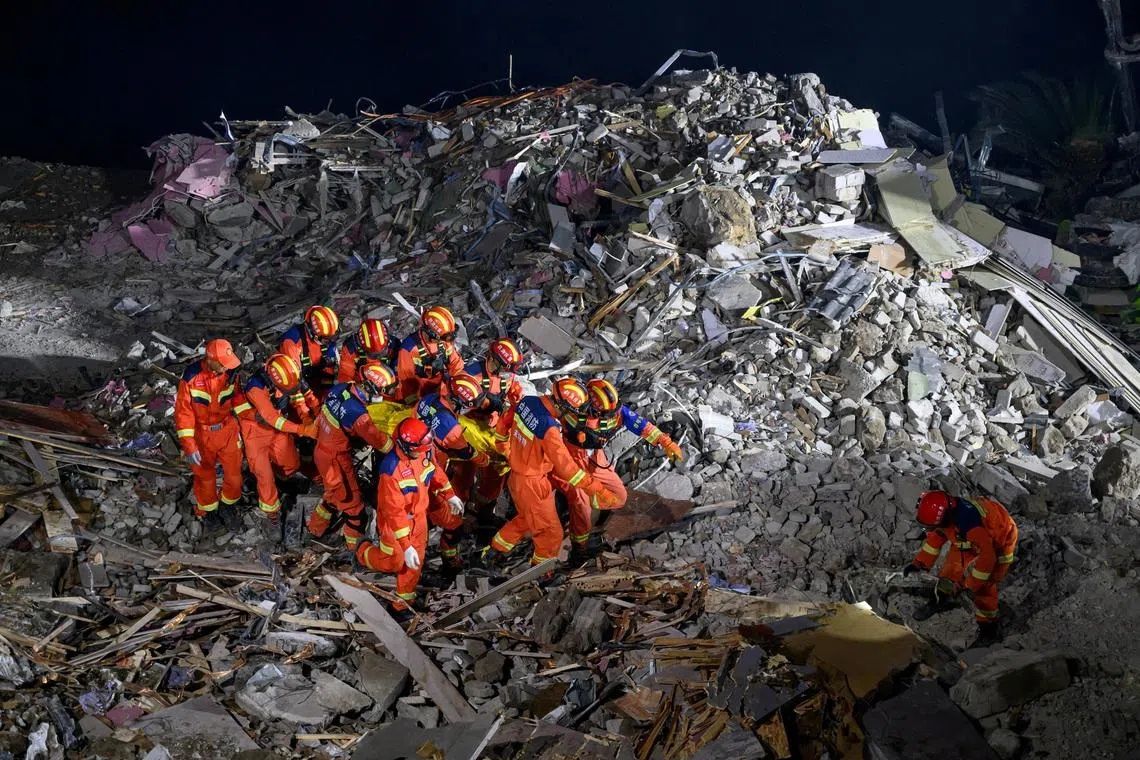
Rescue operations in southwestern China entered a critical phase on Monday when teams detonated explosives to blast apart massive boulders blocking the search for 34 people unaccounted for since a devastating landslide triggered by heavy rainfall struck the Penghui county area on Friday. The controlled blasting effort, captured in footage broadcast by state media CCTV, represents a significant escalation in the recovery mission some 270 kilometres from Chongqing's urban core, as rescuers work to penetrate deeper into the disaster zone where terrain and geological obstacles have severely hampered progress.
The initial disaster claimed eight lives and forced authorities to evacuate more than 1,100 residents from the affected hillside communities. Penghui county, home to approximately 500,000 people, is characterized by dense settlements clinging precariously to steep slopes that descend toward the Wujian river. Dramatic video evidence showed a segment of the mountainside collapsing into the waterway, effectively severing the main arterial route through the narrow township and trapping residents in isolated pockets of the surrounding hills.
President Xi Jinping's directive for coordinated, scientifically-grounded rescue operations set the tone for Monday's intensified response. His emphasis on both locating missing persons and conducting a thorough investigation into causal factors underscored Beijing's commitment to addressing not merely the immediate humanitarian crisis but the systemic vulnerabilities underlying such disasters. The transition to what CCTV termed a "deep rescue phase" signalled that initial surface-level searches had given way to more complex excavation and debris removal strategies necessitated by the scale of geological obstruction.
China confronts a chronic vulnerability to landslides that few nations match in severity or frequency. The country's topography—with mountains, hills, and plateaus comprising roughly two-thirds of total landmass—creates inherent susceptibility to gravitational collapse. This geological reality, when combined with accelerating urbanization, intensive construction activities, and the concentration of development on marginal terrain, has transformed China into a global hotspot for landslide-related disasters. The Penghui incident exemplifies this intersection of natural hazard and human settlement patterns.
Weather conditions compounded the crisis at multiple levels. The torrential rainfall that triggered the initial collapse continued throughout the weekend with forecasts warning of additional heavy precipitation through Monday across multiple provinces. This relentless moisture threatened not only the rescue effort itself but created conditions for secondary landslides and debris flows. Authorities mobilized geological survey teams to systematically identify hidden dangers lurking in destabilized terrain surrounding the primary disaster zone, a precaution that reflects lessons learned from previous catastrophes.
The broader hydrological picture indicated widespread regional vulnerability. Eight smaller and medium-sized river systems across Yunnan, Guangxi, Guangdong, Anhui, and Shanghai were simultaneously elevated above flood warning thresholds, suggesting that the Penghui landslide represented merely one manifestation of an extensive weather system affecting the entire region. Official warnings urged enhanced protective measures in areas characterized by high groundwater saturation and aggressive construction development, zones where the combination creates maximum instability.
Historical context reveals that China's landslide crisis has claimed hundreds of lives over the past decade. A retrospective examination identified approximately 294 deaths across at least five major incidents spanning the previous ten years. The most catastrophic single event occurred in December 2015 when the collapse of a massive stockpile of construction waste at an industrial facility in Shenzhen—the southern technological and financial hub—killed more than 70 people. That disaster demonstrated how anthropogenic activities, specifically the accumulation of construction debris on unstable slopes, can transform into mass casualty incidents.
The Penghui landslide's geographic setting reinforces why southwestern China experiences such persistent disaster vulnerability. The region's combination of intense seasonal rainfall patterns, mountainous terrain that concentrates settlements in narrow valleys alongside waterways, and the pressure to develop economic zones in geologically marginal areas creates a perfect storm of risk factors. Communities like Penghui's hillside townships reflect decades of incremental urban expansion into increasingly hazardous locations.
Rapid industrialization and construction pressures have fundamentally altered slope stability across the region. Deforestation, road construction, mining operations, and building development all modify natural drainage patterns and destabilize historically stable terrain. The concurrent presence of abundant groundwater—both a blessing and curse in such topography—creates hydrostatic pressure within hillsides that can trigger catastrophic failure, particularly when intense rainfall saturates soils already compromised by human intervention.
The rescue operation's evolution from initial searches to explosive clearance operations reflects the practical complexities of disaster response in China's challenging geography. While rescue teams demonstrated impressive mobilization capability and technical sophistication, the fundamental challenge remains unchanged: dense populations inhabit terrain where natural hazards operate with little warning and devastating speed. Monday's blasting operations, while dramatic and necessary, address immediate symptoms rather than the deeper vulnerabilities embedded in settlement patterns and development strategies.

