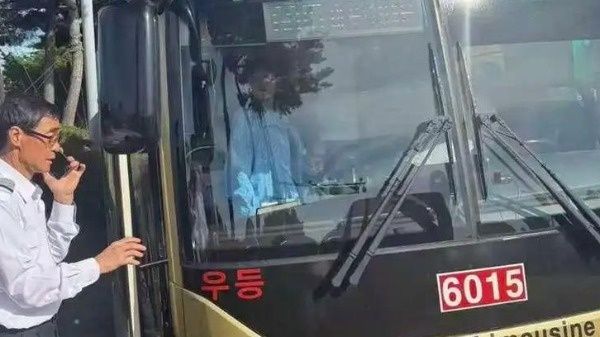
A group of Chinese women tourists demonstrated remarkable composure and teamwork on a Seoul highway when they took control of an airport shuttle bus after its driver suddenly collapsed, preventing what could have been a catastrophic accident involving more than twenty passengers. The incident unfolded on Saturday afternoon aboard the No 6015 airport bus bound for Incheon International Airport from central Seoul, transforming an ordinary journey into an extraordinary test of crisis management that has since captivated audiences across East Asia.
Sun Qian, a health sector professional in her mid-thirties from Nanjing in Jiangsu province, was seated in the second row directly behind the driver when she noticed the vehicle beginning to veer dangerously. Without hesitation, she recognised the critical nature of the situation and moved to intervene. Her immediate assessment proved correct — the bus was scraping against a roadside guardrail as it lost stability. Sun lunged forward and seized the steering wheel, using her own body weight and strength to counteract the vehicle's uncontrolled trajectory. The sheer size and unfamiliar mechanics of the coach's steering mechanism added to her anxiety, yet she managed to hold firm while simultaneously shouting for assistance from fellow passengers.
Du He, Sun's 33-year-old friend also from Nanjing, coordinated with the driver's efforts by locating and engaging the emergency brake system. Within seconds of the driver's collapse, the two women had established control over the bus's movement. This rapid, synchronized response proved decisive — had the vehicle continued unimpeded along the busy highway corridor, the consequences for the thirty-plus passengers aboard could have been catastrophic. The combination of highway traffic, the bus's considerable mass and momentum, and the unpredictable nature of an uncontrolled vehicle created conditions ripe for a multi-vehicle collision.
Once the bus had been stabilised, the passengers' focus shifted to the driver himself. Du He attempted traditional first-aid techniques, pinching the driver's philtrum in accordance with established medical practices in China. However, she quickly noticed alarming symptoms — the driver's breathing had ceased and his complexion had darkened to a purplish hue, indicating severe circulatory compromise. These observations pointed toward a cardiac event as the likely cause. Rather than accepting defeat, the passengers organised themselves to provide cardiopulmonary resuscitation in coordinated rotations, with multiple individuals taking turns performing chest compressions to maintain circulation.
Sun Qian's linguistic abilities proved invaluable in summoning professional emergency services. She utilised the driver's mobile phone to place a call to Seoul's emergency response system in fluent Korean, communicating their precise location and the nature of the medical crisis unfolding aboard the bus. This action ensured that ambulance and medical personnel were dispatched immediately, minimising response time. Simultaneously, other passengers continued their resuscitation efforts, working methodically to maintain blood flow and oxygenation to the driver's vital organs during the critical window before professional medical intervention could be provided.
Despite their sustained and dedicated efforts, the passengers were ultimately unable to revive the driver. Emergency responders transported him to a hospital where medical staff attempted additional resuscitation procedures lasting approximately two hours before he was pronounced deceased. South Korean authorities subsequently initiated an investigation to determine the precise medical cause of the collapse, with early indications pointing toward acute myocardial infarction, commonly known as a heart attack. The loss of life, though tragic, occurred under circumstances where intervention by trained medical professionals would have offered marginal improvement at best, given the apparent severity of the cardiac event.
Du He reflected on how the narrow margins separating tragedy from catastrophe became apparent only in retrospect. She noted that the highway conditions — notably light traffic density during the afternoon period — meant that the disabled bus did not collide with other vehicles or cause a cascade of accidents. This fortunate timing allowed the passengers to address the driver's medical emergency without simultaneously managing a traffic accident scenario. The passengers quickly coordinated with other bus services to continue their journey to Incheon International Airport, prioritising their travel commitments while processing the extraordinary events they had just experienced.
The emotional weight of their experience manifested only after the immediate crisis had passed. Du He described a delayed onset of fear and anxiety that struck her upon arrival at the airport terminal, hours after the incident had concluded. This temporal disconnect — the calm, decisive action followed by trembling realisation — is characteristic of acute stress responses, where adrenaline and situational focus enable clear thinking during emergencies but give way to nervous system activation once safety has been established. Sun Qian similarly noted the dreamlike, almost surreal quality of the experience while it unfolded, comparing it to witnessing a television drama script come to life before her eyes.
When confronted with widespread praise and admiration across Chinese and South Korean social media platforms, both women demonstrated remarkable humility. Du He characterised their actions as instinctive responses rooted in cultural values emphasising mutual aid and collective responsibility. She articulated a philosophy wherein heroic action represents not exceptional virtue but rather the natural expression of how people ought to behave when others face danger. Sun Qian emphasised the collaborative dimension of the rescue, stressing that no single individual deserved sole credit and that the coordinated efforts of multiple passengers — those managing the steering, locating the brake, performing resuscitation, and calling emergency services — created the successful outcome. She highlighted how the presence of compatriots in a foreign setting fostered rapid, instinctive cooperation rooted in shared cultural bonds.
The incident has resonated across digital communities in both countries, generating commentary that extends beyond simple admiration for individual bravery. South Korean observers noted the remarkable composure displayed by foreign nationals navigating a life-threatening emergency whilst simultaneously contending with language barriers and unfamiliar surroundings. Chinese social media users circulated the story widely across platforms including Xiaohongshu, where audiences celebrated the women's actions as expressions of collective Chinese values centred on solidarity and community protection. The narrative has transcended the specifics of the incident itself, becoming emblematic of cross-cultural human decency and the capacity for strangers to function as a unified response team when confronted with existential crisis.

