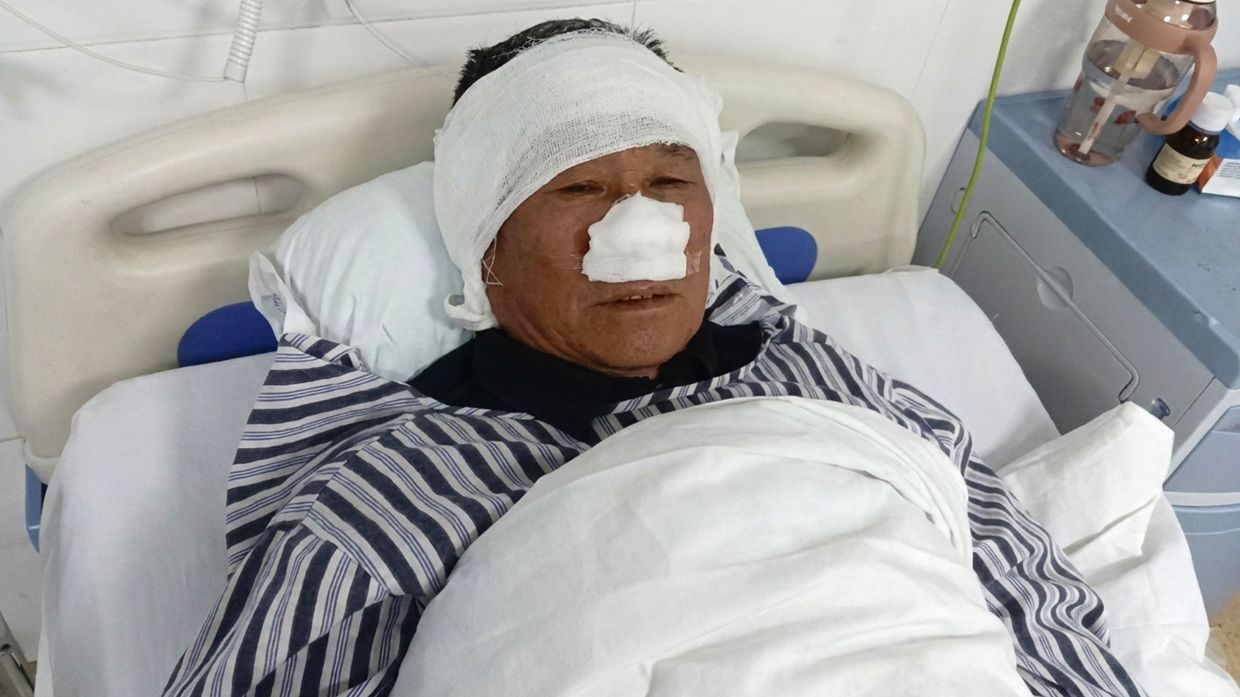
A 69-year-old volunteer mediator from Chenzhou in Hunan province has been officially recognised as a national hero after losing his nose while subduing a violent attacker and saving a woman's life. Zeng Fanlin, who was named among 86 recipients of the Chinese government's latest "national heroes for a just cause" honour on July 9, tackled the assailant in April when the man launched a rampage through the village, attacking passers-by and kicking doors. The decisive intervention, made without regard for his own safety, has sparked widespread admiration in China and raised questions about moral courage in everyday life.
The incident unfolded as bystanders witnessed an alarming scene. A man in his twenties, who had entered the village in an emotional state, stopped a woman riding an e-bike and grabbed her by the neck in what appeared to be an escalating attack. Despite the apparent danger, nearby villagers initially hesitated to intervene, choosing instead to contact police. With the woman's life at immediate risk and emergency responders still minutes away, Zeng took action. He rushed forward and tackled the attacker, bringing him to the ground with physical force. Two other villagers quickly joined the struggle to help restrain the man until authorities could arrive.
During the chaotic confrontation, the attacker bit off a substantial portion of Zeng's nose—a severe and disfiguring injury that would permanently alter his appearance. Despite experiencing what must have been excruciating pain, Zeng maintained his grip on the assailant and refused to release him until police officers reached the scene. His determination to hold on ensured the suspect was successfully taken into custody rather than escaping into the community. The rescue came at an extraordinary personal cost, and Zeng was immediately transported to hospital for emergency medical treatment.
The medical challenge facing doctors was substantial. Zeng had lost most of his nose, making reconstruction unusually complicated and risky. Surgeons warned him of potential long-term complications, ongoing pain, and significant scarring that might never fully disappear. Medical costs rapidly escalated beyond 70,000 yuan, equivalent to approximately US$10,000—a considerable burden for a rural family. The financial strain was alleviated when government support and assistance from charitable organisations intervened. The Alibaba Foundation and local media outlets subsequently awarded Zeng an additional 20,000 yuan to recognise his bravery and help offset expenses.
Zeng has since undergone two reconstructive surgeries designed to restore function and appearance. Medical staff grafted skin from his head to rebuild the missing nasal structure and reconstructed his nose wings, successfully restoring his ability to breathe normally. However, the recovery process has been marked by persistent pain that continues daily. The expected recovery timeline stretched to at least six months, reflecting the complexity of nasal reconstruction. Despite these ongoing challenges and the permanent changes to his physical appearance, Zeng has maintained a philosophical perspective about his sacrifice. In interviews with local media, he reflected that compared to the life he had saved, the personal cost was entirely justified and worth bearing.
Zeng's willingness to help others springs from his own difficult history. Orphaned during childhood, he grew up supported by compassionate villagers and later benefited from government educational assistance that allowed him to attend school without fees. This early experience of community support and institutional care shaped his values and created within him a powerful sense of obligation to reciprocate. Throughout his life, he has sought opportunities to contribute to his community's wellbeing. Before his role as a volunteer mediator, he served as a village official, and his reputation for justice has led to previous interventions. In 2016, he reportedly helped police capture a thief, demonstrating a long-standing pattern of civic engagement that precedes the April incident.
Zeng's daughter has characterised him as possessing an exceptionally strong sense of justice—a person constitutionally unable to witness wrongdoing without responding. She describes someone whose moral convictions override personal safety considerations, a trait that clearly manifested in his split-second decision to tackle a violent stranger with unknown intentions. This characterisation has resonated with the public narrative surrounding his recognition as a national hero, portraying him as representative of ordinary citizens whose quiet principles guide extraordinary actions.
The attacker's motivation appears rooted in emotional instability rather than premeditated malice. According to police investigations, the suspect attacked strangers after losing emotional control, suggesting a crisis situation rather than targeted violence. Under Chinese criminal law, intentionally causing serious bodily injury carries prison sentences ranging from three to ten years, though the case remains under investigation as prosecutors evaluate the evidence and circumstances. The rescued woman has maintained silence regarding the incident and has not issued public statements about her experience or her rescuer.
Zeng's recognition as a national hero reflects broader Chinese governmental and societal values emphasising moral courage and communal responsibility. The selection of 86 individuals for this honour suggests systematic government attention to identifying and recognising exemplary conduct. His inclusion alongside other recipients underscores a state priority in publicly celebrating citizens who prioritise collective safety over personal interest. In the context of rapid social change and urbanisation across China, such official recognition may serve to reinforce traditional values of mutual aid and community bonds that government officials view as essential social cohesion elements.
The response to Zeng's story within Chinese social media circles has been largely celebratory, though with pointed commentary about justice. Online observers have praised him as a "true everyday hero" while calling for severe punishment of the attacker, reflecting public sentiment that heroic sacrifice should be matched by proportional accountability through the legal system. For Southeast Asian audiences, Zeng's story raises pertinent questions about the balance between individual safety and civic responsibility in increasingly diverse and mobile societies, where intervention by strangers cannot be assumed and where institutional response times may vary significantly.

