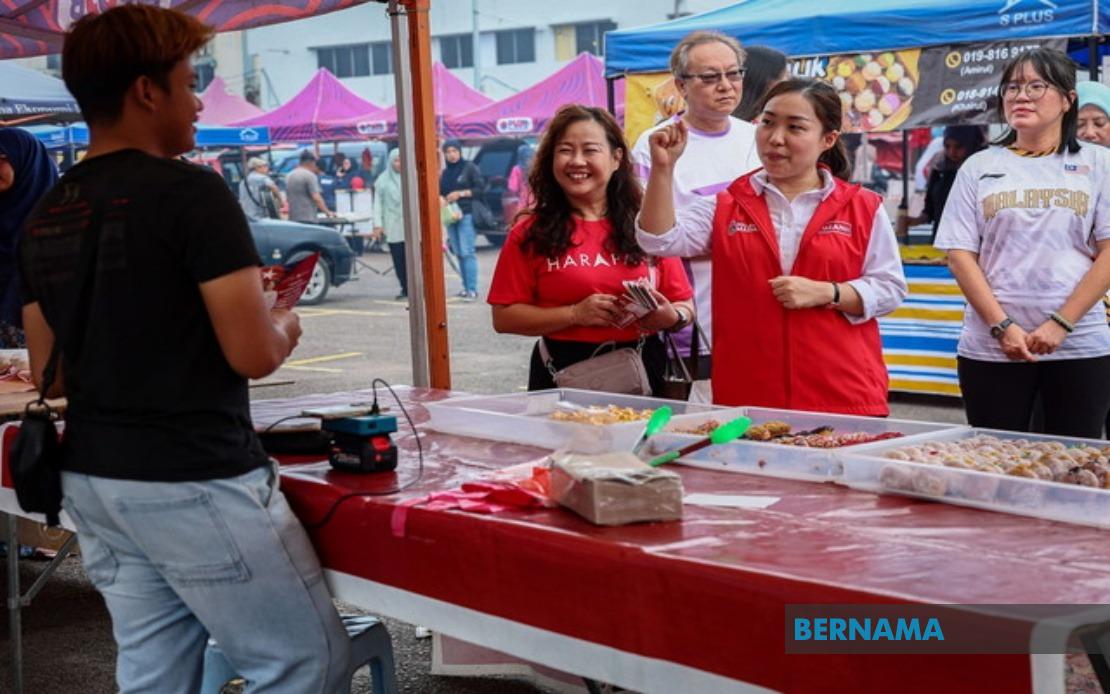
Chu Poh Yee, a lawyer contesting Mengkibol for Pakatan Harapan, is building her campaign around three interconnected policy pillars designed to address both the immediate needs and long-term aspirations of constituents in this southern Johor constituency. Speaking in Kluang, she outlined a vision that merges practical infrastructure development with economic dynamism and social support systems, positioning herself as a candidate attuned to the pressures facing working families and young entrepreneurs in the district.
The first element of her platform centres on physical infrastructure transformation. Chu has prioritised the rehabilitation and expansion of road networks throughout Mengkibol, recognising that connectivity directly influences quality of life and business accessibility. Beyond conventional roadworks, she is advocating for community-based agricultural initiatives, particularly urban farming schemes that could generate supplementary income for residents while reducing pressure on household budgets. These projects, she argues, represent a dual investment—in both environmental sustainability and grassroots economic participation.
Economically, Chu's analysis identifies considerable untapped potential within Kluang's existing business landscape. She contends that the district's entrepreneurial ecosystem can absorb significantly more activity through deliberate policy support, such as simplified business registration frameworks and expanded access to financing for small and medium enterprises. Her observations suggest that while foundational commerce exists, institutional barriers and limited platforms prevent ambitious locals from scaling their ventures or establishing new ones. This retention focus becomes especially crucial given the documented pattern of youth outmigration from smaller towns to metropolitan centres.
Chargeable to tourism, Chu points to the Kluang Rail Festival as evidence that strategic cultural events can generate tangible economic spillovers beyond spectacle. She views such initiatives as catalysts that draw visitor expenditure into the local economy while simultaneously enhancing civic pride and social cohesion. The implication is that community-oriented events should be strategised as economic development tools rather than one-off celebrations, a perspective reflecting broader trends across Southeast Asian towns seeking to diversify income streams.
A distinctive dimension of her platform addresses the structural barriers facing women in the workforce. Chu advocates for workplace environments that accommodate dual roles—professional and familial—without forcing false choices between career advancement and family time. She has identified childcare infrastructure as foundational to this objective, proposing that government-supported, adequately resourced care centres would enable parents, particularly mothers, to participate fully in employment without anxiety about dependent children. This reflects recognition that labour force participation statistics mask quality-of-life realities for families navigating inadequate support systems.
Chu's positioning on gender and work also resonates with broader Malaysian demographic and economic patterns. As female workforce participation remains contested terrain politically and socially, her emphasis on enabling infrastructure rather than merely exhorting women to work represents a pragmatic rather than ideological approach. The proposal sidesteps cultural debates by framing childcare as a community-wide investment generating returns through increased earning capacity and economic activity.
The candidate has acknowledged friction encountered during campaigning, including vandalism of promotional materials at multiple locations and other provocative incidents. Rather than interpreting these as signs of weakness, her framing emphasises team resilience and commitment to the contest. This response strategy serves multiple purposes: it signals to supporters that adversarial tactics will not deter her campaign, it positions her as facing unjust treatment requiring community support in response, and it subtly questions the methods of opposing campaigns without directly naming rivals.
Mengkibol represents one of fourteen constituencies in this Johor election featuring straight fights—contests between just two candidates—rather than three-cornered or more fragmented races. This binary structure concentrates voter choice and typically yields higher turnout, as strategic voting becomes more straightforward. Chu faces Barisan Nasional candidate Yap Zhi Peng in what electoral analysts would classify as a competitive marginal seat, given PH's mixed recent performance in Johor state contests.
The broader Johor state election encompasses 172 candidates pursuing 56 seats, representing a substantial electoral exercise with significant implications for national politics. Johor's size and demographics make it a bellwether of voter sentiment across Malaysia's most populous southern region. Early voting commenced on July 7, with main polling scheduled for July 11, compressing the campaign window and emphasising the intensity of the pre-election period.
Chu's candidacy reflects a deliberate PH strategy of presenting younger, professionally credentialled candidates in winnable seats—a contrast to long-standing incumbent politics. Her legal background provides technical credibility on governance and administrative matters, while her youth appeals to demographic segments concerned about economic opportunity and social modernisation. The three-pronged agenda she articulates avoids ideological abstraction, instead grounding political promises in tangible service delivery expectations that resonate with middle-income suburban and small-town Malaysian voters grappling with cost-of-living pressures and limited local economic dynamism.
For Malaysian observers monitoring Johor politics, Mengkibol encapsulates current electoral dynamics: the competition between Pakatan Harapan's ascendant but still-consolidating presence and Barisan Nasional's entrenched institutional advantages; the appeal of fresh candidates with professional credentials; and the centrality of pocketbook issues and family welfare to voter decision-making in smaller constituencies. The election outcome will partly signal whether PH can maintain momentum in Johor beyond the 2022 federal election breakthrough, or whether BN continues reasserting dominance in its traditional heartland.

